Haz clic en el botón para descargar | Download Here
Study of modern steel processes used for the manufacture of Magnetic sheets of non–oriented grain. New qualities obtained
Ignacio Ibarrondo Mtz-Iturralde
Dr. Ing. Industrial
Formerly Catedrático E.U. University of Basque Country (U.P.V./E.H.U.)
C.D.U. 669.14.018.58 – 416 : 539.4.015.1 = 60
Abstract:
In this work the most modern siderurgical processes used in the manufacture of non-oriented sheets for electrical machinery are reviewed. Previous work by the author is also included along with work that corresponds to decarburized mild steel sheet for electrical applications, non-oriented magnetic sheets with and without texture and new crystalline and amorphous materials recently obtained. Propenties and applicatios of all these new qualitities obtained are detailed as well.
Since 1906, the date of the industrial production of non-oriented grain magnetic sheet as a consequence of the work of Barrett, Brown and Hadfield (1-3), the evolution of the iron and steel processes for the manufacture of these materials has been, until relatively recent dates, quite slow (4-7), not having produced in the decades prior to 1976, in accordance with what was indicated by Taguchi (8), basic modifications in the manufacturing processes of these materials, as well as new qualities
However, the growing increase in energy costs, especially since 1974, has made saving it acquire a singular relief.
Accordingly, and taking into account The factors that must be taken into consideration in the selection of the magnetic plate that must constitute a motor, which are:
-Costs derived from the quality selected for the raw material.
-Transformation costs.
-Exploitation or operating costs.
The need for a progressive change in the raw material selection criteria is evident, since although prior to the energy crisis of 1974 the first of these factors was essential, after that date, the greater incidence of the third factor, becoming more and more evident the need to use electrical machines with higher performance (9) obtained through the combination of the appropriate technological design and the use of superior qualities in the chosen raw material.
The consequence of all this is the modification of conventional steel processes and the introduction of new techniques, among which it is worth mentioning, preferably, those aimed at obtaining non-oriented grain magnetic sheet but with texture, as well as the obtaining, at the laboratory level, new materials, such as crystalline bands with a high silicon content and amorphous materials. All of which has raised entirely new expectations in the domain of non-oriented magnetic sheeting.
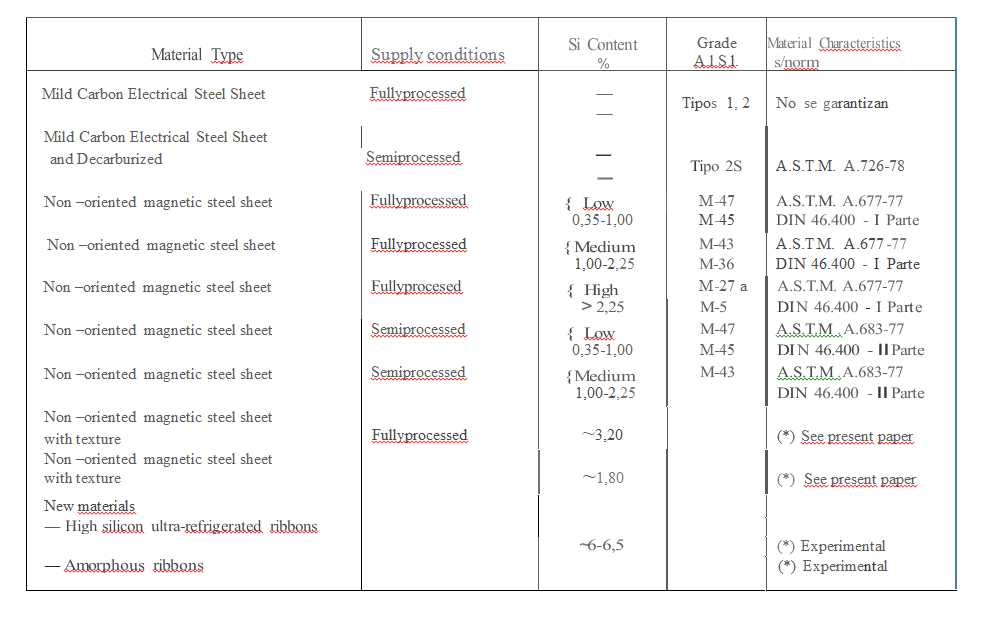
Table I shows a classification, according to the author’s criteria, of the various types of materials and qualities that are currently included under the generic name of non-oriented grain magnetic sheets, whose steel production processes, as well as their characteristics magnetic, will be studied below.
TABLE I.- Classification of the various qualities and grades of non- oriented grain magnetic sheet.
2.-DECARBURED MILD CARBON STEEL PLATE FOR ELECTRICAL APPLICATIONS
This type of material, decarburized mild carbon steel sheet for electrical applications, is currently used throughout the world for the production of nuclei of small motors (1-50 h.p.) and fractional (<1 h.p.), being able to indicate, in way of example, that in the period 1976-1979 it represented 50% of the total volume of sheet produced in the United States for electrical applications.
The explanation resides in the fact that in fractional and small motors, the section corresponding to the costs derived from the quality selected for the raw material acquires special importance due to the low energy consumption in operation.
If we add to this, the great relative specific weight of the losses in the copper of the stator, as a consequence of the high excitation currents required, and its possible minimization through the increase of the permeability of the material and improvement in the design of the motor, the wide use of this type of material in the manufacture of small and fractional engines, is consequently justified.
Steelmaking process
Figure 1 shows the schematics of the iron and steel processes used in the manufacture of decarburized mild steel sheet for electrical applications

Fig 1.-Schemes of the iron and steelmaking processes used in the manufacture of decarburized mild steel sheet for electrical applications.
(Colada convencional : casting; Colada continua: continous casting; Laminación en caliente: Hot rolling; Decapado: Pick line; Reduccion en frío: Cold Rolling; Recocido: Annealing; Horno Cont: Continous Furnace; Bateria Open – Coil: Open coil furnace; Recocido no decarburante en horno continuo: Non decarburant annealing in continous furnace; Instalaciones de acabado: Finishing lines; Material totalmente tratado: Fully processed material; Material semitratado: Semiprocessed Material.)
As regards the process in the steelworks, it is carried out using a standard practice in an LD converter or in an electric furnace; It should be noted, in accordance with the work of Anan’evsky et al. (11), that the elaboration of this type of steel by means of continuous casting allows to obtain a final product with magnetic characteristics similar to those achieved by the conventional process of casting in an ingot mold; in the aforementioned work the values of these characteristics are collected, as well as the work parameters of the steel process.
As far as cold rolling is concerned, it is currently carried out in a single stage that includes reduction percentages of 80%, achievable by using emulsions with a high saponification index.
In the case of semi-treated materials, the critical reduction stage deserves special mention, regarding which it should be noted, in accordance with the studies carried out by Knight et al. (12) and Bochkov et al.(13), that the optimization of the magnetic characteristics is achieved for an equiaxed and homogeneous grain structure, with a grain size between 1-3 of the A.S.T.M. scale, which corresponds to critical reductions, prior to the final annealing, between 5 and 10%. These results agree with those obtained in similar works carried out by the author (14), where critical reductions of the 10% followed by a final annealing performed at 780±10ºC.
Finally, in the stage corresponding to decarburizing annealing, recrystallization and decarburization of the material occur simultaneously to levels below 0.005 %, using continuous decarburizing annealing furnaces or open coil annealing.
In the case of mild carbon steels for electrical applications, contrary to what happens with silicon magnetic sheet, especially in medium and high content steels, the use of continuous decarburizing annealing is not advisable, since in this case, decarburizing at temperatures below A1 leads to slow decarburizing rates, and therefore to low productivities. On the other hand, decarburization at temperatures above A1 leads to a carbon diffusion process in a biphasic medium (alpha + gamma), which decreases the diffusion coefficient of carbon and a columnar grain structure (15,16) is produced simultaneously, origin of bad magnetic characteristic.
For this reason, the most appropriate method for the manufacture of these materials is the use of decarburant annealing in open coil furnace.
In previous works by the author (17, 18) a more complete vision of this type of open coil annealing facilities is offered, as well as the theoretical foundations and factors that affect the kinetics of the decarburization process, especially in what to the annealing atmospheres it refers.
It should also be noted that a low-cost steelmaking process (19) has been developed very recently (Fig. 1) that incorporates vacuum-degassing in the steelworks, and that allows carbon levels to be reached in the range 0.002 < C < 0.02 %, with what is possible, in these conditions, submit the material to a continuous non decarburizing final annealing (760-815 ºC, 2 min, H.N.X. atmosphere) of high productivity, since the aforementioned drawbacks are avoided.
Magnetic and mechanical characteristics
The materials treated in this way present average magnetic and mechanical characteristics that are described in the bibliography related to this type of material (20,21), as well as in previous works by the author (22) that are summarized in table II.
Table II.-Magnetic and mechanical characteristics of decarburized mild steel sheet for electrical applications
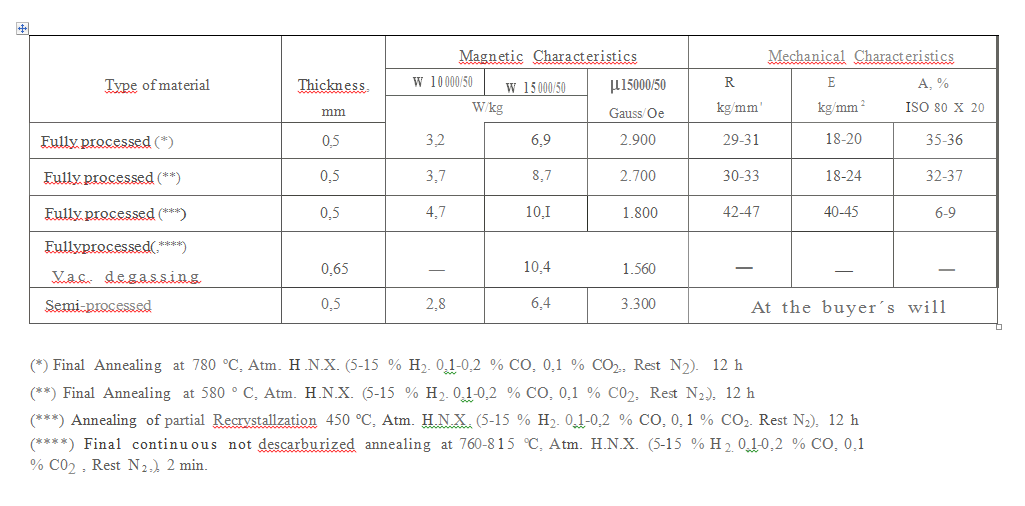
In view of the results presented here, the low mechanical characteristics of the fully treated material become evident. To obviate this inconvenience, the supply of these materials in semiprocessed quality is becoming increasingly important.
However, currently and in order to improve the formability of the fully treated material, we proceed to:
– Increase the phosphorus and manganese contents to levels between 0.10-0.15% and between 0.40 – 0.60%, respectively.
– Summit the material to partial recrystallization annealing at low temperature (23), which allows, by controlling the degree of recrystallization, to obtain the desired mechanical characteristics prior to shaping.
-
NON ORIENTED MAGNETIC STEEL SHEET
Although this general heading includes the entire range of non-oriented silicon magnetic sheets, it is currently necessary to distinguish between the grades corresponding to a low silicon content (0.35-1.00% ) and those whose content is medium or high, taking into account the differences established in their respective manufacturing processes, as well as in their applications.
3.1. NON ORIENTED MAGNETIC STEEL SHEET AND LOW SILICON CONTENT
Nevertheless what has been stated in the previous paragraph, referring to the current wide use of decarburized mild steel sheet in the manufacture of fractional and small engines, it is evident that, as a consequence of the progressive increase in the costs of the energy, acquires a greater and greater increase the progressive substitution of said material by the low grades of the magnetic non-oriented silicon steel sheets, pointing in this sense the recommendations of the Ministry of Industry and Foreign Trade of Japan (Moonlight Project) (24) and the Department of Energy of the United States (25), who recommend the use of the lowest grades of Non- Oriented Magnetic Steel as substitution of Decarburized Mild Steel Sheet for fractional and small motors, respectively.
Example of this has been the beginning, from 1975, of the production of electric motors of this type with greater performance, estimating that in the United States, in 1980, 7% of these engines were manufactured for this purpose, a figure which is expected to reach 75% in 1990 (26).
A complete study on the steel manufacturing process and characteristics of the non-oriented grain magnetic sheet, in the low range of silicon (0.35-1.20%), in its application to the case of fractional and small motors can be seen at a previous work by the author about this type of material (27).
3.2. NON ORIENTED MAGNETIC STEEL SHEET of MEDIUM AND HIGH SILICON CONTENT
Within this range of silicon content, and in order to improve both the surface quality and the magnetic properties of these steels, a series of new techniques have recently been developed leading to:
- Reduce the levels of impurities in the material, by introducing vacuum degassing techniques and intense desulphurization of the material. In this way it is possible to eliminate the negative incidence, which both directly; slowing down the movement of the Bloch wall, magnetic dilution effects, etc., as well as indirectly, inhibition of grain growth, exerted by these impurities.
- To induce certain textures, giving rise to the non-oriented grain magnetic sheet, but with texture, which we will deal with in the following section.
Constituting both variables, impurities present in the material and its texture, the current lines of work and research for the improvement of the electromagnetic characteristics of the non-oriented grain magnetic sheet.
Iron and steelmaking process
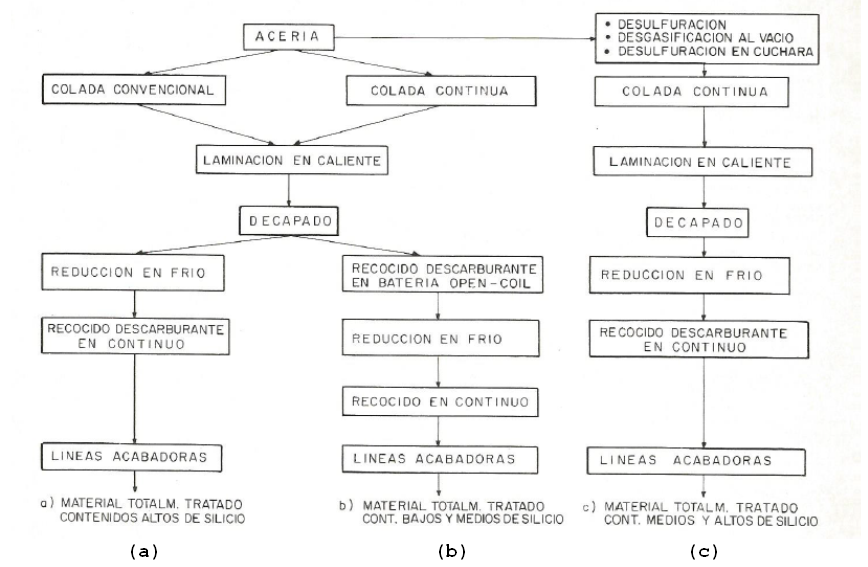
Fig 2.-Scheme of the steel processes used in the manufacture of non-oriented grain magnetic sheet
( Aceria: Steelworks; Desulfuracion: Desulfurization; Desgasificacion al vacío: Vacuum degassing; Desulfuracion en cuchara: Ladle desulfurization ; Colada continua : Continous casting; Laminación en caliente: Hot rolling; Decapado: Pick line; Reduccion en frío : Cold Rolling; Recocido en continuo: Continous Annealing; Recocido decarburante en continuo: Continuous decarburizing annealing ; Líneas acabadoras: Finishing lines )
( Material totalmente tratado contenidos altos en silicio: Fully processed material high silicon content; Material totalmente tratado contenidos bajos y medios en silicio: Fully processed material low and médium silicon content.)
All of the above, allows us to affirm that both the desulfurization techniques through the use of synthetic slags (28), which achieve final sulfur contents in the range 0.010-0.015%, and the use of critical reductions prior to the final annealing, are procedures that, even being currently used, tend to be replaced, and should be considered as procedures of the past, whose general description can be seen in the work of Coombs (29).
Figures 2a) and b) show the modern, although conventional, schemes for obtaining non-oriented grain magnetic sheets in the interval of high and medium-low silicon content, respectively.
The use of the steel process a) is exclusively limited to high silicon content (Si > 2.25 %) for reasons similar to those stated in the previous section, producing as then, in the case of medium and low silicon content, a decrease in productivity of the continuous annealing line and a grain structure columnar for carbon contents in the range 0.03-0.04%, it being possible to obviate this inconvenience by subjecting the hot rolled material to decarburant annealing in the open-coil battery (process b), so that in this case the final annealing becomes a recrystallization non-decarburant annealing at high speed (v ≈ 40-45 m/min).
Figure 2c) shows the scheme of the most recent steelmaking process for the manufacture of medium and high grades of non-oriented grain magnetic sheet, which includes the removal of impurities in the steelworks through the stages of vacuum degassing and desulfurization of the material, including additional ladle desulfurization to sulfur levels below 0.005 %, all in accordance with modern iron and steel practices (30,31) that allow obtaining chemical compositions such as those indicated in table III.
TABLE III.- Composition obtained in the steelworks after the processes of vacuum degassing and desulfurization of the material, in(%).
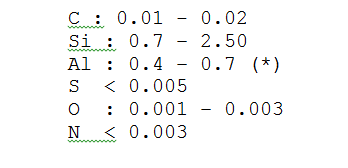
(*) Only for the highest grades
The removal of these impurities up to the indicated levels:
– Minimizes the negative effects that these impurities exert on the magnetic properties, especially the hysteresis losses.
– Avoids the development, for medium silicon contents, of a columnar grain structure during the continuous annealing process.
– Improves control and performance of ladle ferroalloys.
– As a consequence of the lower degree of decarburization required during the continuous decarburizing process, it is possible to partially eliminate the oxide sublayer generated at the gas-metal interface during the aforementioned process (32, 33), resulting in a decrease in the number of losses due to hysteresis.
It is also possible to promote adequate grain growth (ASTM 3-5) by canceling the mechanism that inhibits grain growth, the latter being linked to the presence of aluminum nitride and manganese oxysulfide precipitates.
In the works by Browne (34) and Goto et al.(35) a complete study can be seen on the factors involved in the aforementioned inhibition mechanism, pointing out that the size, morphology and distribution of the manganese oxysulfide precipitates produced during the course of the stage of hot rolling, is closely related to the sulfur, oxygen and manganese contents, as well as to the reheat temperatures of the slab.
Likewise, and as a consequence of all this, the dependence between the final grain size and the number of magnetic losses is shown as a function of the mentioned factors, proposing small additions of rare earths (0.006-0.015%) in order to reduce the solubility of the precipitates, thus blocking their inhibitory effect and obtaining as a consequence the best magnetic characteristics within the range of non-textured non-grain oriented magnetic sheet.
Magnetic characteristics and applications
The minimum magnetic characteristics required for the various grades, in fully treated and semi-treated qualities, are established in accordance with the various standards and specifications (36-38). Regarding the applications, it should be noted that, given the enormous diversity of electrical machines operating in the field of high and medium power, it is very difficult to establish an unequivocal correlation between the characteristics required in the machine and the type of magnetic sheet to be used, however, in the works of Vacari (39) and Stiebler et al. (40) can be seen the correlations between the magnetic characteristics of the materials and the specific applications for which they are intended.
-
NON ORIENTED MAGNETIC STEEL SHEET WITH TEXTURE
It has already been pointed out above that the recent industrial production of non-textured grain-oriented magnetic sheet constitutes a authentic technological innovation within this range of steels.
Its development is closely related to the work carried out prior to 1970 leading to the production of doubly oriented magnetic sheet «Cube Texture (100) [001]», whose manufacturing process was never developed at an industrial level, due to its high economic cost. However, using the non-oriented variant of this texture, called «Random Cube Texture {100} <u v w>», lower loss figures and higher permeability values were obtained than the best grade of non-oriented grain magnetic sheet, This is due to the elimination of directions that are difficult to magnetize <111> from the plane of the sheet, which makes this material ideal for its application in rotating machines.
Let us now see the different procedures that make it possible to obtain this type of texture.
4.1. Texture induction in mild carbon steel sheets using the transformation Gamma to alpha.
Krause and Popovic (41), based on previous laboratory work by Aspden et al. (42,43), have pointed out that the «Non oriented Cube Texture {100} <u v w>» can be developed in mild carbon steel plates through selective grain growth in the course of transformation g ® a, this being associated with the surface energy necessary to generate this type of texture, which, in turn, is a function of the type of atmosphere used and the sulfur content in the sheet surface (44), either from the annealing atmosphere (H2 + SH2) or from the dissolution of manganese sulfides and subsequent diffusion process from the metal base.
For all these reasons, in the opinion of the author, a complex physical-chemical process is present in the development of these textures, since to the selective growth of the grain during transformation gamma to alpha, the processes of dissolution of manganese sulfides and diffusion of sulfur towards the solid-gas interface are simultaneously joined, as well as the processes of transport in the boundary layer, and phenomena of adsorption and desorption of H2 and SH2 on the surface. If to all this we add the kinetics of the superficial metal purification reactions, the latter depending on the previous stages as well as the temperature and composition of the atmosphere, it is evident evidence the enormous complexity of the process as a whole.
Figure 3 and Table IV show the schemes of the iron and steelmaking processes used by Krause and Popovic for the development of this texture as well as the results obtained.
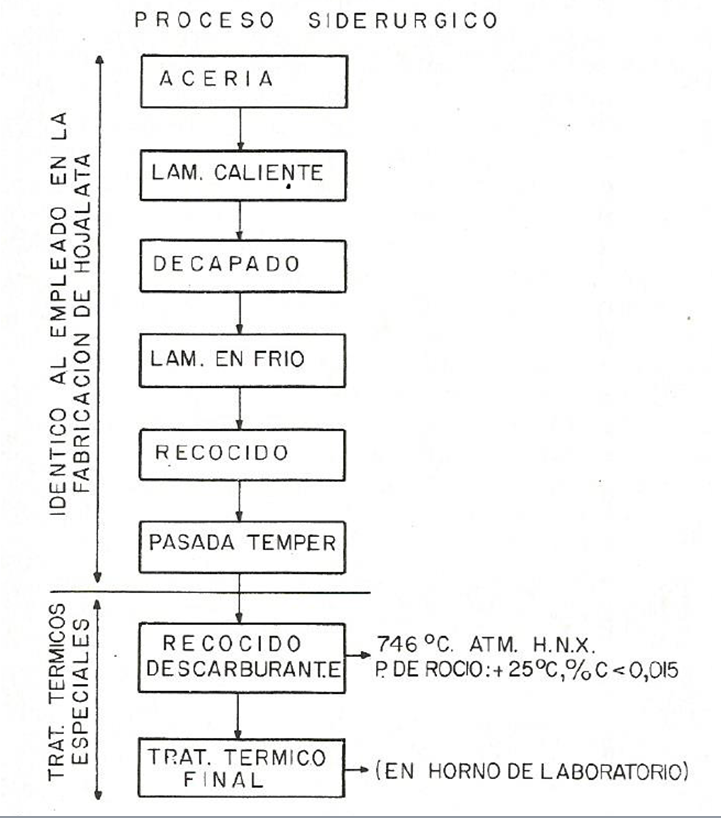
Fig 3.- Iron and steelmaking processes used in the manufacture of textured mild carbon steel sheet for electrical applications.
(Idéntico al empleado en la fabricación de hojalata: Identical to that used in the manufacture of tinplate; Tratamientos térmicos especiales: Special heat treatments; Laminación en caliente: Hot rolling; Decapado: Pick line; Laminación en frío: Cold Rolling; Recocido: Annealing; Pasada temper:Skin pass; Recocido decarburante: Decarburant annealing; Punto de Rocio: Dew point; Tratamiento térmico final: Final heat treatment; Horno de laboratorio: Laboratory furnace.).
TABLE IV.-Magnetic characteristics of textured mild carbon steel sheet (41).
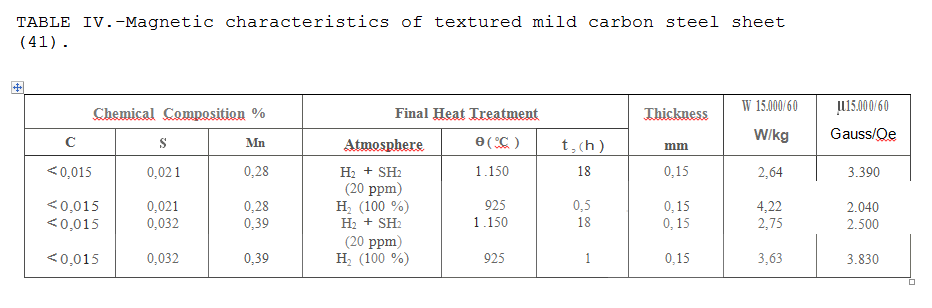
From their analysis it can be deduced that the optimization of the magnetic characteristics is achieved for annealing for 18 hours at 1,150 ºC in H2 atmospheres containing 20 p.p.m. of SH2. However, it becomes possible to develop a pronounced {100}< u v w > texture, together with suitable magnetic characteristics, by means of a more operational annealing at industrial level consisting of soaking time of 0.5-1.0 h in an atmosphere of pure H2 at 925 ºC.
4.2. Texture induction in high-content silicon non oriented magnetic steel sheets. Fully- Processed.
Very recently, non-oriented grain magnetic sheets with a high silicon content with texture have been developed at an industrial level, to obtain which, and in accordance with what was indicated in the previous section, it is necessary to lower the impurity content in the steelworks to very low levels, thus making it possible to develop an adequate texture, and reach values in the magnetic characteristics higher than any of the qualities that existed until recently in the market (45, 46).
According to these works, it becomes possible to correlate the final texture developed and, therefore, the magnetic characteristics depending on the parameters of the iron and steelmaking process, among which it is worth mentioning:
– Chemical composition: impurities levels and contents of aluminum and silicon.
– Temperature and texture developed in the intermediate annealing.
– Degree of reduction in cold rolling prior to the recrystallization process.
– Variables of the final recrystallization process.
Figure 4 shows a scheme of the iron and steel process that enables the development of cube textures random and favorable oriented {100} <u1v2w3> and {110} <u2 v2 w2>, and partially prevents the development of the unfavorable {111} <u3 v3 w3 >, {211} <u4 v4 w4>.
Table V also shows the magnetic characteristics corresponding to these steels, being the same higher than those required for grades M.15 of the North American specification. A.I.S.I. or S.09 from the Japanese J.I.S., which makes this steel with the best characteristics in the world within the range of non-oriented grain magnetic sheet.

Fig 4.-Scheme of the iron and steelmaking process used in the manufacture of fully treated, non-textured, grain-oriented magnetic sheet with high silicon content.
( Aceria: Steelworks; Desulfuracion: desulfurization; Desgasificacion al vacío: Vacuum degassing; Desulfuracion en cuchara: Ladle desulfurization ; Colada continua : Continous casting; Laminación en caliente: Hot rolling; Decapado: Pick line; Reduccion en frío a espesor intermedio: Cold Rolling to intermediate thickness; Recocido intermedio en continuo: Intermediate Continous Annealing; Reduccion en frío a espesor final: Cold reduction to final thickness ; Recocido final en continuo: Continuous final annealing ; Instalaciones de acabado: Finishing lines ).
TABLE V.- Magnetic characteristics of the non-oriented magnetic sheet with texture. High silicon content. Fully treated (46)
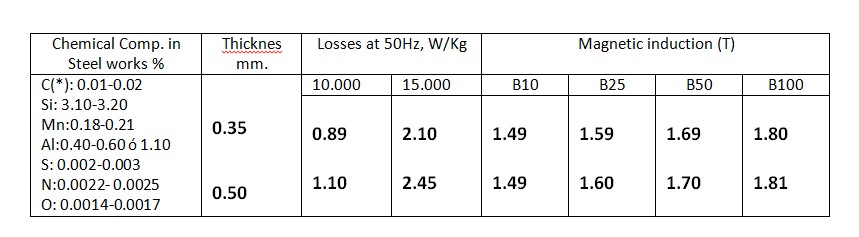
(*)Final Carbon Content after decarburizing : 0.003-0.005%
For all these reasons, it becomes very suitable the use of this material in rotating machines, especially those in which it is desired to increase performance by reducing the amount of energy losses.
The case of large rotating machines deserves special mention, such as the case of bipolar turbogenerators, in which, taking into account the types and distributions of flows in the outer and inner parts of the stator, as well as the specific weight of each of them in accordance with the works of Moses and Radley (47), it is concluded that this new quality of material can advantageously replace grain-oriented magnetic steel sheets, that is currently being used in the manufacture of this type of machine (48), also avoiding the elliptical vibrations that occur in this type of machine and, therefore, its oversizing.
4.3. Texture induction in magnetic sheets of nonoriented grain and medium silicon content. Semiprocessed quality.
Another type of non-oriented magnetic plate, very adequate for use in rotary machines, it is obtained in semiprocessed quality and medium silicon content by inducing the appropriate texture (46).
It is known that when a hot strip of this material is cold processed and annealed, recrystallization occurs, giving rise to the development of a final texture component {111}<211> very sharp and the origin of poor magnetic characteristics. This texture nucleates in the subjoints of the grains originated in the hot rolling (49,50).
The development of this undesirable texture can be avoided by submitting the hot rolled material to a bell furnace anneal before cold rolling; the effect of eliminating said texture is reinforced by the addition of small amounts of Sb (0.04-0.08 %) (51), which, due to its tendency to segregate preferentially in grain joints, inhibits the nucleation of the previous texture and developing a texture of type {100} <uvw> . For this, said annealing must be verified in a bell furnace, since the high cooling speeds of continuous annealing prevent the segregation of antimony, avoiding its effect.
On the other hand, and since the impurities act in the same sense as the grain subjoints, nucleating the {111} <211> texture, it is desirable to obtain the material as free of impurities as possible with the aim to optimize the texture.
Fig. 5 and Table VI show the scheme of the iron and steelmaking process developed to obtain these materials, as well as their magnetic characteristics depending on the antimony content.
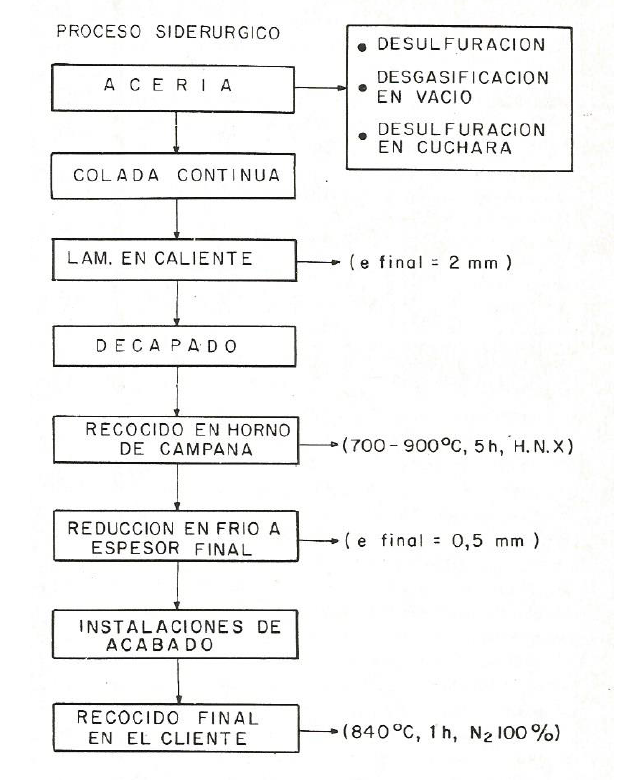
Fig 5.- Scheme of the iron and steelmaking process used in the manufacture of semiprocessed nonoriented non-textured magnetic sheet with medium silicon content.
( Aceria: Steelworks; Desulfuracion: desulfurization; Desgasificacion al vacío: Vacuum degassing; Desulfuracion en cuchara: Ladle desulfurization ; Colada continua : Continous casting; Laminación en caliente: Hot rolling; Decapado: Pick line; Recocido en horno de campana : Annealing in Bell furnace; Reduccion en frío a espesor final: Cold Rolling to final thickness; Instalaciones de acabado: Finishing lines; Recocido final en el cliente: Final annealing in the customer. )
Tab. VI.-Magnetic characteristics of the non-oriented magnetic sheet with texture. Medium silicon content. Semiprocessed (46).
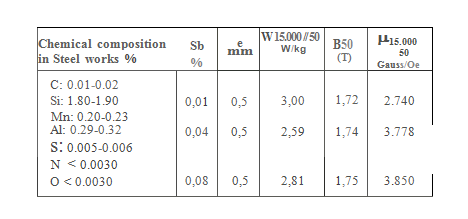
In view of these results, it is possible to affirm that this type of material presents magnetic characteristics superior to the M.27 grade of the specification American A.I.S.I. for semiprocessed quality. The high value of permeability at high inductions deserves special attention, which makes it a very suitable material for use in the wide range of large motors (> 50 h.p.) with high performance.
5. NEW MATERIALS
The most notable advance during the past decade, at the laboratory level, has been the obtaining and development of a series of new materials obtained directly from the molten state using special techniques.
These new materials are configured in two groups: crystalline bands with a high silicon content and materials in an amorphous state.
5.1. Crystalline ribbons of high silicon content
It is known that Fe-Si alloys with a high silicon content (~6% Si) have a high brittleness, and are therefore difficult to process by conventional steelmaking processes. However, very recently a new technique (52) has been developed at the laboratory level, similar to that used to obtain amorphous materials, which allows the manufacture of these materials by direct projection of molten metal onto a rotating disk at high revolutions. In this way, ribbons with width ranges between 5-50 mm and thickness between 20 and 300 µm are obtained.
Subsequently, and in order to improve the magnetic characteristics of the material, it is subjected to vacuum annealing at temperatures between 1.100-1.200 ºC. (0.5 – 5 hours). As a result, a tertiary recrystallization is achieved, accompanied by a growth in grain size (1 mm) and texture development (100) [o u v], which gives the material a high planar isotropy in terms of magnetic characteristics refers.
In the various works carried out on these materials (53-55) the grain size, final developed texture and, therefore, the magnetic characteristics of these new materials are studied as a function of parameters such as:
-Silicon content.
-Thickness.
-Annealing atmosphere (argon, vacuum).
-Temperature and time of the annealing.
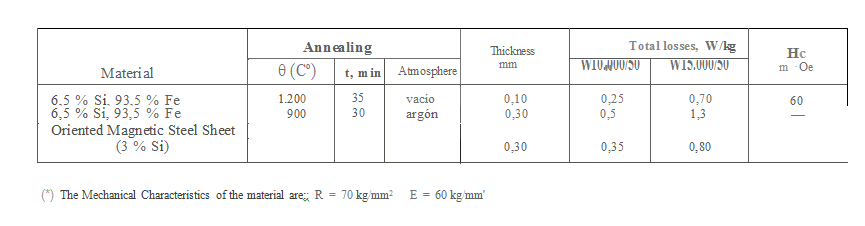
Table VII shows, based on these parameters, the most representative magnetic characteristics for a 6.5% Si 93.5% Fe composition material heat-treated after it was obtained from the molten state.
TABLE VII-Magnetic characteristics of the crystalline ribbons of high silicon content (*) (53)
5.2 Amorphous Materials
These materials, obtained by means of a procedure similar to the previous one (56) or by electrodeposition, they are alloys with an amorphous structure formed by metals (Fe, Ni, Co, Cr) and elements such as (C, Si, P, B, ..).
Said structure is a consequence of its own cooling process, not presenting long range ordering and obtaining, as a consequence, specific characteristics, among which it is worth highlighting the electrical and magnetic ones.
A general review regarding the development of these materials in regards to:
– Manufacturing process, with special mention to the casting process in rectangular section(57) for the manufacture of amorphous ribbons with a width greater than 5 cm.
– Types of alloys
– Applications.
It can be seen in the works of Davis et al. (58) and Luborsky et al. (59). The latter compiles the most important works referring to the structure, properties and applications, as well as the most significant bibliography (60) on this type of alloys.
Regarding its applications, it should be noted that, although amorphous alloys have been developed for very diverse uses, among which alloys with high mechanical and corrosion resistance, etc., can be mentioned, actually, one of the most interesting applications of these materials are based on their peculiar electrical and magnetic properties, a consequence of their amorphous state and high isotropy.
Indeed, ferromagnetic amorphous materials combine being soft, magnetically speaking, with adequate hardness and mechanical resistance. If we add to this their high resistivity, they become especially suitable materials for use in magnetic applications, with lower loss figures than those obtained in grain oriented magnetic steel sheets.
By way of example, the alloy Fe82 B13 Si4 C (METGLASS 2605SC) has great potential for application as a core in motors and transformers, since this material has losses ranging from 33 to 50% of those produced in grade H.2 (J.I.S. C 2553) of grain-oriented magnetic sheet and 12% of those corresponding to grade M.15 (A.I.S.I.) of non-oriented magnetic sheet, hence the enormous interest aroused by these materials.
However, it is necessary to point out some negative aspects, which together with the difficulty of obtaining it on a large scale, mean that its use at an industrial level is not foreseeable in the short term.
Such aspects are:
-Low value of induction at saturation 1.6 T compared to 1.9 T corresponding to the silicon magnetic sheet (3% Si). This last aspect is inherent to a material in whose composition approximately 20% of atoms of non-ferromagnetic material are integrated.
-Low thickness, 20-50 µm, due to the need for very fast heat transfer during the solidification process and which leads to a reduction in the stacking factor.
If we add to this the great sensitivity of the magnetic properties of the material against the stresses induced during the manufacturing process, as well as the brittleness that occurs after final annealing in the case of transformers, it becomes evident the need to modify conventional manufacturing processes, replacing them with techniques more in line with these new materials.
In spite of all this, it is possible to affirm at present, that these types of new materials have surpassed the stage in which they were considered as a laboratory curiosity, the current investigation being aimed at solving the technical problems that would entail the large scale manufacturing and transformation of these materials, taking into account the enormous potential they present in terms of energy savings.
References
(1) BARRET, W. F.; BROWN, W., y HADFIELD, R. A.: Conductivity and Permeability of Iron Alloys. Sci. Proc. R. Dublin Soc. 7, 1900: 67- 126.
(2) BARRET, W. F.; BROWN, W., y HADFIELD, R. A.: Trans. R. Dublin Soc. 8, 1902 : 1-22.
(3) HADFIELD, R. A.: Pat. EE.UU, 745.829 (1903).
(4) BECHTOLD, J. H., y WIENER, G. W.: The Hístory of Soft Magnetic Materials. The Sorby Cemennial Symposium on the History of Metallurgy. C. S. Smith (Editor), Gordon and Breach. Nueva York, 1963, Cap. 32.
(5) WALTER, J. L.: History of Silicon-iron. The Sorby Centennial on the History of Metallurgy. C. S. Smith (Editor). Gordon and Breach. Nueva York, 1963, Cap. 32.
(6) THOMPSON, J. E.: Br. J. Appl. Phys. Ser. 2, 2, 1969: 933- 952.
(7) MALAGARI, F. A.; MILLER, F. J., AMES, S. L.: Metall.Eng. Q., 13 (1), 1973: 14- 18.
(8) TAGUCHI, S.: Trans. Iron Steel lnst. Jpn, 17 (10), 1977: 604-615.
(9) WERNER, F. E.: Electrical Steels 1970-1990, Energy Efficient Electrical Steels. Proceedings Fall Meeting Met. Soc. of A.I.M. E. Pittsburgh, Pennsylvania, 5-9 Oct. 1980: 1-33.
(10) Met. Bull. Mon.: Jan. 1981.
(11) ANAN’EVSKY, M. A.; BOCHKOV, N. G., y PARFENOV, G. V.: Steel USSR, 2 (7), 1972 : 567-568.
(12) KNIGHT, D. J., ADZlMA, P. J.: Trans, Am. Soc. Met., 54, 1961: 351-361.
(13) BOCHKOV, N. G., y PARHNOV, G. V.: Steel USSR, 5 (3), 1975: 166- 168.
(14) IBARRONDO, I.: Rev. Metal. (Madrid), 19 (6), 1983: 343- 348.
(15) ADZEMA, P. J., y KNIGHT, D. J.: Trans, Am. Soc. Met. 56, 1963: 576-582.
(16) GORMAN, K. M.: Formation of Columnar Grains by Decarburization. 1nter-Office Correspondence of Bethlemen Steel. 19 enero 1981.
(17) IBARRONDO, I.: Tesis Doctoral. E.T.S. Ing. Ind. de Bilbao. Univ. del País Vasco. (UPV/EHU) Mayo 1980.
(18) IBARRONDO, I.: V Asamblea General del CENIM. Tomo lI (T-74). Oct. 1981. Madrid, Revista Dyna (Bilbao, España), 57 (11), 1982: 25-29.
(19) CHATHELD, D. A.; RZEPKA, j. F., y PREBLE, A . C.: Off. Gaz. 17 feb. 1981. Pat. EE.UU, 4251.294, 22 Agosto 1978.
(20) MISRA, S.; RAMASWAMY, V.; SINGH, K. N., y PATNAIK, B. B.: Steel India, 1 (2), 1978: 66-73.
(21) NARULA, M. L., y SINGH, B.: Steel India, 6 (1), 1983: 17- 21.
(22) IBARRONDO, I.: Rev. Metal. Madrid, 19 (6), 1983: 343-348.
(23) SMYTHE, T. W.: Met. Aust.,7 (11), Dic. 1975-Enero 1976 : 280-283.
(24) SHIMANAKA. H.; ITO, Y.; MATSUMURA, K., y FUKUDA, B.: J. Magn. Magn. Mater., 26 ( 1-3) 1982: 57-64, 59, 61. ·
(25) U. S. Department of Energy. Energy Efficient and Electric Motors. Cap. IV.: Technical and Economics Evaluations. Abril 1978: 57-58.
(26) WERNER.F.E.: Electrical Steels 1970-1990. Energy Efficient Electrical Steels. Proceedings Fall Meeting Met. Soc. Of A.I.M.E. Pittsburgh, Pennsylvania, 5-9 Oct. 1980: 17.
(27) IBARRONDO, I.: Estudio del proceso siderúrgico de obtención de los grados bajos en silicio en chapa magnética de grano no orientado. Aplicación a motores fraccionarios pequeños y medianos. Trabajo presentado a la 27th Mechanical Working and Steel Processing Conference of A.l.M.E. Session I: Flat Rolled Products, 27-29 oct. 1985. Cleveland, Ohio (EE.UU.)
(28) AFANAS’EV, S. G., et al.: Stal. Engl. (USSR). (3), 1969: 259-262.
(29) COOMBS, A.: Steel Times, 198 (5), 1970: 311 -321.
(30) SMYTHE, T. W.: B. H. P. Tech. Bull., 25 (2), 1981: 25
(31) PFLIPSEN, H. D., WEBER, R. A.: Stahl Eisen, 98 ( 15), 1978: 747-753.
(32) HUFFFMAN, G. P., y STANLEY, E. B.: J. Appl. Phys., 50 (3-11), 1979: 2363-2365.
(33) GEIGER, A. L.: J. Appl. Phys., 50 (3-11), 1979: 2365-2368.
(34) BROWNE, K. M.: The Effetc of Sulphur on the Magnetic Propcrties of Silicon Steel. Metals77. The 30th Annual Conference of the Australasian lnstitute of Metals, 1977: 3A.7-3A.8.
(35) GOTO, I.; SHIMANAKA, H.; IRIE, T.; MATSUMURA, K.; NAKAMURA, H., SHONO, Y.: Development of Non oriented Electrical Steel R.M -8 with High Magnetic lnduction and Low Core Loss. Paper presented at S M. M. 3, Batislava, Checoslovaquia, Sept. 1977.
(36) Normas A.S.T.M. A. 677-77, DIN 46.400 (I Parte), J.I.S. C 2.552 (1978).
(37) Normas A.S.T.M. A. 683-77, DIN 46.400 (11 Parte), J.I.S. C 2.552 (1978).
(38) American Iron and Steel Institute. Steel Produces Manual. Flat Rolled Electrical Steel (Sept. 1975). 1.000, l6th Street N.W., Washington D.C. 20.036.
(39) VACARI, J. A.: Mater. Eng., 80 (2), 1974: 20-26.
(40) STIEBLER, M., et al.: Stahl Eisen, 97 (10), 1977: 495-504.
(41) KRAUSE, R. F., y Porov1c, B. A.: J. Appl. Phys., 52 (3), 1981: 2419-2421.
(42) ( ASPDEN, R. G.; BERGER, J. A., y TROUT, H. E.: J. Appl.Phys. 37 (3), 1966: 1195-1196.
(43) ASPDEN, R. G.; BERGER, J. A., y TROUT, H. E.: Acta Metall., 16, 1968: 1027-1035.
(44) BARRET, C. S., y MASSALSKI, T. B.: Structure of Metals. Series in Materials Science and Engineering. 3.ª Ed. Mac. Graw-Hill. Nueva York 1966: 579.
(45) IRIE, T.; MATSUMURA, K.; NAKAMURA, H., y 5HONO, Y.: Kawasaki Steel Tech. Rep. 10 (1), 1978: 15-22.
(46) SHIMANAKA, H.; ITO, Y.; IRIE, T.; MATSUMURA, K.; NAKAMURA, H., y SHONO, Y.: Non-Oricnted Si-Steel Useful for Energy Efficicnt Electrical Apparatus. Proceedings Fall Meeting Met.Soc. of A.I.M.E. Pittsburgh, Pennsylvania, 5-9 Oct. 1980: 193-204.
(47) MOSES, A. J., y RADLEY, G. S.: J. Magn. Magn. Mater., 19, 1980: 60-62.
(48) SHIMANAKA, H.; ITO, Y.; MATSUMURA, K., y FUKUDA, B.: J. Magn. Magn. Mater., 26 (1-3), 1982: 57-64, 57, 58.
(49) HUGHES, I. F.: Metall. Trans., 2 (4), 1971: 929-936.
(50) HUGHES, I. F., y SHAPIRO, J. M.: Metall. Trans., 2 (12), 1971: 3347-3354.
(51) SHIMANAKA, H.; IRIE, T., MATSUMUR A, K., y NAKAMURA, H., J. Magn. Magn. Mater., 19, 1980: 63-64.
(52) TSUYA, N., ARAI, K. I.: Jpn .J. Appl. Phys., 18 (1), 1979: 207-208.
(53) TSUYA, N., ARAI, K. I., OHMORI, K.; SHIMANAKA, H., y KAN, T., I. E.E.E. Trans. Magn., Vol. Mag- 16, 5, Sept. 1980: 728-733.
(54) ARAI, K. I., TSUYA, N., OHMORI , K., SHIMANAKA, H., y MIYAZAKI, T., J. Magn. Magn. Mater., 15-18, 1980: 1425- 1426.
(55) KAN, T., ITO, Y., y SHIMANAKA, H.: J. Magn. Magn. Mater., 26, 1982: 127-129.
(56) PECES, J. A., GARCIA ESCORIAL, A., Rev. Metal. (Madrid), 19 (5), 1983, 296-298.
(57) NARASIHAM, M. C.: Pat. EE.UU., núm. 4.142.571, 6 marzo 1979.
(58) DAVIES, L. A., DeCRISTOFARO, N., SMITH, C. H., Technology of Mctallic Glasses. Proccedings of the Conf. on Metallic Glasses. Science and Technology, Budapest, Hungría 30 junio -4 julio 1980.
(59) LUBORSKY, F. E., et al.: Amorphous Mctallic Alloys. Butterworths Monographs in Materials. Londres.
(60) LUBORSKY, F. E., et al.: Amorphous Metallic Alloys. Butterworths Monographs in Materials. Londres: 6, 7.
——–