Haz clic en el botón para descargar | Download Here
A New and revised more complete version 2024, as the occasion of COP 28 – , especially in relation to the use of Hydrogen as a reducing agent, |
Autor:
Ignacio Ibarrondo Martínez-Iturralde
Dr. Ing. Ind.- Formerly Catedrático E.U (U.P.V/E.H.U.)
Mailing Address:
Ignacio Ibarrondo Dr.
C/ Javier Barcaiztegui 21 – 5.B
20010- San Sebastián
SPAIN
Download from :
https://www.ironandsteelmaking.com
or
https://www.researchgate.net/profile/Ignacio-Ibarrondo/research
Autor: Ignacio Ibarrondo Martínez Iturralde
Editor: Ignacio Ibarrondo Martínez Iturralde
ISBN : 978-84-09-28360-6
DOI : 10.13140/RG.2.2.22765.56805
Depósito legal:
Copyight: Marzo 2021. Queda prohibida la reproducción total ó parcial
de esta obra, por cualquier medio, sin la autorización expresa y
escrita del autor.
Los Derechos de Propiedad Intelectual y Copyright de las
figuras y tablas, continúan perteneciendo a los Autores,
Institutos y Empresas, así como a las Revistas y Editoriales que se citan en cada una de ellas.
Review: The Iron and Steelmaking Industry and its Impact on Climate Change
Object of this work:
In view of the importance of climate change and the influence on it exerted by the iron and steelmaking industry, I have prepared, in this section of the website, a compilation of information from different official organizations, international environmental agencies, iron and steelmaking companies…, and some experts.
Ordering everything, for a better understanding by students and people whose objective is to learn about the impact on the environment of the iron and steelmaking industry.
In each of the cited pages there is a considerable amount of information and evidently we have tried to choose the most modern references on this field in order that the information transmitted is as interesting as possible for the reader.
A New and revised more complete version 2024, as the occasion of COP 28 – , especially in relation to the use of Hydrogen as a reducing agent,
Index
1.- Importance of the Subject. pp. 05
2.- Introduction : Basic and Technical Knowledge for Change – General Overview. pp. 08
General information and bibliography about this section pp. 30
3.- Environmental Performance of the Steel Sector : Current Situation and Modification to Conventional Processes. pp. 41
3.1-Innovative developments concerning non or low CO2 pp.41
Specific Bibliographic References pp.56
3.2-Reduction in solid phase (Blast Furnace and Direct Reduction Iron DRI ) pp. 66
Research and Development for Global Warming Prevention. pp.66
3.3-Direct Reduction in liquid phase (Smelting process) pp. 110
3.4-Biomass as a reducing agent pp. 114
3.5-Recycling and circular economy. pp. 126
4.- Prospects for Future Radical Change: pp. 131
4.1- Hydrogen Use as a Reducing Agent. pp. 131
4.1.1– Possibility of Hydrogen Reduction in Iron-making Process pp. 131
4.1.2- Blast Furnace and Direct Reduction by Hydrogen. ( Solid Phase ) pp. 134
4.1.3– The HYBRIT process . pp. 182
4.1.4.- Hybrit – Specific Bibliography pp. 194
4.1.5.- Smelting by Hydrogen. (Liquid Phase) pp. 198
4.1.6.- Specific bibliography pp. 204
4.2 -Electrolysis pp. 208
5.- Actions Undertaken by International Companies. pp. 211
Hydrogen Production. pp. 270
Production of hydrogen for steelmaking pp.276
6.- Bibliography pp. 295
——————-
1.- IMPORTANCE OF THE SUBJECT
001 The Race is On For Greener Steelmaking
29.10.2020 – The global steel industry’s primary challenge over the next few decades is climate change, and it must rapidly develop new technological solutions, as said by several industry leaders during:
Fastmarkets AMM’s annual Steel Success Strategies conference.(Oct 26-28, 2020 Virtual Platform)
https://www.amm.com/events/amm-steel-success-strategies/details.html
002 Sanjeev Gupta, executive chairman and chief executive of Liberty Steel Group.
https://libertysteelgroup.com/about/greensteel-strategy/
https://libertysteelgroup.com/about/message-from-the-chairman/
A vision for carbon neutral steel by 2030
“Across the world, the direction of travel is set. We are moving toward a carbon-neutral world. Pressure will only grow. Demand for sustainably produced metals will grow. And regulation will intensify,”
During the annual conference, which brings together steel industry leaders throughout the world, Gupta and others urged the industry to take action, and quickly. Gupta noted that the industry is responsible for 9% of global emissions. At the same time, demand is expected to grow is over the next 30 years, given steel’s necessity to society. That, he said, will place a greater responsibility on theindustry.
003 Tata Steel, T.V. Narendran, chief executive and managing director.
“Climate change is not a regulatory issue. It is an existential issue,”
Narendran said other industrial sectors are reinventing themselves, and steel must do the same.
Based on the discussion during the conference, a reinvention is likely to include electric arc furnace (EAF) steelmaking paired with hydrogen-based direct reduction, all powered by renewable energy.
004 Nucor Corp. chief executive Leon Topalian.
Noted that in the U.S., EAF steelmaking has helped to reduce the domestic industry’s carbon footprint by 45% over the last 40 years.
“The footprint will continue to shrink as the energy grid becomes greener,” he said.
But he said the steel industry will need enabling advancements from other sectors, such as utility-scale battery storage to meet baseload needs of large mills. He also said policymakers will have to work toward policies that encourage the technological innovations necessary to reduce emissions and expand the use of renewable energy.
005 ArcelorMittal. Founder and chief executive Lakshmi Mittal
“If the world is to achieve net zero by 2050, it will require all parts of the economy in all regions of the world to contribute. As the world’s leading steel company, we believe we have a responsibility to lead the efforts to decarbonize the steelmaking process, which today has a significant carbon footprint,”
005.01 Lourenco Goncalves – Chairman, President and Chief Executive Officer of Cleveland-Cliffs.
- AMERICAN STEEL, THE ENVIRONMENT, AND THE NEXT DECADE.
In 2015, I talked about IRON ORE. At that time, 99% of the audience believed that iron ore would be free in a few months.
99% of the audience were wrong.
I’m glad that the presentation was recorded and you can go check.
So you can still talk about the next decade without fear, as long as you base your presentation in FACTS.
Let’s talk about my view for the next decade.
- Prime scrap WILL BECOME A PRECIOUS METAL. Still good, just very expensive.
- NATURAL GAS will emerge as the key to clean steelmaking.
- STEELMAKING across the world Looks A LOT closer to the US model: LOTS of EAF, ONLY environmentally pellets. NO SINTER NO POLLUTION, NO PM2.5 (a lot worse than CO2), A lot of Direct Reduction (DRI), based on natural gas, and a lot of HBI feeding both blast furnaces and EAFS.
- Steel’s inevitability allows for a prosperous period of return on capital, reinvestment, and modernisation.
BUSINESS IS BUSINESS. we are here in the end to make money for ourselves, our shareholders, and our employees so they can supply a livelihood for their families.
That’s what we have in front of us. It’s already here; its our job not to screw it up.
- STEEL’s INEVITABILITY IN OUR FUTURE WORLD
- Electric Vehicles. All car manufacturers are working very hard to play catch up and produce battery electric vehicles. Cliffs is a leader in AHSS (Advanced High Strength Steel), Stainless Steel, and NOES (Non Oriented Electrical Steel), which is key for the engines of battery powered vehicles.
- MODERNISATION OF THE ELECTRICAL GRID: Cliff’s GOES (Grain Oriented Electrical Steel). TO build an modern electric network to recharge all the cars. Think of the rolling blackouts in the west coast and in texas. Cliffs is the only supplier of GOES in America.
- SUSTAINABLE ENERGY: Cliffs Carbon Steel and Plate.
AMERICAN STEEL COMPANIES WILL BE ENTITLED TO RETURNS ON THEIR INVESTED CAPITAL. They will continue to be this powerhouse and the envy of the world.
- STEEL EMISSIONS FROM PRODUCTION VS OTHER MATERIALS.
(Scope 1 and Scope 2 emissions)
Steel: 1 metric ton of CO2 emissions
Aluminium: 6.0 metric tons of CO2 emissions
Carbon Fibre: 9.9 metric tons of CO2 emissions
Magnesum: 15.3 metric tons of CO2 emissions
We are gonna use steel going forwards to produce cars.
- THE PROBLEM IS GLOBAL WARMING, and CO2 is the proxy.
Steel industry in US releases 90Million tons of CO2. CHINA RELEASES 2.5 BILLION tons of CO2.
Of course, Nike, Hollywood, Fox, CNN, dont want to do that. They like the 1.4 billion people that buy stuff. But numbers dont lie.
5. WHO WINS WITH THE ENERGY CRISIS?
The Russian invasion of Ukraine has turned the energy table upside down. The prices of gas, coal, oil and other raw materials have skyrocketed and have triggered a battery of geostrategic movements. There will be winners and losers. The US has already greatly increased its presence in Europe by offering the gas that the Old Continent wants to stop buying from Putin. Venezuela, Qatar, Algeria, Norway and China have also benefited. In the short term, the most dependent countries lose. Spain, among them.
Texto Víctor Martínez
Infografía Alberto Hernández Elsa Martín
https://lab.elmundo.es/crisis-energetica/index.html
2.- INTRODUCTION : BASIC AND TECHNICAL KNOWLEDGE FOR CHANGE – GENERAL OVERVIEW.
C. DE Maré .
(VERY IMPORTANT FOR GENERAL OVERVIEW )
Why Both Hydrogen and Carbon Are Key for Net-Zero Steelmaking
The 2021 AIST Howe Memorial Lecture
https://www.aist.org/AIST/aist/AIST/Publications/Monthly/049-066_September-2021.pdf
and
Key Note 2nd ESTEP Brokerage Event
November 17, 2021
https://www.estep.eu/assets/Uploads/ESTEP-Brokerage-20211117-Key-Note-Carl-De-Mare-v2.pdf
005.02 Worldsteel Association
World Steel Association AISBL
Avenue de Tervueren 270 – 1150 Brussels – Belgium
T: +32 2 702 89 00 – F: +32 2 702 88 99 – E: steel@worldsteel.org
Environmental sustainability indicators
Climate change is the biggest issue for the steel industry in the 21st century.
Reducing CO2 emissions in steelmaking must be tackled on a global level. Making the substantial CO2 reductions required will need technology transfer, collaboration and breakthrough technologies.
Today, a large number of promising breakthrough technology projects are ongoing in different parts of the world.
Some projects are in the early research stage while others are in pilot or demonstration phase.
https://www.worldsteel.org/steel-by-topic/sustainability.html
https://www.worldsteel.org/steel-by-topic/environment-climate-change.html
Very Important:
The author of this web page recommends the access to the web page the Wordsteel Association where he will be able to find a very complete information as well as technical reports, papers, free pdf etc … on the climatic change due to iron and steel industry.
https://www.worldsteel.org/publications/position-papers/climate-change-policy-paper.html (very important )
This Website Includes:
Climate Change and the production of iron and steel (pdf)
Step Up programme (pdf)
https://www.worldsteel.org/steel-by-topic/raw-materials.htmlcrap use
Breakthrough technologies
- Using carbon as a reductant while preventing the emission of fossil CO2, for example using carbon capture, utilisation and storage (CCUS) and/or sustainable biomass.
- Using electrical energy through an electrolysis based process.
- Substituting hydrogen for carbon as a reductant, generating H2O (water) rather than CO2.
Several projects are under developmentare shown:
005.03 Steelmakers must rethink decarbonisation strategies.
Dominic Ellis
Mining 28.06.2022 (economically important)
Rising natural gas and electricity prices are impacting the ability of direct-reduced-iron (DRI) plants to decarbonise their steel production
The steelmaking industry needs to step back and adjust its decarbonisation strategies on account of rising natural gas and electricity prices, according to recent McKinsey research.
Over the past two years, nearly all European flat-steel players have announced the gradual replacement of their coking-coal-based blast furnaces (BFs) with direct-reduced-iron (DRI) plants to decarbonise their steel production. The more than 16 DRI plants currently announced represent more than 25mn metric tons of capacity……..
McKinsey research (economically important)
Frank Bekaert, Marc-Daniel Halbgewachs, Christian Hoffmann, Bruno van Albada, and Marlene Weimer, representing views from McKinsey’s Basic Materials Practice.
European steelmakers need to reconsider their decarbonization strategies because of rising natural-gas and electricity prices, as well as potential limitations on the natural-gas supply.
Over the past two years, nearly all European flat-steel players have announced the gradual replacement of their coking-coal-based blast furnaces (BFs) with direct-reduced-iron (DRI) plants to decarbonize their steel production. The more than 16 DRI plants currently announced represent more than 25 million metric tons of capacity
A buildup of direct-reduced-iron plants using H2 or a resurrection of carbon capture usage and storage seem to be the most viable options for flat-steel players to safeguard their decarbonization efforts.
https://www.mckinsey.com/industries/metals-and-mining/our-insights/safeguarding-green-steel-in-europe-facing-the-natural-gas-challenge (copy and paste)
————
005.04 With this purpose The Global Steel Climate Council has developed :
The Steel Climate Standard (Very important for the future )
Framework for Steel Product Certification and Corporate Science-Based Emissions Targets.
This standard aims to reduce GHG emissions globally-aligning with a science‑based glide path to achieve a 1.5°C scenario by 2050.
https://globalsteelclimatecouncil.org/
The Issue
1.The world needs steel.
- The world needs to lower its greenhouse gas (GHG) emissions
- We already have the technology.
4. We need a global standard
Customers need to know the GHG emissions intensity of the steel they are purchasing to meet their company’s ambitions related to decarbonization.
Numerous groups and companies — including the GSCC — are advocating for a global standard to measure and report carbon emissions from steel. Some steelmakers and organizations are advocating for a common standard that features a «ferrous scrap sliding scale» relative to use of scrap steel for setting carbon reduction trajectories.
With four Objectives of the greatest importance:
That can be seen in :
https://globalsteelclimatecouncil.org/issue/
The Steel Climate Standard
The GSCC is publishing a technology-agnostic global standard that measures and reports steel carbon emissions, which would apply to all producers on a global basis. The standard aims to reduce GHG emissions across the global steel industry, is aligned with a science-based glide path to achieve a 1.5° C scenario by 2050 and requires third-party verification of emissions data and science-based targets.
Download from:
https://globalsteelclimatecouncil.org/the-standard/
http://globalsteelclimatecouncil.org/wp-content/uploads/2023/08/GSCC-Standard-August2023.pdf
Global Steel Climate Council Puts Final Touches on Green Steel Standard
| The Nucor Corp.-led Global Steel Climate Council has published the final version of its green steel standard. 3.08.2023 |
—————–
006 Blog: Worldsteel at ( Climate Change Conference ) COP25 (Very interesting)
Steel and climate change – a three phase approach to industrial transformation
Andrew Purvis
Director, Safety, Health and Environment,
Worldsteel Association, 5 December 2019
Summary:
See the industry’s transition as a three phase process: 1). Step up. 2). Increased scrap use. 3). Breakthrough technology.
https://www.worldsteel.org/media-centre/blog/2019/COP25-blog-steel-climate-change-CO2-reduction.html
Environment and Climate Change:
Climate change is the biggest issue for the steel industry in the 21st century.
Reducing CO2 emissions in steelmaking must be tackled on a global level. Making the substantial CO2 reductions required will need technology transfer, collaboration and breakthrough technologies.
During the transitional period it will be important that policy supports the transformation and enables rather than inhibits the very high levels of investment that will be necessary to create a steel industry fit for the challenges of the 21st century.
https://www.worldsteel.org/steel-by-topic/environment-climate-change.html
https://www.worldsteel.org/steel-by-topic/sustainability.html
———–
006.01 Blog: Worldsteel at (Climate Change Conference ) COP28.
Marian D’Auria,
COP 28: A Pivotal Moment for Climate Action
COP28 in Dubai arrives at a pivotal moment in our fight against climate change. The world is experiencing unprecedented climate-related events like wildfires, floods, storms, and droughts. Yet, the consequences of climate change extend beyond the visible physical impacts like extreme weather and rising sea levels; they also encompass the policies and market responses that affect regulations, as well as the prices of goods and services we rely on. Therefore, this COP is a crucial opportunity to chart a more sustainable course for our planet.
What are the main themes this year?
What should we be hoping for from COP28?
Latest News:
https://libertysteelgroup.com/cop-28-a-pivotal-moment-for-climate-action/
——————
007 International Energy Agency IEA
World Outlook Energy 2015
A complete and important and essential overview of Global Energy Trends.
ISBN 978-92-64-24366-8 Pages 1 – 718
Register and Download from:
https://www.iea.org/reports/world-energy-outlook-2015
With the limitations:
Or Purchase :
https://www.iea.org/reports/world-energy-outlook-2020
————
008 International Energy Agency (IEA) Technology Roadmap: The global iron and steel sector – March 2019
Peter Levi
International Energy Agency OECD. Steel Committee, Paris, 22 March 2019.
Very complete and interesting report, which includes:
The global climate challenge: Where are we?
The global climate challenge: Where do we need to go?
The global climate challenge: How are we doing?
Why steel?
Enabling strategies for sustainable iron and steel production
High-level overview of the core Iron and Steel modelling structure
See especially: Exploring alternative low-CO2 steel technologies
www.oecd.org › sti › ind › 86th Steel Committee meet…
———-
009 International Energy Agency (IEA) Iron and Steel Analysis: Tracking report – June 2020.
Authors: Peter Levi, Tiffany Vass, Hana Mandová, Alexandre Gouy.
Contributor. Andreas Schröder.
https://www.iea.org/reports/iron-and-steel
https://www.iea.org/reports/iron-and-steel-technology-roadmap
https://webstore.iea.org/download/direct/4208
Very complete and interesting report, which includes:
Tracking progress:
Table: Direct CO2 intensity in iron and steel, 2000-2018
https://www.iea.org/data-and-statistics/charts/direct-co2-intensity-in-iron-and-steel-2000-2018
Table: Global steel production, 2010-2019
https://www.iea.org/data-and-statistics/charts/global-steel-production-2010-2019
Table: Energy demand and intensity in iron and steel, 2000-2018
Summary:
In 2018, the energy intensity of steel fell by 3.6%, compared with 1.3% average annual declines from 2010 to 2017. While these recent reductions are positive, they resulted primarily from energy efficiency improvements in conventional production processes, as well as a small increase in scrap-based production, rather than from a transformative change towards low-carbon steel production methods. The steel sector is still highly reliant on coal, which meets 75% of its energy demand.
The energy intensity of crude steel needs to decline by 1.2% annually during 2018‑30 to attain the SDS ( Sustainable Development Scenario ) level. Energy efficiency is important for SDS alignment, but on its own cannot decarbonise the sector. Transformational change is required, and the ground work for breakthrough technologies needs to be laid before 2030.
Short-term CO2 emissions reductions could come largely from energy efficiency improvements and increased scrap collection to enable more scrap-based production.
Longer-term reductions would require the adoption of new direct reduced iron (DRI) and smelt reduction technologies that facilitate the integration of low-carbon electricity (directly or through electrolytic hydrogen) and CCUS, ( Carbon Capture Utilisation and Storage ) as well as material efficiency strategies to optimise steel use. The groundwork for commercialising these technologies needs to be laid in the next decade.
CCUS, ( Carbon Capture Utilisation and Storage )
https://www.iea.org/fuels-and-technologies/carbon-capture-utilisation-and-storage
CCUS in Clean Energy Transitions:
Innovation in low-emissions steelmaking:
Innovation will be critical to reduce primary steel production emissions. Several RD&D efforts are under way, including those working towards near-zero-emissions production such as:
In the next sections we will see in detail each one of these procedures
1.-Innovative developments concerning non or low CO2 (See Section 3.1 of this Web Page ).
–Carbon Capture and Storage (CCS) – Generates a clean and concentrated CO2 stream that can be captured and stored. The process involves retrofitting steel plants with capture technology and requires the development of transportation networks and access to storage sites.
Nucor Enters Into Carbon Capture & Storage Agreement with ExxonMobil
ExxonMobil will capture, transport and store carbon from Louisiana DRI plant
CHARLOTTE, N.C., June 1, 2023 /PRNewswire/ — Nucor Corporation (NYSE: NUE) announced today that it has signed an agreement with ExxonMobil to capture, transport, and store carbon from the company’s direct reduced iron (DRI) plant in Convent, Louisiana. ExxonMobil will capture up to 800,000 metric tons per year of CO2 from the DRI plant and store the CO2 at an ExxonMobil-owned facility in Louisiana.
«This transformative CCS project with ExxonMobil is a key part of our decarbonization strategy and will result in some of the lowest embodied carbon DRI or HBI in North America,» said Leon Topalian, Chair, President and Chief Executive Officer of Nucor Corporation. «We are taking a multi-faceted approach to decarbonization, and this partnership builds on previous investments we have made in a carbon-free iron start-up, renewable energy generation, and the development of small modular nuclear reactor technology.»
The project is expected to start-up in 2026 and supports Louisiana’s objective of reaching net-zero CO2 emissions by 2050
Details
https://nucor.com/news-release/19816
https://corporate.exxonmobil.com/news/news-releases/2023/0601_lcs-nucor-agreement
https://lowcarbon.exxonmobil.com/lower-carbon-technology/carbon-capture-and-storage (Copy and paste).
–Carbon Capture and Utilisation (CCU) – Uses the components of the co-product gases from existing processes to produce fuels or input material for the chemical industry.
VIDEOS :
https://www.youtube.com/watch?v=laGtd-b0vMY
https://www.youtube.com/watch?v=wu3hoo3p4Kk
2- Reduction in solid phase: Blast Furnace and Direct reduction Iron (DRI), (See Section 3.2 of this Web Page)
3-Direct Reduction in liquid phase (Smelting process), (See Section 3.3 of this Web Page).
With:
-The HIsarna project testing of an enhanced smelt-reduction technology that could be combined with CCS. (Carbon Capture and Storage).
4-Biomass as a reducing agent – Can partially substitute coal for biomass such as charcoal, (See Section 3.4 of this Web Page).
5-Recycling and circular economy. – Overall, the United States Environmental Protection Agency (EPA), estimated the recycling of ferrous metals from durable goods (large and small appliances, furniture, and tires) to be 27.8 percent (4.7 million tons in 2018). (See Section 3.5 of this Web Page).
Prospects for Future Radical Change:
6 – Hydrogen as a Reducing Agent, (See Section 4.1 of this Web Page).
a) Prospects for Future Radical Change: Hydrogen use. – Possibility of Hydrogen Reduction in Iron-making Process (COURSE 50: Ultimate Reduction in Steelmaking Process by Innovative Technology for Cool Earth 50. Programs in Japan)
Authors: Matsuzaki, Shinroku; Higuchi, Kenichi; Shinotake, Akihiko; Saito., Koji.
42º Seminário de Redução de Minério de Ferro e Matérias-primas / 13º Seminário Brasileiro de Minério de Ferro / 6th International Congress on the Science and Technology of Ironmaking — vol. 6, nº 6, (2012), pp 977-983.
Japan’s COURSE 50 project to develop lower-emissions steel production, based on the blast furnace 1) but with several emissions-reducing features to recover gases from the blast furnace to reduce fuel input needs, 2) reform coke oven gas into hydrogen to be used as fuel, and integrate carbon capture. The first phase of testing in an experimental blast furnace was completed in 2017, and the programme is aiming for commercial-scale demonstration by 2030.
Download:
(See Sections 4.1.1 and 4.1.2 of this Web Page).
b) The HYBRIT project in Sweden, which is developing hydrogen-based DRI production.
(See Section 4.1.3 of this Web Page).
7-Electrolysis – Reduces iron ore using electricity,
(See Section 4.2.of this Web Page)
-Low-temperature electrolysis:
The Siderwin project, which is developing production via low-temperature electrolysis, known as electrowinning. An engineering-scale pilot is expected to be commissioned in 2020.
Siderwin, targeting radically new steel production without CO2 emissions
What if in the future we produced steel by electrolysis and therefore without CO2 emissions? Electrolysis is one of the long-term options being explored by ArcelorMittal to make steel production more environmentally friendly. The Siderwin project is the enactment of this commitment, bringing together 12 European partners.
Launched in October 2017, Siderwin falls within the framework of long-term step-change projects. It seeks to develop a radically new steel production process without CO2 emissions, based on electrolysis technology. It follows an initial project launched in the early 2000s, one of whose missions was to lay the foundations for electrolytic steel production at the laboratory stage.
Siderwin :
https://automotive.arcelormittal.com/news_and_stories/news/2019Siderwin
Video:
https://www.youtube.com/watch?v=0SG421hiKXA
-High-temperature electrolysis:
Boston Metal’s work on high-temperature electrolysis, with a prototype cell commissioned in 2014 and plans to test full-scale cells by 2024.
The Molten Oxide Electrolysis process:
Fe2O3 + e– — 2 Fe + 3/2 O
———–
009.01 IEA Special report : Net Zero by 2050
A Roadmap for the Global Energy Sector (general overview) pp. 1-224
2 – A global pathway to net‐zero CO₂ emissions in 2050 pp 47
2.5- Key pillars of decarbonisation 2.5.1 to 2.5.7 pp.64-79
https://iea.blob.core.windows.net/assets/deebef5d-0c34-4539-9d0c-10b13d840027/NetZeroby2050-ARoadmapfortheGlobalEnergySector_CORR.pdf ( copy and paste )
———————-
009.02 IEA Global Hydrogen Review 2023
The Global Hydrogen Review is an annual publication by the International Energy Agency that tracks hydrogen production and demand worldwide, as well as progress in critical areas such as infrastructure development, trade, policy, regulation, investments and innovation.
This year’s report includes a focus on demand creation for low-emission hydrogen. Global hydrogen use is increasing, but demand remains so far concentrated in traditional uses in refining and the chemical industry and mostly met by hydrogen produced from unabated fossil fuels. To meet climate ambitions, there is an urgent need to switch hydrogen use in existing applications to low-emission hydrogen and to expand use to new applications in heavy industry or long-distance transport.
This report is part of the IEA’s support of the first global stocktake of the Paris Agreement, which will be finalized in the run up to COP28, the next UN Climate Change Conference, at the end of 2023. Find other reports in this series on the IEA’s Global Energy Transitions Stocktake page.
https://www.iea.org/reports/global-hydrogen-review-2023
Download Complete Report Pdf pp 1 – 176 ( Very important )
Specially :
Chapter 2. Hydrogen use
Chapter 3. Hydrogen production
——————–
010 Low Carbon Future
Exploitation of projects for Low-Carbon future steel industry. ( Very interesting )
The project “Low Carbon Future” has the objective to collect, summarize, evaluate and promote research projects and knowledge dealing with CO2 mitigation in iron and steelmaking.
https://www.lowcarbonfuture.eu/
Projects Area:
Carbon Direct Avoidance (CDA)
Process Integration (PI)
Carbon Capture, Storage and Usage (CCS) and (CCU)
https://www.lowcarbonfuture.eu/projects-area/
Events News etc…
———–
011 CDA – Steelmaking without carbon
Axel Sormman
Technological pathways to CO2 reduction in Steel
EU roadmap for a low carbon economy
CO2 intensity of different production routes
Process routes for steel production
Hydrogen Plasma Smelting Reduction (HPSR process
https://www.google.com/search?client=firefox-b-d&q=Axel+Sormann
(KnetMET — Kompetenznetzwerk für … – europa.eu)
————
011.01 Decarbonization challenge for steel
Christian Hoffmann, Michel Van Hoey, and Benedikt Zeumer
McKinsey & Company, June 3,2020
In 2015, the global response to the threat of climate change took a step forward when 190 nations adopted the Paris Agreement. In 2019, the United Nations announced that over 60 countries—including the United Kingdom and the European Union (with the exception of Poland)—had committed to carbon neutrality by 2050, although the three principal emitters China, India, and the United States were not among that number. 1 Moreover, some nations have pledged to work toward earlier dates. Together, these agreements have led to growing pressure to pursue decarbonization across all industrial sectors.
Every ton of steel produced in 2018 emitted on average 1.85 tons of carbon dioxide, equating to about 8 percent of global carbon dioxide emissions. 2 Consequently, steel players across the globe, and especially in Europe, are increasingly facing a decarbonization challenge. This challenge is driven by three key developments that go beyond the Paris Agreement:………
Interesting: Technology landscape for decarbonization in steel production, -BF/BOF efficiency programs,- Biomass reductants.- Carbon capture and usage. -Increase share of scrap-based EAFs,-Optimize DRI and EAF.- DRI and EAF using hydrogen.
And table: Steel producers are evaluating decarbonization strategies across a range of options
See and download from
————————-
011.02 Tackling the challenge of decarbonizing steelmaking.
Ajitesh Anand, Toralf Hagenbruch, Anoop Muppalla, and Benedikt Zeumer
McKinsey & Company, May 18,2020

https://www.mckinsey.com/industries/metals-and-mining/our-insights/tackling-the-challenge-of-decarbonizing-steelmaking
—————————
012 The Steel Industry in the European Union on the Crossroad to Carbon Lean Production—Status, Initiatives and Challenges. ( very interesting )
Monika Draxler, Johannes Schenk, Thomas Bürgler, Axel Sormann
Berg Huettenmaenn Monatsh 165, 5,221–226 (24 March 2020).
The EU commission has committed to fulfil the targets of greenhouse gas (GHG) emission reduction in 2050 by 80% in comparison to the level of 1990. The fulfilment of the EU’s climate policies brings new challenges for the iron and steel industry. The European steel industry is forced to develop strategies for the transition of their technology to a carbon lean production and to keep the competitiveness in the world market. The steel companies in EU27 are taking the challenge to secure the steel production in Europe and have launched innovation projects for CO2 mitigation with the focus on the technological pathways Carbon Direct Avoidance (CDA) and Smart Carbon Usage (SCU), which are, beside Circular economy, defined as important pillars for CO2 abatement in European steel industry. The transformation of the steel industry must go hand in hand with a decarbonisation of the energy supply and other industries within EU27.

Fig 2 Reference 012 Page 223
https://link.springer.com/article/10.1007/s00501-020-00975-2#citeas
————
General information and bibliography about this section
013 Challenges & opportunities for the steel industry in moving towards green growth. (Very interesting).
Anthony de Carvalho
OECD: Organisation for Economic Cooperation and Development
Green Growth Workshop Seoul, 4 March 2010.
Includes:
Current status of steel industry
Enhancement of energy efficiency
Presence of developing economies
Further enhancement of energy efficiency
Best available technology and technical savings potential
Use of steel to create a greener low-carbon world
The CO2 Breakthrough Programme in: (EU) ULCOS, (US) AISI, (Korea) POSCO, (Japan) COURSE 50.
Challenges & Opportunities in Steel Industries for … – OECD
https://www.oecd.org/sti/ind/45010081.pdf
————–
013.01 Decarbonization challenge for steel
Christian Hoffmann, Michel Van Hoey, and Benedikt Zeumer
Mckinsey & Company Metals & Mining, 3.June 2000.
-Steel players across the globe, and especially in Europe, are increasingly facing a decarbonization challenge.
–Steel is one of the core pillars of today’s society and, as one of the most important engineering and construction materials, it is present in many aspects of our lives. However, the industry now needs to cope with pressure to reduce its carbon footprint from both environmental and economic perspectives. Currently the steel industry is among the three biggest producers of carbon dioxide, with emissions being produced by a limited number of locations; steel plants are therefore a good candidate for decarbonization. While the industry must adapt to these new circumstances, it can also use them as a chance to safeguard its license to continue operating in the long term.
-14 percent of steel companies’ potential value is at risk if they are unable to decrease their environmental impact
https://www.mckinsey.com/industries/metals-and-mining/our-insights/decarbonization-challenge-for-steel#
————–
014 European Commission
J R C R e f e r e n c e R e p o r t ( Very Interesting )
Best Available Techniques (BAT) Reference
Document for Iron and Steel Production
Rainer Remus, M.A. Aguado Monsonet, Serge Roudier, L. Delgado Sancho.
Industrial Emissions Directive 2010/75/EU
(Integrated Pollution Prevention and Control)
EUR 25521 EN
Download:
Chapter 1 provides general information on the iron and steel sector.
Chapter 2 provides information and data on general industrial processes and techniques used within this sector. These are horizontal matters or specific activities that do not relate to one specific iron and steel activity.
Chapters 3 to 8 provide the following information given below on particular iron and steel processes (sinter plants, pelletisation, coke ovens, blast furnaces, basic oxygen steelmaking and casting, electric arc steelmaking and casting).
Section X.1 Information on applied processes and techniques
Section X.2 Provides data and information concerning the environmental performance of installations within the sector, and in operation at the time of writing, in terms of current emissions, consumption and nature of raw materials, water consumption, use of energy and the generation of waste.
Section X.3 Describe in more detail the techniques to prevent or, where this is not practicable, to reduce the environmental impact of operating installations in this sector that were considered in determining the BAT. This information includes, where relevant, the environmental performance levels (e.g. emission and consumption levels) which can be achieved by using the techniques, the associated monitoring, the costs and the cross-media issues associated with the techniques.
Chapter 9 presents the best available techniques (BAT) conclusions as defined in Article 3(12) of the Directive.
Chapter 10 provides information on alternative iron making techniques that are already being applied.
Chapter 11 presents information on ‘emerging techniques’ as defined in Article 3(14) of the Directive.
Concluding remarks and recommendations for future work are presented in Chapter 12.
————-
015 The State–of-the-Art Clean Technologies (SOACT) for Steelmaking Handbook (2nd Edition)
(Very Complete, since it includes almost all iron and steelmaking processes)
Ali Hasanbeigi, Lynn K Price, Aimee T McKane
Prepared for the Asia-Pacific Partnership on Clean Development and Climate, United States Department of State, and United States Department of Energy
Prepared by :
Lawrence Berkeley National Laboratory Berkeley, California, and American Iron and Steel Institute, Washington D.C.
December 2010. Pages 1 – 138.
The State–of-the-Art Clean Technologies (SOACT) for Steelmaking Handbook seeks to catalog the best available technologies and practices to save energy and reduce environmental impacts in the steel industry. Its purpose is to share information about commercialized or emerging technologies and practices that are currently available to increase energy efficiency and environmental performance between all the member countries in the Asia-Pacific Partnership on Clean Development and Climate.
Includes:
Agglomeration, Cokemaking, Ironmaking ( Blast Furnace, Direct reduction DRI/HBI; ITmk3, Corex Finex, Rotary kiln etc.. and Direct Smelting) , Steelmaking, Ladle Refining and Casting, Rolling and finishing, Recycling and Waste, Reduction technologies, Common Systems, General Energy Savings & Environmental Measures ( Cogeneratión, Hydrogen production) .
https://china.lbl.gov/publications/state-art-clean-technologies-soact
Download
(SOACT) for Steelmaking Handbook (2 Edition)
https://www.jisf.or.jp/business/ondanka/eco/docs/SOACT-Handbook-2nd-Edition.pdf (copy and paste )
————
016 Energy-efficient Iron and Steelmaking
Future Technologies for Energy-efficient Iron and Steel Making
Jeroen de Beer, Ernst Worrell, Kornelis Blok.
Annual Review of Energy and the Environment, Vol. 23, Nov. 1998, pp 123 – 205.
Energy efficiency, manufacturing industry, technology assessment, exergy analysis, smelting reduction, near net shape casting.
Summary
Techniques for the reduction of the specific energy consumption for iron and steelmaking are identified and characterized to assess the potential for future energy-efficiency improvement and research and development priorities.
Worldwide average specific energy consumption for steel making is estimated to be 24 GJ/tonne. The most energy-efficient process requires 19 GJ/tonne for primary steel and 7 GJ/tonne for secondary steel.
Seven specific smelting reduction processes and four groups of near-net-shape casting techniques are described and evaluated.
In the longer term, the specific energy consumption for making steel from iron ore can be reduced to 12.5 GJ of primary steel per tonne. A further reduction of up to 2.5 GJ of crude steel per tonne may be achieved when techniques are developed that can recover and apply heat from the hot steel at a high temperature. The specific energy consumption for secondary steel making can be reduced to 3.5 GJ/tonne by energy-efficient melting and shaping techniques.
Download (pdf)
https://www.annualreviews.org/doi/abs/10.1146/annurev.energy.23.1.123
———————
017 U. S. ENVIRONMENTAL PROTECTION AGENCY
Office of Scientific and Technical Information (2010).
Energy Efficiency Improvement and Cost Saving Opportunities for the U.S. Iron and Steel Industry.
An Energy Star Guide for Energy and Plant Managers. October 2010, pages 161.
Ernst Worrell, Paul Blinde, Maarten Neelis, Eliane Blomen, and Eric Masanet
Energy Analysis Department
Environmental Energy Technologies Division.
Ernest Orlando Lawrence Berkeley National Laboratory
University of California
Berkeley, CA 94720
Abstract:
Energy is an important cost factor in the U.S iron and steel industry. Energy efficiency improvement is an important way to reduce these costs and to increase predictable earnings, especially in times of high energy price volatility. There are a variety of opportunities available at individual plants in the U.S. iron and steel industry to reduce energy consumption in a cost-effective manner.
This Energy Guide discusses energy efficiency practices and energy-efficient technologies that can be implemented at the component, process, facility, and organizational levels.
A discussion of the structure, production trends, energy consumption, and greenhouse gas emissions of the iron and steel industry is provided along with a description of the major process technologies used within the industry. Next, a wide variety of energy efficiency measures are described. Many measure descriptions include expected savings in energy and energy-related costs, based on case study data from real-world applications in the steel and related industries worldwide.
Download pdf
——————
018 OECD: Industry and Globalisation. Environmental performance of the steel sector
The world steel industry is being called on to play an important role in mitigating climate change, by reducing the CO2 emissions of its production, but also by contributing to the infrastructure of a low-carbon economy.
In the long run, reducing the industry’s emissions to be consistent with a low-carbon economy will require innovation and breakthrough technologies, in other words a shift away from current production methods towards completely new ways of making steel. In the shorter term, there is still significant scope for improving energy efficiency in existing production processes.
Steel and Environmental performance of the steel sector:
https://www.oecd.org/sti/ind/steel.htm
https://www.oecd.org/sti/ind/steel-environment-energy-efficiency.htm
Greening Steel: Innovation for Climate Change Mitigation in the Steel Sector OECD 2015:
Copy and paste:
https://www.oecd.org/sti/ind/Environmental-patents-steel.pdf
———
019 China’s Policies and Actions for Addressing Climate Change (2019).
Ministry of Ecology and Environment of the People’s Republic of China.
27 November 2019, pp.1-32.
Download: (copy and paste)
https://english.mee.gov.cn/Resources/Reports/reports/201912/P020191204495763994956.pdf
———
020 Future Technologies for Energy-efficient Iron and Steel making.
Jeroen de Beer,Ernst Worrell, Kornelis Blok.
Annu. Rev. Energy Environ. 23, 1998, pp. 123–205
Techniques for the reduction of the specific energy consumption for iron and steel making are identified and characterized to assess the potential for future energy-efficiency improvement and research and development priorities. Worldwide average specific energy consumption for steel making is estimated to be 24 GJ/tonne. The most energy-efficient process requires 19 GJ/tonne for primary steel and 7 GJ/tonne for secondary steel. Seven specific smelting reduction processes and four groups of near-net-shape casting techniques are described and evaluated. In the longer term, the specific energy consumption for making steel from iron ore can be reduced to 12.5 GJ of primary steel per tonne. A further reduction of up to 2.5 GJ of crude steel per tonne may be achieved when techniques are developed that can recover and apply heat from the hot steel at a high temperature. The specific energy consumption for secondary steel making can be reduced to 3.5 GJ/tonne by energy-efficient melting and shaping techniques.
Download
———
021 Technologies and policies to decarbonize global industry: Review and assessment of mitigation drivers through 2070.
(Very complete and modern Review, since it includes all iron and steelmaking technologies and policies enable net zero industrial greenhouse gas emissions by 2070 ).
(Includes 331 Bibliographic references with direct acces).
Authors
Jeffrey Rissmana, Chris Bataille, Eric Masanet, Nate Aden, William R. Morrow III, Nan Zhou, Neal Elliott, Rebecca Dell, Niko Heeren, Brigitta Huckestein, Joe Cresko, Sabbie A. Miller, Joyashree Roy, Paul Fennell, Betty Cremmin,Thomas Koch Blank, David Hone, Ellen D. Williams, Stephane de la Rue du Can, Bill Sisson, Mike Williams, John Katzenberger, Dallas Burtraw, Girish Sethi, He Ping, David Danielson, Hongyou Lu, Tom Lorber, Jens Dinkel, Jonas Helseth.
Applied Energy ,266, 2020, 114848, Pag 1-34
Includes:
-Technology and policies enable net zero industrial greenhouse gas emissions by 2070. ( Iron and Steelmaking included ).
-Electrification, use of hydrogen, energy efficiency, and carbon capture and storage (CCS) or use (CCU).
-Material efficiency, longevity, re-use, material substitution, and recycling
Fully decarbonizing global industry is essential to achieving climate stabilization, and reaching net zero green house gas emissions by 2050–2070 is necessary to limit global warming to 2°C.This paper assembles an devaluates technical and policy interventions, both on the supply side and on the demand side. It identifies measures that, employed together, can achieve net zero industrial emissions in the required time frame. Key supply-side technologies include energy efficiency (especially at the system level), carbon capture, electrifica-tion, and zero carbon hydrogen as a heat source and chemical feedstock. There are also promising technologies specific to each of the three top-emitting industries: cement, iron & steel, and chemicals & plastics. These include cement admixtures and alternative chemistries, several technological routes for zero-carbon steelmaking, and novel chemical catalysts and separation technologies. Crucial demand-side approaches include material-efficient design, reductions in material waste, substituting low-carbon for high-carbon materials, and circular economy interventions (such as improving product longevity, reusability, ease of refurbishment, and recyclability.
Download :
https://www.sciencedirect.com/science/article/pii/S0306261920303603
—————
022 Environmental Sustainability of the Iron and Steel Industry: Towards Reaching the Climate Goals
Volodymyr Shatokha
European Journal of Sustainable Development, 5, 4, 2016, Pag. 289-300
Download :
Project: Plausible scenarios for sustainable development of iron and steel industry
———
023 A Brief Overview of Low CO2 Emission Technologies for Iron and Steel Making.
Journal of Iron and Steel Research, International, 17, 3, March 2010, pp. 1-7
https://www.sciencedirect.com/science/article/pii/S1006706X10600647
—————————–
023.01 DECARBONIZATION NEWS 2023 – 2024
https://gmk.center/en/tag/decarbonization/
———————————-
———————————-
3.- ENVIRONMENTAL PERFORMANCE OF THE STEEL SECTOR : CURRENT SITUATION AND MODIFICATION TO CONVENTIONAL PROCESSES.
Worldwide Greenhouse Gas Emission:
3.1-Innovative developments concerning non or low CO2 emissions in Iron and Steelmaking.
Steel industry is a source of carbon dioxide (CO2) emissions which is generated during iron and steel making operations, either as a result of the reaction of carbon (coke) with iron oxide in the blast furnace, BOF, etc…or from a power plant producing electricity used in the production of steel.
Reducing CO2 emissions in steelmaking must be tackled on a global level. Making the substantial CO2 reductions required will need technology transfer, collaboration and breakthrough technologies.
———–
024 OECD STEEL COMMITTEE – IEA – IISI
DIRECTORATE FOR SCIENCE, TECHNOLOGY AND INDUSTRY STEEL COMMITTEE
Technological Solution Paths for Reducing CO2 Emissions in the Steel Sector.
Wolfgang Hübner, Head of Structural Policy Division
Presentation: Jean Pierre Birat
DSTI/SU/SC(2006)68
7-8 November 2006
The plans, projects and efforts made up to 2006 for reducing CO2 emissions in the steel sector:
General Overview:
Energy intensity and CO2 emissions of the European Steel Industry.
-Carbon consumption
-CO2 record – EU
-Steel contributes to the CO2-leanness of other sectors
-Today’s status – EU- World
The ULCOS (Ultra Low CO2 Steelmaking ) example.
-How is steel made?
-Explore a broad range of solutions..( very interesting as summary)
-A new Blast Furnace concept…
-A new Smelting Reduction concept…
-A new Prereduction concept…
The CO2 breakthrough program.
Conclusions.
Download:
http://www.oecd.org/industry/ind/37897441.pdf
https://context.reverso.net/traduccion/italiano-espanol/ULCOS
——————
024.01 OECD STEEL Directorate for science, Technology and Innovation.
Greening Steel :
Innovation for Climate Change Mitigation in the Steel Sector
https://www.oecd.org/sti/ind/Environmental-patents-steel.pdf
——————————
025 Innovative developments concerning non or low CO2 energy and industries: steel case.
Very Complete, since it includes the different processes (in 2011) that make possible the reduction in CO2 emissions.
Bertrand de Lamberterie
European Commission, Community Research: European Steel Technology Platform (ESTEP). ITRE, 17 March 2011, pp. 1-16.
Focused on topics linked with Societal Challenges for Europe. One of them is « reducing the CO2 emissions directly in steelmaking and indirectly by offering suitable steel solutions ».
Includes:
Steel production process, CO2 emissions and energy consumption, Our challenges for CO2 emissions,
Download (Copy and paste )
ULCOS: Ultra Low CO2 Steelmaking
ULCOS is a major RTD program, which plans to find innovative and breakthrough solutions to decrease the CO2 emissions of the Steel industry. The context is the Post-Kyoto era. The target is an expected reduction of specific CO2 emissions of 50% as compared to a modern Blast Furnace.
ULCOS, an initiative launched by the major players in the European Steel Industry and its main partners in other industries and academia (47 partners, 15 European countries). 2004 – 2010.
https://cordis.europa.eu/project/rcn/74430/factsheet/es
ULCOS Program: Status and Progress (9.11.2010)
Jean-Pierre Birat, European Coordinator of the ULCOS program
www.eesc.europa.eu › docs › estep_ulcos_nov_2010
https://www.eesc.europa.eu/resources/docs/estep_ulcos_nov_2010.pdf
Development of ULCOS – Blast Furnace: 4 – 7.11.2013
Jan van der Stel
Blast furnace with top gas recycling. The gases are separated and the useful gases fed back into the furnace. This results in savings on coke use.
https://www.lkab.com › documents › kund › 2011-de.
www.ieaghg.org › docs › 1050 Jan van der Stel
ULCOS: Update on the ULCOS program : 1.03.2011
Jean-Pierre Birat, European Coordinator of the ULCOS program
Includes:
–Timeline and perspective.
–The ULCOS process solutions.
–ULCOS
-BF ( Blast Furnace).
-HIsarna – Direct Reduction ( Smelting Process ).
Primetals Technologies and Thyssenkrupp join forces to launch an innovative blast furnace technology enabling a key step towards carbon neutrality. 30.09.2021.
- Increases blast furnace efficiency and reduces costs
- Reduces CO2 emissions
- Offers a rapid return on investment
- Exclusive, worldwide cooperation agreement
https://www.thyssenkrupp.com/en/newsroom/press-releases/pressdetailpage/primetals-technologies-and-thyssenkrupp-join-forces-to-launch-an-innovative-blast-furnace-technology-enabling-a-key-step-towards-carbon-neutrality-121322
ULCORED
Experimental Direct Reduction Pilot (EDRP): planned by LKAB in Luleå (1t/hr). Here iron is produced directly from iron ore via a reducing gas produced from natural gas. After this the iron is converted into steel using the EAF process.
ULCOwin and ULCOlysis
Here iron and oxygen are produced by electrolysis of iron ore. This technology is the least developed in comparison with the three alternatives, however the process emits no CO2.
Top gas recycling and HIsarna appear the most promising for Ultra Low CO2 Steelmaking. In 2010 ULCOS carried out phase two: a first step towards scaling up the technology to an industrial production process. To do this a ‘small’ blast furnace was built in IJmuiden in 2011 having a capacity of 1 million tons of steel.
Brief outline of these procedures:
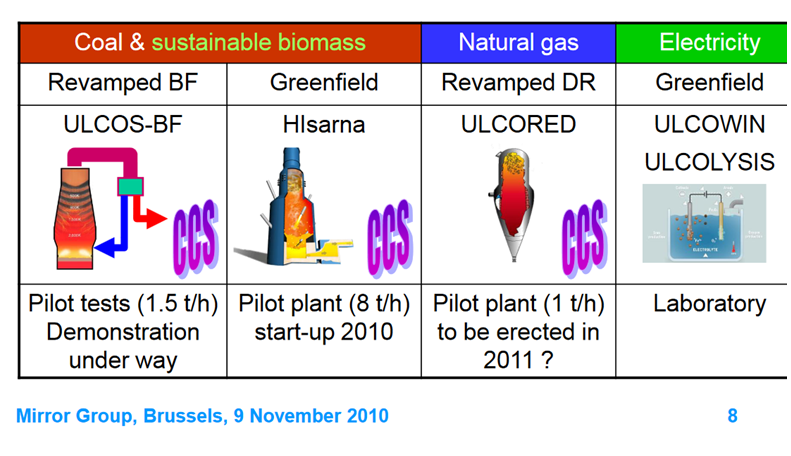
Figure: page 8 reference 025
erc-online.eu › wp-content › uploads › 2014/0
http://erc-online.eu/wp-content/uploads/2014/04/2011-00612-E.pdf
(Power Point)
——————
025.01 European Commission: Climate strategies and targets. 2017.
The EU has set itself targets to progressively reduce its greenhouse gas emissions up to 2050.
Key climate and energy targets are set in the:
2020 climate and energy package
2030 climate and energy framework
The EU tracks its progress on cutting emissions through regular monitoring and reporting. Before proposing new policies, the Commission carefully assesses their potential impacts.
https://ec.europa.eu/clima/policies/strategies_en
——————-
025.02 In oposite side
It will take decades to produce green steel in Asia — BHP
Halina Yermolenko 03.12.2022
About 72% of steelmaking facilities under construction in the world are blast furnaces
According to the Australian mining giant BHP, it will take decades to produce environmentally friendly steel on an industrial scale. South China Morning Post writes about it.
It is currently unprofitable for steelmakers in the region to invest in direct reduction iron (DRI) plants using hydrogen, as the operating blast furnaces are relatively “young”. The average age of blast furnaces in China is 12 years, in India – 18 years, says BHP development director Johan van Jaarsveld.
Johan van Jaarsveld. BHP development director
“The adoption of hydrogen in steel making – the replacement of blast furnace iron with direct reduced iron – is something possible in the future. However, we don’t think that is something that is going to happen in material quantities in this part of the world for another few decades. The reason is just costs,” he noted.
According to the Post, BHP chief development officer Johan van Jaarsveld said that the age of the fleet — the average Chinese blast furnace is 12 years old — makes it difficult to justify the cost of building new direct reduced iron plants.
https://gmk.center/en/news/it-will-take-decades-to-produce-green-steel-in-asia-bhp/
——————
026 ArcelorMittal Carbon Reduction Projects Receive EU Financial Support. 19.05.2020
The European Investment Bank is loaning ArcelorMittal 75M € in support of two capital projects aimed at reducing carbon emissions:
The European Investment Bank (EIB), with the support of the European Commission, has granted a 75M € loan to ArcelorMittal for the construction of two ground-breaking projects at ArcelorMittal Ghent, Belgium, to considerably reduce carbon emissions by converting waste and by-products into valuable new products, helping to develop low-carbon steelmaking technologies, in line with the EU’s climate objectives
Details of the projects include:
– Steelanol: 165M € industrial-scale demonstration plant that will capture waste gases from the blast furnace, and biologically convert them into recycled-carbonethanol, the first commercial product of ArcelorMittal’s Carbalyst® family of recycled carbon chemicals.
The ethanol produced can be blended for use as a liquid fuel. The technology was developed by LanzaTech, with whom ArcelorMittal has entered a long-term partnership, together with Primetals and E4tech.
The project is expected to be completed in 2022.
ArcelorMittal inaugurates flagship carbon capture and utilisation project at its steel plant in Ghent, Belgium
08.12.2022
The €200 million ‘Steelanol’ project is a first of its kind for the European steel industry. Utilising cutting edge carbon recycling technology developed by our project partner LanzaTech, the CCU plant uses biocatalysts to transform carbon-rich waste gases from the steelmaking process and from waste biomass into advanced ethanol, which can then be used as a building block to produce a variety of chemical products including transport fuels, paints, plastics, clothing and even cosmetic perfume, hence helping to support the decarbonisation efforts of the chemical sector. The advanced ethanol will be jointly marketed by ArcelorMittal and LanzaTech under the Carbalyst® brand name
Once production reaches full capacity the Steelanol plant will produce 80 million litres of advanced ethanol, almost half of the total current advanced ethanol demand for fuel mixing in Belgium. It will reduce annual carbon emissions from the Ghent plant by 125,000 tonnes. Other partners involved in the Steelanol project are Primetals Technologies and E4tech.
-Carbalyst®, also known as Steelanol: Captures carbon off-gases from the blast furnace and converts into recycled carbon ethanol
– Torero: 50M € large-scale demonstration plant to convert waste wood into bio-coal, partially replacing the coal currently injected into the blast furnace.
In the early stage, the Torero plant will be able to convert up to 60,000 tonnes of waste wood into around 40,000 tonnes of bio-coal every year.
This volume will be doubled in a second stage of the project, after the start of the first Torero reactor.
“With (the European Investment Bank) and the European Commission’s support, we can scale up technologies and transition steel to carbon neutrality, and thereby play a significant role in helping Europe achieve its green ambitions.”
https://www.torrcoal.com/ Biocoal
————
027 ArcelorMittal Europe sets out path to net zero by 2050, with pioneering technologies at the forefront of the company’s roadmap for carbon-neutral steelmaking.
( Very Complete information ) 25.06.2020
From Lakshmi Arcelor-Mittal :
“Steel will remain a vital material for our world and indeed is the most circular of all materials. Our challenge is to be able to make steel using clean energy technologies on a commercial scale, while remaining competitive in the global steelindustry,” .
The future of steel manufacturing
https://corporate.arcelormittal.com/smarter-future/steel-manufacturing
————
028 Carbon emissions reduction roadmap: 30% by 2030 and carbon neutral by 2050 (see and download pdf road technical map )
https://corporate.arcelormittal.com/sustainability/climate-action-in-europe
Today, primary (iron-ore based) steel production relies on fossil fuel-based energy sources that emit CO2. We recognise the vital need to transition to clean energy to be carbon neutral.
Climate Action in Europe Our carbon emissions reduction roadmap: 30% by 2030 and carbon neutral by 2050.
A practical guide to a prosperous, low carbon in Europe. An initiative of the European Climate Foundation (ECF).
(Copy and paste)
https://corporate-media.arcelormittal.com/media/yw1gnzfo/climate-action-in-europe.pdf
First way
This transition to clean energy will be in the form of:
1) Clean electricity.
2) Circular carbon.
3) Carbon capture and storage (CCS).
Alone, each of these three clean energies can in theory be carbon neutral. But the reality is that the scale of investment in the infrastructure that will deliver clean electricity, circular carbon and CCS is different, and the availability and access to them varies. As a result, we will use different combinations of these three clean energies to reach carbon neutrality. This means we can move faster to reduce our CO2 emissions. And where we deploy circular carbon technology, not only will we produce carbon-neutral steel, we could also put steelmaking at the heart of the circular economy by avoiding CO2 emissions from other industries: we will create recycled carbon materials to replace polyethylene-based plastics. And, through creating a carbon-neutral primary production process, we could generate carbon-neutral slag (a direct substitute for cement).
1.- Clean electricity is a carbon-neutral energy that comes from sources such as solar and wind energy, that do not emit CO2.
For the steel industry, clean electricity can be used by extracting hydrogen from electrolysis of water. This hydrogen is then used to reduce iron ore into iron.
While innovations should drive costs down, the timetable remains unclear and it is likely to be decades before clean electricity and hydrogen are available on a scale and cost that would benefit the steel industry. If the European steel industry fully switched to clean electricity today, this would imply a 15% increase in power consumption. The energy infrastructure investment needed to move the entire European steel industry to clean electricity via hydrogen would be 450-700 € billons.
2.- Circular carbon means we can achieve carbon neutrality by relying on the earth’s natural carbon cycle and making use of biowaste materials, such as sustainable forestry and agriculture residues, to produce bioenergy for steelmaking.
Additionally, using waste plastics as the source of energy, in combination with our carbon capture and use technology, we can convert carbon that would otherwise be emitted as CO2, into hydrocarbon liquids (ethanol) or solids (plastics).
This creates a carbon-neutral, circular carbon cycle while addressing society’s waste challenge with plastics. If the European steel industry switched to using bioenergy, around 200-250 million tonnes of biomass and waste would be needed each year.
Additionally, the steel industry would be producing up to 30% of today’s plastic needs in a carbon – neutral way. Although today it is not technically possible to make a complete shift to bioenergy, the investment in a clean energy system to transition the entire European steel industry to bioenergy is estimated at 50-70 € billons.
3.- Carbon capture and storage (CCS) technology captures CO2, transports it and stores it safely underground. Avoiding emissions from fossil fuels renders industrial processes such as steelmaking carbon neutral.
The North Sea basin alone is estimated to have up to 300,000 mt of CO2 storage capacity. Longer term, combining CCS with circular carbon can move the industry beyond carbon neutrality, turning the steel industry into an agent to remove CO2 from the atmosphere.
If the entire European steel industry became carbon neutral through CCS, we estimate 150-200 million tonnes of CO2 transport and storage would be needed annually, needing investment of 100-150 € billons in clean energy infrastructura.
A complete description of this First way can be seen in page 4 of pdf. Ref 028
——————–
029 The stepwise project :
STEPWISE is a project executed within the European H2020 LCE program. It has received funding from the European Union’s Horizon 2020 research and innovation programme under grant agreement No. 640769. The project aims at the demonstration of advanced pre-combustion CO2 removal technology within the framework of the Iron and Steel industry, aiming at lowering the CO2 footprint of steel production. 05.09.2017
Includes:
Project : Why, How, Work packages, Pilot plant.
Sorption Enhanced Water-Gas Shift (SEWGS) technology,(SEWGS)
https://www.youtube.com/watch?v=7_xbe-EMyRc&t=14s (VIDEO)
Process integration in Iron and Steel ( Lawrence Hooney , Swerea MEFOS)
The advanced pre-combustion CO2 removal is effectuated by the Sorption Enhanced Water-Gas Shift (SEWGS) technology. This is a solid adsorption technology for CO2 capture from fuel gases in combination with water-gas shift and acid gas removal. The main objectives of the proposed STEPWISE project is to scale up the SEWGS technology for the CO2 capture from Blast Furnace Gas (BFG) with three overall demonstration goals in comparison to state-of-the-art technologies:
Partners
Publications and Conference Contributions: Downloadable 18
https://www.stepwise.eu/publications/
——————–
029.01 Carbon capture in the steel industry: ArcelorMittal, Mitsubishi Heavy Industries Engineering, BHP and Mitsubishi Development sign collaboration agreement. 27.10.2022
The agreement, which involves a trial at ArcelorMittal’s steel plant in Gent, Belgium and another site in North America, brings together the expertise of the various partners in identifying ways to enhance carbon capture and utilisation and/or storage (CCUS) technologies in the hard-to-abate steelmaking industry. The industry is estimated to account for around seven-to-nine per cent of global greenhouse gas (GHG) emissions. CCUS has the potential to be a key technology for reducing emissions from existing global blast furnaces, which are anticipated to remain a significant portion of steel production over coming decades. The IEA estimates CCUS technology needs to apply to more than 53 per cent of primary steel production by 2050, equivalent to 700 Mtpa of CO2, for the Net Zero Emissions scenario………
———————
Specific Bibliographic References
030 Recent advances in carbon emissions reduction: policies, technologies, monitoring, assessment and modeling
Donald Huisingh, Zhihu Zhang, John C. Moore, Qi Qiao, Qi Li.
Journal of Cleaner Production ,Volume 103, 15 September 2015, Pages 1-12.
https://www.sciencedirect.com/science/article/pii/S0959652615004734
———-
031 Sustainable Iron and Steel Making Systems Integrated with Carbon Sequestration.
Zhou Xiaozhou.
Earth and Environmental engineering
PhD. Columbia University. These Doctoral, April 17, 2015
https://academiccommons.columbia.edu/doi/10.7916/D8XW4HQH
——–
032 Study of CO2 emissions in China’s iron and steel industry based on economic input–output life cycle assessment.
Li Li, Yalin Lei, Dongyang Pan.
Nat Hazards , 81, 2, March 2016, 957 – 970
https://link.springer.com/article/10.1007/s11069-015-2114-y
———
033 A bottom-up analysis of China’s iron and steel industrial energy consumption and CO2 emissions.
Wenying Chen, Xiang Yin, Ding Ma.
Applied Energy, 136, 31 December 2014, 1174 – 1183
https://www.sciencedirect.com/science/article/abs/pii/S0306261914005765
————-
033.01 Tenova 03.03.2022
ENERGIRON® Largest Hydrogen-Based DRI Facility in China.
A hydrogen-based 1,000,000 ton/year ENERGIRON® direct reduction (DR) plant will reduce carbon dioxide emission for a sustainable steel industry.
Castellanza, March 03, 2022 – Sinosteel Engineering & Technology Co., Ltd., located in Beijing, China, has recently contracted Tenova, a leading developer and provider of sustainable solutions for the green transition of the metals industry, for the design and supply of a hydrogen-based 1,000,000 tonnes/year ENERGIRON® direct reduction (DR) plant.
The plant will be installed at Baosteel Zhanjiang Iron & Steel Co., Ltd, located in the Zhanjiang Economic and Technological Zone, Guangdong Province, China. The plant capacity of 1,000,000 ton/year will make it the largest hydrogen-based DRI facility in China.
The new ENERGIRON® plant will use mainly hydrogen as reducing gas with the possibility to mix it with Natural Gas (NG) and Coke Oven Gas (COG) .The plant has in fact the flexibility to use different reducing gases in any combination or proportion, using the same ENERGIRON® ZR scheme.
https://tenova.com/newsroom/press-releases/energironr-largest-hydrogen-based-dri-facility-china
ENERGIRON R
SteelOrbis
Second hydrogen-based DRI plant to be installed in China
25 July 2022
The plant to be installed will annually produce one million mt of DRI by using natural gas, coke-oven gas and hydrogen. Baosteel Zhanjiang will be the largest hydrogen- based DRI plant in China and in the world, capable of lowering carbon dioxide emissions thanks to the extensive use of hydrogen and the intrinsic capacity of Energiron® DRI plants to capture the carbon generated by the reduction process. The DRI plant is scheduled to be commissioned by the beginning of 2024.
https://www.steelorbis.com/steel-news/latest-news/second-hydrogen-based-dri-plant-to-be-installed-in-china-1253415.htm
——————–
034 Impacts of Environmental Policy in China’s Beijing-Tianjin-Hebei Region: A Case Study of the Iron and Steel Industry
Danielle L. Wilson.
B.S. Environmental Engineering Tufts University, 2012. Pages 1 – 96
Submitted to the Institute for Data, Systems, and Society in partial fulfillment of the requirements for the degree of:
Master of Science in Technology and Policy at the Massachusetts Institute of Technology. June 2017.
This thesis focuses on the drivers of regional development and environmental control decisions in the iron and steel industry in the Beijing-Tianjin-Hebei region of China. The analysis presented includes 1) a county-level econometric analysis of the geographic distribution of the iron and steel industry between 2004 and 2009 in Hebei province and 2) a firm-level case study that analyzes the value of a flexible space option for a hypothetical, relocated steel plant that faces uncertainty in the timing and stringency of future environmental policy.
Download :
https://dspace.mit.edu › handle › 1031848936-MIT
————
035 Assessment of the carbon emissions reduction potential of China’s iron and steel industry based on a simulation analysis.
Zhaoling Li, Hancheng Dai, Junnian Song, Lu Sun, Yong Geng, Keyu Lu, Tatsuya Hanaoka.
Energy, 183, 15 Sept. 2019, 279 – 290
This study provides a feasible approach for decreasing the carbon emissions of China’s iron and steel industry (ISI) by 2030 using the environmental-economic simulation model. The ISI and its upstream industries are optimized by introducing both technological upgrades and environmental policies.
https://www.sciencedirect.com/science/article/abs/pii/S0360544219312319?via%3Dihub
————–
036 General Vision for Reduction of Energy Consumption and CO2 Emissions from the Steel Industry. Special Issue: Challenges and Prospects of Steelmaking Towards the Year 2050.
Lauri Holappa
Metals Vol. 10, 9, 19 August 2020, pag 1117.
Excellent review about CO2 emissions from the Steel Industry and its reduction. (Bibliographic references 100, downloadable directly via Web).
The 2018 IPCC (The Intergovernmental Panel on Climate Change’s) report defined the goal to limit global warming to 1.5 °C by 2050. This will require “rapid and far-reaching transitions in land, energy, industry, buildings, transport, and cities”. The challenge falls on all sectors, especially energy production and industry. In this regard, the recent progress and future challenges of greenhouse gas emissions and energy supply are first briefly introduced. Then, the current situation of the steel industry is presented. Steel production is predicted to grow by 25–30% by 2050. The dominant iron-making route, blast furnace (BF), especially, is an energy-intensive process based on fossil fuel consumption; the steel sector is thus responsible for about 7% of all anthropogenic CO2 emissions. In order to take up the 2050 challenge, emissions should see significant cuts. Correspondingly, specific emissions (t CO2/t steel) should be radically decreased. Several large research programs in big steelmaking countries and the EU have been carried out over the last 10–15 years or are ongoing. All plausible measures to decrease CO2 emissions were explored here based on the published literature. The essential results are discussed and concluded. The specific emissions of “world steel” are currently at 1.8 t CO2/t steel. Improved energy efficiency by modernizing plants and adopting best available technologies in all process stages could decrease the emissions by 15–20%. Further reductions towards 1.0 t CO2/t steel level are achievable via novel technologies like top gas recycling in BF, oxygen BF, and maximal replacement of coke by biomass. These processes are, however, waiting for substantive industrialization. Generally, substituting hydrogen for carbon in reductants and fuels like natural gas and coke gas can decrease CO2 emissions remarkably. The same holds for direct reduction processes (DRI), which have spread recently, exceeding 100 Mt annual capacity. More radical cut is possible via CO2 capture and storage (CCS). The technology is well-known in the oil industry; and potential applications in other sectors, including the steel industry, are being explored. While this might be a real solution in propitious circumstances, it is hardly universally applicable in the long run. More auspicious is the concept that aims at utilizing captured carbon in the production of chemicals, food, or fuels e.g., methanol (CCU, CCUS). The basic idea is smart, but in the early phase of its application, the high energy-consumption and costs are disincentives. The potential of hydrogen as a fuel and reductant is well-known, but it has a supporting role in iron metallurgy. In the current fight against climate warming, H2 has come into the “limelight” as a reductant, fuel, and energy storage. The hydrogen economy concept contains both production, storage, distribution, and uses. In ironmaking, several research programs have been launched for hydrogen production and reduction of iron oxides. Another global trend is the transfer from fossil fuel to electricity. “Green” electricity generation and hydrogen will be firmly linked together. The electrification of steel production is emphasized upon in this paper as the recycled scrap is estimated to grow from the 30% level to 50% by 2050. Finally, in this review, all means to reduce specific CO2 emissions have been summarized. By thorough modernization of production facilities and energy systems and by adopting new pioneering methods, “world steel” could reach the level of 0.4–0.5 t CO2/t steel and thus reduce two-thirds of current annual emissions.
Download
https://www.mdpi.com/2075-4701/10/9/1117
———-
037 Society, Materials, and the Environment: The Case of Steel. Special Issue: Challenges and Prospects of Steelmaking Towards the Year 2050.
Jean – Pierre Birat
Metals ,Vol. 10, 3, 2 March 2020, pag 331.
This paper reviews the relationship between the production of steel and the environment as it stands today. It deals with raw material issues (availability, scarcity), energy resources, and generation of by-products, i.e., the circular economy, the anthropogenic iron mine, and the energy transition. The paper also deals with emissions to air (dust, Particulate Matter, heavy metals, Persistant Organics Pollutants), water, and soil, i.e., with toxicity, ecotoxicity, epidemiology, and health issues, but also greenhouse gas emissions, i.e., climate change. The loss of biodiversity is also mentioned. All these topics are analyzed with historical hindsight and the present understanding of their physics and chemistry is discussed, stressing areas where knowledge is still lacking. In the face of all these issues, technological solutions were sought to alleviate their effects: many areas are presently satisfactorily handled (the circular economy—a historical’ practice in the case of steel, energy conservation, air/water/soil emissions) and in line with present environmental regulations; on the other hand, there are important hanging issues, such as the generation of mine tailings (and tailings dam failures), the emissions of greenhouse gases (the steel industry plans to become carbon-neutral by 2050, at least in the EU), and the emission of fine PM, which WHO correlates with premature deaths. Moreover, present regulatory levels of emissions will necessarily become much stricter.
Download
https://www.mdpi.com/2075-4701/10/3/331
———–
038 Special Issue «Challenges and Prospects of Steelmaking Towards the Year 2050»
Special Issue Editor Prof. Lauri Holappa
A special issue of :Metals (ISSN 2075-4701), (31 May 2020)
Bibliographic References: 10 Downloadable directly
Interest : fundamentals of metallurgical processes; sustainability in steel production; converter processes; clean steel production; inclusion engineering; Tundish metallurgy; slag chemistry
This themed Issue aims to review the present situation of steel production, energy consumption, and CO2 emissions. The potential methods to decrease CO2 emissions in current processes via improved energy and materials efficiency, increasing recycling, and utilizing alternative energy sources are considered. Development programs for current and novel innovative processes as well as trends of alternative energy sources are surveyed. Additionally, the role of steel as an integral part of the global circular economy should be discussed. As a whole, the target of this Issue is to give a holistic overview of the current situation and challenges, and a comprehensive cross-section of the potential technologies and solutions for the global CO2 emissions problem.
https://www.mdpi.com/journal/metals/special_issues/metal_steelmaking
——————–
039 Clean Ironmaking and Steelmaking Processes
Efficient Technologies for Greenhouse Emissions Abatement
Dr. Pasquale Cavaliere
Verlag: Springer International Publishing ,2019
ISBN: 978-3-030-21208-7
Presents the most recent technological solutions in productivity analyses and dangerous emissions control and reduction in steelmaking plants.
https://www.springer.com/gp/book/9783030212087
————————–
039.01 INDUSTRY EUROPE
New CO2 conversion project turns steel emissions into e-fuels
Steven Gislam 8.02.2022
Californian electrofuels company Infinium is teaming up with French energy giant Engie on a project that is set to convert hundreds of thousands of tonnes of CO2 emissions from steel production into clean electrofuels for European aviation and shipping.
The new Reuze CO2 conversion facility will be located in Dunkirk, France and one of the largest of its kind in Europe.
https://corporate.arcelormittal.com/climate-action/decarbonisation-technologies/the-3d-project-dmx-demonstration-in-dunkirk
The electrolyser system is designed to neutralise 300,000 tonnes of carbon emissions per year from local ArcelorMittal steelmaking operations.
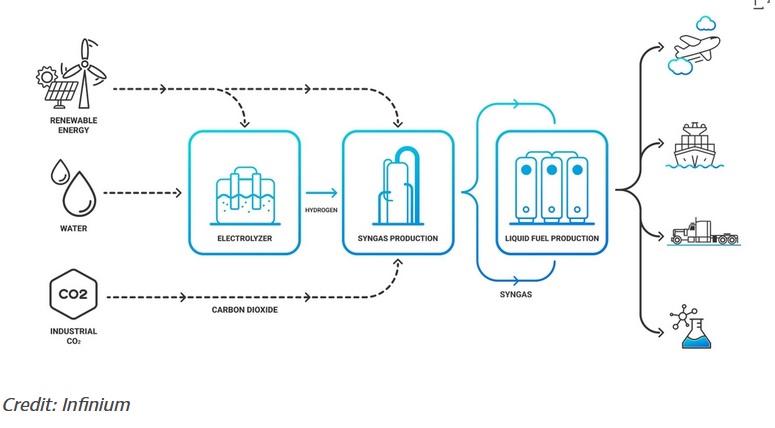
https://industryeurope.com/sectors/energy-utilities/new-co2-conversion-project-turns-steel-emissions-into-e-fuel/
———————–
———————–
3.2- Direct Reduction in solid phase (Blast Furnace and Direct Reduction Iron DRI )
Despite everything stated above, and what is noted below and given that 75% of global steel production continues to be the BF-BOF route, and this will continue for many years despite the efforts made due to to the enormous CO2 emissions, in all currently existing facilities.
We must consider now the efforts made to reduce CO2 emissions in the blast furnace.
Below I will point out some of them, among which are the injection of hydrogen through the BF tuyeres as well as other procedures in order to always reduce the amount of harmful greenhouse gases produced in this process.
Note:
Some of the concepts that appear in this section may have been mentioned previously, since this section is actually an application to the case of the Blast Furnace and Direct Reduction Processes (DRI), previously mentioned.
In the case of Blast Furnace the CO2 content of the top gas is raised by replacing the air in the blast furnace with oxygen and recycling the top gas. Lowers coke requirements.
In the case of DRI processes, based on natural gas, reuses off-gases from the shaft furnace as a reducing agent after CO2 capture.
Research and Development for Global Warming Prevention.
040 The COURSE50 Project: (Technological Development and Innovative Steelmaking Process)
¨CO2 Ultimate Reduction in Steelmaking Process by Innovative Technology for Cool Earth 50 (COURSE 2050) Project” which is aimed at developing dramatically new CO2 reduction technology. Its goal is to develop technology to reduce CO2 emissions in the steelmaking process by 30% through technology that reduces iron ore using hydrogen amplified coke oven gas to curb CO2 emissions from blast furnaces.
Very interesting in order to know modifications in conventional ironmaking processes, in order to reduce CO2 emissions:
Includes:
-The COURSE50 Project (Technological Development and Innovative Steelmaking Process)
-Technology development to sequester CO2 as useful substance
-Development of a new hydrogen production process, which contributes to reduction in CO2 emissions
-From “Creation of Sea Forests” to “Blue Carbon”
-New coke furnace at Nagoya Works using the next-generation coke-making technology (“SCOPE 21”)
https://www.nipponsteel.com/en/csr/env/warming/future.html
—————–
041 Prospects for Future Radical Change: Hydrogen use. – Possibility of Hydrogen Reduction in Iron-making Process (Course 50: CO2 Ultimate Reduction in Steel-making process by Innovative Technology for Cool Earth 50. Programs in Japan)
Authors: Matsuzaki, Shinroku; Higuchi, Kenichi; Shinotake, Akihiko; Saito., Koji.
42º Seminário de Redução de Minério de Ferro e Matérias-primas / 13º Seminário Brasileiro de Minério de Ferro / 6th International Congress on the Science and Technology of Ironmaking — vol. 6, nº 6, (2012), pp 977 – 983.
COURSE50 project, consisting of two major research activities.
One is development of technology to reduce CO2 emissions from blast furnaces, involving with 1) Development of reaction control technology to reduce iron ore by using hydrogen, 2) Reforming technology of Coke Oven Gas (COG) that increases the amount of hydrogen produced and 3) Technology to manufacture high-strength and high-reactivity coke for hydrogen-reduction blast furnaces.
The other is development of technology to separate and recover CO2, involving with development of a high-efficiency CO2 absorption method and technology to utilize unused waste heat in steelmaking plants for CO2 separation and recovery

Environmentally Harmonized Steelmaking Process Technology Development “COURSE50”: Structure and Features
Download :
Very interesting in order to know modifications in conventional ironmaking processes, in order to reduce CO2 emissions:
A complete description of this modification to the conventional process can be seen in :
042 Sustainable Aspects of CO2 Ultimate Reduction in the Steelmaking Process (COURSE50 Project), Part 1:Hydrogen Reduction in the Blast Furnace
Koki Nishioka, Yutaka Ujisawa, Shigeaki Tonomura, Natsuo Ishiwata, Peter Sikstrom.
J. Sustain. Metall. Vol 2., (23 May 2016), pag. 200–208 (download).
AND
043 Sustainable Aspects of Ultimate Reduction of CO2 in the Steelmaking Process (COURSE50 Project), Part 2: CO2 Capture.
Masami Onoda, Yoichi Matsuzaki, Firoz A. Chowdhury, Hidetaka Yamada, Kazuya Goto, Shigeaki Tonomura.
J.of Sustain Metall. Vol 2., (14 June 2016), pag. 209–215.
https://link.springer.com/article/10.1007/s40831-016-0067-3
——————-
043.01 SMS group
Paul Wurth and the steel partners Dillinger and Saarstahl join forces on development of dry reforming technology
The dry reforming process allows the conversion of coke oven gas into a hot reducing gas or syngas that is injected in the blast furnace at tuyere or shaft level. The mixture of coke oven gas and blast furnace gas is compressed and heated-up in a regenerative heat exchanger of similar design than a traditional hot stove. At high temperature, the methane contained in the coke oven gas will react with the CO2 contained in the blast furnace gas to produce hydrogen and carbon monoxide.
The injection of this hot reducing gas into the blast furnace entails a significant reduction in coke consumption. Such use of steelmaking gases for metallurgical purposes rather than for thermal purposes, translates into a significant reduction in CO2 emissions of up to 12%. The use of hydrogen can further improve and almost double the CO2 saving potential.
043.02 Bulletin H2
Ethan Mandel 29.04.2021
Paul Wurth, Saarstahl and Dillinger strengthen cooperation on H2Syngas
The cooperation agreement will help Paul Wurth to test the dry reforming process under industrial-like conditions, supporting the development of the new technology.
See at the same time the item 053 about Syngas in the Midrex Process
Paul Wurth (a part of SMS Group) has joined the H2Syngas project, a joint project of Saarstahl and Dillinger, to develop a technology using process gases and significant quantities of hydrogen in the blast furnace process, H2 Bulletin reports.
The first phase of the project will see building a pilot plant to test the dry reforming process on a small scale, which is scheduled to start operating this summer. The Luxembourg Ministry of Economy has awarded Paul Wurth a grant for the pilot project. A further objective of the pilot plant is to test materials and components regarding their suitability for the construction of an industrial-scale plant, which is vital for the selection of refractory materials used in the regenerative heat exchanger.
In the next stage, the process will be further developed to semi-industrial and later to industrial scale with support from public funding by producing larger amounts of hot syngas and inject them at shaft level in one of the two blast furnaces in Dillingen. Elaboration of a blast furnace shaft injection technology is thus part of the dry reforming development. The technology will enable steelmakers to reduce further their carbon emissions which is a step toward carbon-neutral steelmaking.

https://www.h2bulletin.com/paul-wurth-saarstahl-and-dillinger-strengthen-cooperation-on-h2syngas/
———————–
043.03 SMS Group (Brochure)
ACTING ECONOMICALLY GROWING SUSTAINABLY
The ecoplants solutions from SMS,
http://sms-group.us/files/X329E_Acting%20Economically%20-%20Growing%20Sustainably_ecoplants_ES.pdf
————————
043.04 SMS Group Paul Wurth
Stepwise CO2 Reduction. Towards the CO2-friendly blast furnace
Before steelmaking customers decide to opt for a complete changeover in technology, stepwise but substantial reduction of the CO2 footprint can be reached in the short and mid-term by deploying innovative, resource-saving solutions to the existing installed equipment.
Currently, Paul Wurth is extending its offering of technologies designed to gradually reduce CO2 emissions in the classic blast furnace process, thereby creating a sensible balance between ambitious environmental targets and economic constraints. Our “Enhanced Blast Furnace” is capable of substantially reducing the carbon footprint of this established and proven technology.
The primary aim is to achieve the efficient metallurgical use of off-gases – particularly coke oven gas, blast furnace gas and converter gas – from the steel production process. Because of its high calorific value, coke oven gas is a source of energy that has the potential to replace some of the coke used in the blast furnace and thereby save CO2.
One possibility is to inject coke oven gas into the blast furnace via the hot blast tuyeres.
Another possibility is to inject the coke oven gas into the lower shaft of the blast furnace.
As part of this technology, Paul Wurth is working on developing a coke oven gas reforming technology based on reforming and/or partially oxidising the coke oven gas. Paul Wurth is also laboratory testing the transformation of both blast furnace and coke oven gas into a hot synthetic gas by means of a modified hot blast stove based on dry reforming.
https://www.paulwurth.com/en/shaping-the-future/stepwise-co2-reduction/
—————-
043.05 Kobe Steel Ltd.
KOBELCO Group’s CO2 Reduction Solution for Blast Furnace Ironmaking. 16.02.2021
Innovative technology to reduce CO2 emissions from blast furnace operations successfully verified.
Kobe Steel, Ltd. announces that it has successfully demonstrated the technology that can reduce a significant amount of CO2 emissions from blast furnace operations, combining the technologies of Midrex*1) in the engineering business and the blast furnace operation technology in the iron and steel business. This achievement is a result of the integrated efforts of the Kobe Steel Group (also known as the KOBELCO Group) leveraging its diverse businesses. The demonstration test was conducted for a month at a large blast furnace (4,844 m3) of the Kakogawa Works in Hyogo Prefecture, Japan in October 2020.
The quantity of CO2 emissions from the blast furnace is determined by the reducing agent rate (RAR)*2) or the quantity of carbon fuel used in blast furnace ironmaking. In the demonstration test, it was verified that RAR could be stably reduced from 518 kg/tHM (ton hot metal) to 415 kg/tHM by charging a large amount of hot briquetted iron (HBI)*3) produced by the MIDREX® Process*4). The results indicate that this technology can reduce CO2 emissions by approximately 20% compared to a conventional method*5).
The key technologies utilized for this achievement are:
- (1) Technologies of Midrex for HBI manufacturing in the engineering business
- (2) Blast furnace operation technology in the iron and steel business (e.g. advanced pellet production technology, HBI charging technology for blast furnaces, and blast furnace operation technology utilizing AI)
All of these technologies are developed by the KOBELCO Group as generic solution technologies applicable to various blast furnaces.
We will keep improving this CO2 reduction solution technology while further reducing CO2 emissions and achieving lower costs for CO2 reduction. Beyond our own efforts to reduce emissions from our facilities, we will strive to contribute to the acceleration of CO2 reduction through introducing this solution to blast furnaces around the world.
In order to fully understand this improvement process, it is necessary to study the brochure ¨KOBELCO Group’s CO2 Reduction Solution for Blast Furnace Ironmaking¨ Free in (pdf)
Where you can see the Near-Medium Term Management Plan.
Innovative technology to reduce CO2 emissions from blast furnace operations successfully verified.
Key Points of the Announcement:
-Kobe Steel, Ltd. has successfully demonstrated the technology* that can significantly reduce CO2 emissions
from blast furnace (BF) operations, combining the technologies in the engineering business and in the
iron and steel business.
* Verified at the No. 3 blast furnace (4,844㎥) of the Kakogawa Works in Hyogo Prefecture, Japan in October 2020
-This achievement is a result of the integrated efforts of the Kobe Steel Group (also known as the KOBELCO
Group) leveraging its diverse businesses.
Overview of the Technology Demonstrated
1. CO2 emissions significantly reduced from BF operations
(Verified: CO2 emissions reduced by approx. 20% compared to Fiscal Year 2013).
Successfully reduced CO2 emissions from BFs by charging a large amount of HBI*1) produced by Midrex R Process*2) with a significant decrease in RAR*3)
1) HBI (hot briquetted iron):direct reduced iron (DRI) in a briquetted form
2) MIDREX R Process: the leading direct reduced iron (DRI) making process developed by Midrex Technologies, Inc., a Kobe Steel’s wholly owned subsidiary in the U.S.
3) RAR (reducing agent rate): the amount of carbon fuels used as the reductant such as coke and pulverized coal
2. A low-cost CO2 reduction solution
Successfully reduced the use of expensive coke to the world’s lowest level by KOBELCO’s BF operation technologies.
https://www.kobelco.co.jp/english/releases/1207624_15581.html
Kobe Steel to launch “Kobenable Steel” Japan’s first low CO2 blast furnace steel 17.05.2022
Kobe Steel announces today that it will launch “Kobenable Steel” and become Japan’s first* provider of low CO2 blast furnace steel products with significantly reduced CO2 emissions during the blast furnace ironmaking process. The Company plans to start selling the new products this fiscal year.
Kobenable Steel is based on the KOBELCO Group’s CO2 Reduction Solution for Blast Furnace Ironmaking announced on February 16, 2021. It utilizes a technology that can significantly reduce CO2 emissions from the blast furnace, which was demonstrated by charging into the blast furnace at the Company’s production site Kakogawa Works a large amount of HBI produced by the MIDREX® Process in the engineering business.
Kobe Steel plans to launch Kobenable Steel (low CO2 blast furnace steel) in two product categories as shown below.
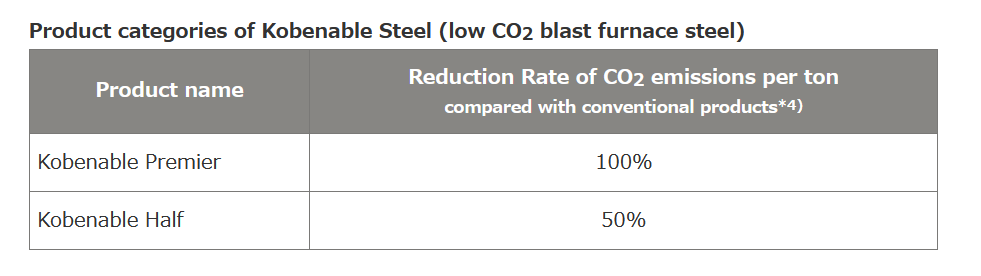
https://www.kobelco.co.jp/english/releases/1210207_15581.html
Japan´s Kobe steel provides low carbon steel to Toyota
And similar articles:
SteelOrbis 06.07.2023
——————–
043.06 Cleveland Cliffs hydrogen injection trial a success.
Steel Times International, Matthew Moggridge 25.05.2023
Cleveland-Cliffs Inc, the largest flat-rolled steel producer in North America, has announced that it has successfully completed a hydrogen (H2) injection trial at its Middletown Works blast furnace in Ohio.
The Cleveland, Ohio-based company has been engaged in what it calls ‘a groundbreaking introduction of hydrogen gas as an iron reducing agent in the blast furnace’. It is claimed to be the first ever use of this carbon friendly technology in the Americas region.
The successful use of hydrogen gas represents a significant step toward the future decarbonization of blast furnaces, which are necessary for the continued service of the most quality-intensive steel applications, particularly for the automotive industry.
During the trial, which was completed on 8 May, 2023, hydrogen gas was injected into all 20 tuyeres at the Middletown 3 blast furnace, facilitating the production of clean pig iron – the foundation of high-end steelmaking. Hydrogen was used as a partial substitute for the coke necessary for iron reduction, ultimately replacing the release of CO2 with the release of H2O (water vapour) with no impact to product quality or operating efficiency. The hydrogen was delivered to the Middletown facility via an existing pipeline and transportation infrastructure in place for the facility’s other hydrogen uses, including for its annealing furnaces.
https://www.steeltimesint.com/news/cleveland-cliffs-hydrogen-injection-trial-a-success
https://www.greencarcongress.com/2023/05/20230509-cliffs.html
———————-
043.06.01 SMS group and Tata Steel join forces to showcase decarbonization technology on industrial scale
EASyMelt (electric-assisted syngas smelter) technology is a cutting-edge metallurgical solution that can be implemented in existing integrated steel plants
The objective is to cut CO2 emissions by more than 50 percent from the blast furnace’s baseline operation
The EASyMelt (electric-assisted syngas smelter) technology is a cutting-edge ironmaking solution that can be implemented in an existing integrated steel plants to accelerate decarbonisation. The core of the technology utilises blast furnace top gas recycling for syngas production through reforming of coke oven gas. The resulting syngas is then injected at both shaft and tuyere level, with the gas injected at the tuyere level further being heated using a plasma torch system.
The EASyMelt concept will be implemented at Tata Steel’s blast furnace E in Jamshedpur, India.
https://www.sms-group.com/en-us/press-and-media/press-releases/press-release-detail/sms-group-and-tata-steel
https://www.tatasteel.com/media/newsroom/press-releases/india/2023/tata-steel-limited-signs-a-mou-with-germany-s-sms-group-to-collaborate-on-decarbonisation-technology/
——————
043.07 JFE Steel Corporation
FOREWORD
HASEGAWA Shinji
General Manager (Executive Assistant)
Ironmaking Technology Dept. JFE Steel
Two major technological trends accompanied by innovation are now the focus of global attention. One of these trends is GX(GreenTransformation).Customers and investors have already begun to select companies around the world based on their efforts to achieve carbon neutrality, which means substantially eliminating greenhouse gas (GHG) emissions
Special Issue on Ironmaking Technology. JFE Technical report nº 28 Sept. 2022
https://www.jfe-steel.co.jp/en/research/report/028/index.html
Continuing with the efforts to eliminate CO2 in conventional processes, without the use of H2, I will point out some interesting work carried out by JFE.
Establishment of Advanced Recycling Technology for Waste Plastics in Blast Furnace
Asanuma Minoru, Kajioka Masahiko, Kuwabara Minoru, Fukumoto Yasuhiro, Terada Kaneo
Special Issue on Ironmaking Technology. JFE Technical report nº 13 May 2019, pp 34 – 40
Abstract:
The establishment of technology for recycling waste plastics is a highly important issue for global environmental conservation and the society. JFE Steel has pursued the effective use of waste plastics as a reducing agent for injection into blast furnaces, and conducted hot model experiments to study the combustion and gasification behaviour of waste plastics. On the basis of this basic investigation, advanced technologies that can further improve the combustion and gasification efficiencyof waste plastics even with low strength has been developed; i.e. in order to improve combustibility of fine waste plastics, technology for simultaneous injection of such plastics with pulverized coal and/or natural gas has been developed. For improved the strength of plas- tics, technology for combined agglomeration of waste plastics with CaCO3 has been developed. In addition, technology for fine crushing of waste plastics has been studied on the basis of new ideas, and this technology has been applied in actual plant operation. These technologies have been successfully applied in actual blast furnaces, contributing to lowering the reducing agent rate
https://www.jfe-steel.co.jp/en/research/report/013/pdf/013-07.pdf
—–
Recent Development of Ironmaking Technology in JFE
Steel toward Carbon Neutrality.
Sato Michitaka, Fukada Kiyoshi, Hasegawa Shinji.
Special Issue on Ironmaking Technology. JFE Technical report nº 28 Sept. 2022. Pp1- 8
Abstract:
Since the last special issue on ironmaking (2008), the business environment surrounding the ironmaking field has dramatically changed. In other words, in addition to developing countermeasures to the soaring price of raw materials due to rise of China and deteriorating a raw materials grade, a countermeasure to the global warming becomes the most urgent issue since the Paris Agreement in 2015.
Against this background, this paper first summarizes the major technological developments; using technology of inexpensive and low grade resources and low RAR (reducing agent rate) technology at a blast furnace, that have been carried out in the fields of blast furnace, sintering, and coke-making of JFE Steel. Lastly, this paper will offer future prospects on the innovative technologies such as ferro coke and carbon recycling blast furnacethat JFE steel is working on to realize the carbon neutrality in the future.
https://www.jfe-steel.co.jp/en/research/report/028/pdf/028-02.pdf
—-
Reduction of CO2 Emissions from Blast Furnace with Carbon Recycling Methane.
Kawashiri Yuki, Nouchi Taihei, Kashihara Yusuke
Special Issue on Ironmaking Technology. JFE Technical report nº 28 Sept. 2022. Pp 9-15
Abstract:
In order to reduce of CO 2 emissions from blast furnace, a carbon recycling blast furnace, in which methane synthesized from CO 2 in the blast furnace gas (CN methane) is used again in the blast furnace, was studied.
As a result of the evaluation by the Rist diagram, it was shown that CN methane reduced CO 2 emission mainly by the following two functions. (1) To decrease direct reduction by increasing the amount of reducing gas. (2) To supply heat by reacting with oxygen in front of the tuyere. In this study, the carbon recycling blast furnace was found to have the possibility of reducing CO 2 emissions by 30 % or more compared with the conventional blast furnace. It was also found that oxygen blowing and heating gas injection from the shaft upper level were effective for maximizing the amount of CN methane injection
https://www.jfe-steel.co.jp/en/research/report/028/pdf/028-03.pdf
—–
Ferro Coke Production and Its Evaluation in Blast Furnace Utilization.
Hirosawa Toshiyuki, Anyashiki Takashi, Sato Michitaka
Special Issue on Ironmaking Technology. JFE Technical report nº 28 Sept. 2022. Pp 16 – 23
Abstract:
In recent years, the reduction of CO 2 emissions and the stable supply of raw materials are two major issues for the steel industry. Low reducing agent operation in the blast furnace is required to reduce CO 2 emissions in ironmaking. In order to achieve this with using low-grade raw materials, ferro coke characterized by high coke reactivity is considered to be useful.
In this paper, the effect of ore ratio on the reactivity and strength of Ferro Coke produced in the laboratory was investigated. The two-dimensional blast furnace model based on the reaction behavior of Ferro Coke and conventional coke were constructed, and the reaction behavior and strength change in the furnace were predicted. Based on these results, the ferro coke production process was established, and the reducing agent ratio wasreduced by using ferro coke in the actual blast furnace
https://www.jfe-steel.co.jp/en/research/report/028/pdf/028-04.pdf
——
JFE Steel Releases Video about Efforts to Achieve Carbon Neutrality
JFE Steel Corporation June 20, 2022
https://www.jfe-steel.co.jp/en/release/2022/220620-1.html
JFE Steel Corporation announced today that it has released a video on the company’s core efforts to achieve carbon neutrality. The video introduces advanced carbon-recycling blast-furnace technology, which JFE Steel is actively developing, using easy-to-understand explanations supported with computer graphics and other video effects.
Very complete:
JFE Environmental Vision 2050 pag 1- 51
https://www.jfe-holdings.co.jp/en/investor/zaimu/g-data/2020/May2021-210525-release01.pdf
———————-
043.07.01 Kobelco Group’s CO2 Reduction Solution for Blast Furnace Ironmaking Enhanced.
Improved technology to reduce CO₂ emissions from blast furnace by 25% successfully demonstrated Kobe Steel Ltd. 17.10.2023
Kobe Steel, Ltd. announces that it has successfully demonstrated a technology that can reduce CO2 emissions by 25% from a large blast furnace.
Significantly exceeding the previous results of the Kobelco Group’s CO2 Reduction Solution for Blast Furnace Ironmaking , announced in February 2021, the new technology has achieved the world’s highest level of CO2 reduction effect among the CO2 reduction methods demonstrated in existing blast furnaces that have been made public so far.
The demonstration test was conducted for approximately two months using a large blast furnace (4,844 m3) at Kakogawa Works from April to June 2023.
The quantity of CO2 emissions from the blast furnace is determined by the reducing agent rate (RAR), namely the quantity of carbon fuel used in the blast furnace.
In the demonstration test, it was verified that RAR could be stably reduced to the world’s lowest level of 386 kg/tHM (ton hot metal) by charging a large amount of hot briquetted iron (HBI) produced by the MIDREX® Process. The results prove that this technology can reduce CO2 emissions by 25% compared to a conventional method . In addition, the world’s lowest level of coke rate (230 kg/tHM) was also achieved in the demonstration test of this technology. As a CO2 reduction solution that draws on existing technologies, it enables stable and early reduction of a large amount of CO2 emissions from commercial large blast furnaces.
The new technology has been developed by taking advantage of our strengths as a company engaged in a diverse range of businesses—exploring further integration and enhancement of our engineering business’s MIDREX technologies and steel business’s blast furnace operation technologies
The key technologies utilized for this demonstration are:
(1) Midrex HBI manufacturing technology in the engineering business
(2) Blast furnace operation technology in the steel business: Advanced HBI charging technology for blast furnaces, AI-based blast furnace operation technology, our Company’s proprietary advanced pellet production technology, and blast control technology
All of these technologies were developed exclusively by the Kobe Steel Group (Kobelco Group), but they are also applicable to other companies’ blast furnaces.
Complete description in
https://www.kobelco.co.jp/english/releases/1214021_15581.html
Environmental Management and Reduction of CO2
https://www.kobelco.co.jp/english/about_kobelco/csr/files/20_environmental_en.pdf
Kobelco Group Integrated Report 2023 (pag 1-59)
Taking on the Challenge of Realizing Carbon Neutrality pag 21, 25-27
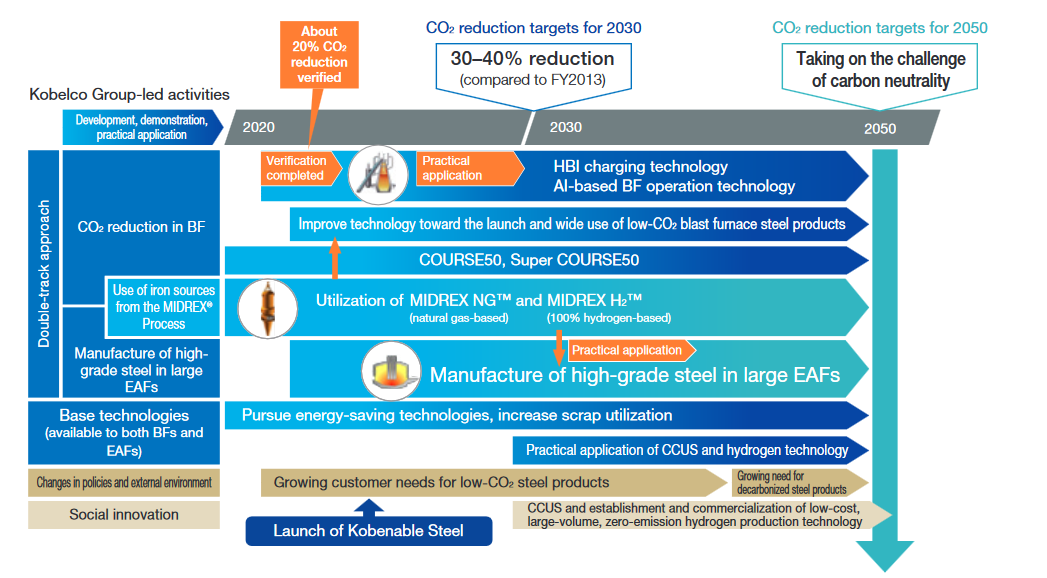
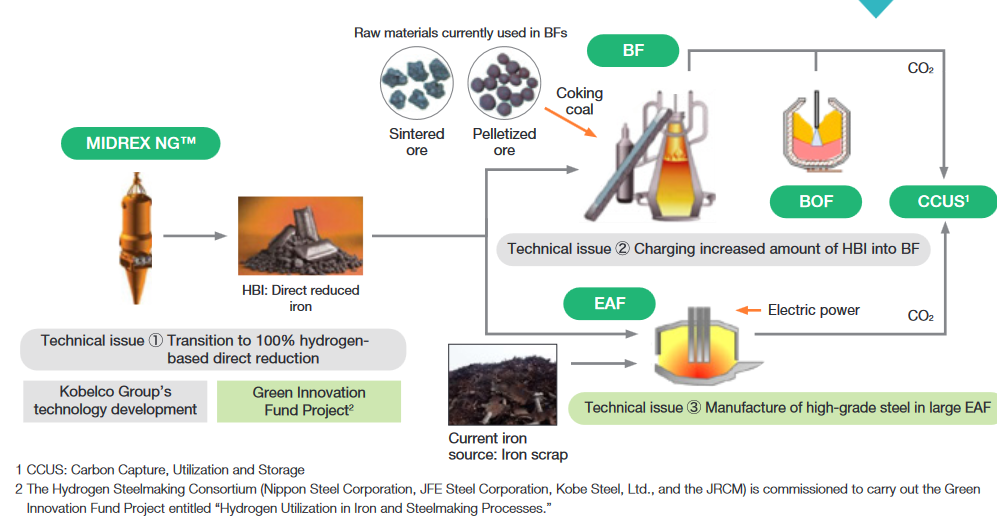
https://www.kobelco.co.jp/english/about_kobelco/outline/integrated-reports/files/integrated-reports2023_e.pdf
—————-
043.06 Primetals Technologies
Near-term emissions re-duction for blast fur-nace operation
(Very interesting in a intermediate step of transition)
The transitional steps towards carbon neutrality.
Colin Morrison Martin Smith Primetals Technologies Ltd.
MetalRussia Magazine, October 2021 pag 1-12
The global challenge faced by all steelmakers to eliminate greenhouse gas (GHG) emissions, reduce raw material and energy consumption in pursuit of carbon neutrality is well documented. The route to achieving this is less clear and will be different for most producers. With around 7-10% of industrial GHG emissions being attributed to the steel industry and 70% of the total global steel production reliant on thermal reduction via the blast furnace /basic oxygen steelmaking route, replacement of carbon-based fuels will be necessary. Hydrogen as a reduction agent is seen as the natural successor.
IMMEDIATE CHALLENGES
CO2 EMISSIONS – MITIGATING MEASURES
THE IMMEDIATE CONCLUSION
Clearly then, the challenge for blast furnace operators to accelerate this transition is immense – but they must continue to produce competitively in the interim. Whilst the task seems daunting, it also presents opportunities where the greatest gains can be made. The blast furnace represents the single highest contributor to the production of GHGs in the process route. As carbon trading markets continue to rapidly develop, operators are facing increasing cost pressure based on their existing footprint.
Many have already declared their own ambitious plans but must act now. The reality remains that there is desperate need for effective technologies to support their roadmap towards carbon neutrality. Implementing technology that can have a significant impact in the blast furnace would represent a major stepping-stone for operators globally.
REDUCING BLAST FURNACE CARBON EMISSIONS
-Reduction with materials and gas
-Reduction with available technology
See complete article
https://www.primetals.com/fileadmin/user_upload/landing_pages/2021/Green_Steel/Publications/downloads/Emission_reduction_BF.pdf
Optimization of integrated steel plants operation using the m.simtop strategic planning platform
Bernd Weiss* – Primetals Technologies GmbH, Turmstr. 44, A–4031, Austria
Stefan Tjaden – KIMET GmbH, Linz, Stahlstr. 14, A–, Austria pp 1-8
https://www.primetals.com/fileadmin/user_upload/landing_pages/2021/Green_Steel/Publications/downloads/OPTIMIZATION_OF_INTEGRATED_STEEL_PLANTS_OPERATION_.pdf
————–
044 ULCOS – TATA STEEL
Development of ULCOS – Blast Furnace:
Working toward technology demonstration.
The ULCOS-BF developments in Europe
Jan van der Stel
IEAGHG (International Environment Agency Green House Gas)/IETS Iron and steel Industry. CCUS and Process Integration 2nd Workshop. Tokyo, Japan 4 – 7 November 2013. Pages 1-45 .
Very complete and graphic demonstration of the Development of ULCOS in the Blast Furnace in Europe.
Includes:
-An integrated steel mill has numerous facilities to come from ore and coal to steel products, and:
-Main CO2 emitters.
-BF (Blast Furnace) main input and outputs
As a consequence :
-ULCOS–Ultra Low CO2 in Ironmaking and Steelmaking
-ULCOS – Process routes
-ULCOS project objective: Modification of the conventional blast furnace to reduce the CO2 emission by 50 % per ton of steel, and how can CO2-emission from the blast furnace be reduced?
-ULCOS Top Gas Recycle Blast Furnace (TGR-BF) concept, development and results.
Download (copy and paste):
www.ieaghg.org › docs › 1050 Jan van der Stel
or Directly:
Development of ULCOS-Blast Furnace – ieaghg
————-
To continue:
045 Developments of the ULCOS Low CO2 Blast Furnace Process at the LKAB Experimental BF in Lule
J.van der Stel, Tata Steel Research, Development and Technology
M.Hattink (Tata Steel RD&T), D. Sert, J. Borlée (ArcelorMittal), A. Hirsch (ThyssenKrupp Steel Europe), M. Zagaria (Riva ), N. Eklund, M. Pettersson, (LKAB ), L. Sundqvist, B.-E. Sköld (MEFOS), C. Feilmayr (Voestalpine), R. Lin, A. Feiterna (Saarstahl – Dillinger Hütte werkke ), M. Grant (Air Liquide), O. Ansseau (CRM), J. Adam (BFI), K. Kinnunen (Rautaruukki Oyj), J . P. Simoes (Paul Wurth) and W. Küttner (Küttner).
METEC INSTEEL.CON, Lean CO2 Ironmaking, Session 5, Düsseldorf, 27 June – 1 July, 2011, pag 1 – 8.
Abstract:
The ULCOS Blast Furnace process (ULCOS-BF) is one of the developments from the European consortium of steel companies, ULCOS, to minimize CO2 emissions in blast furnace ironmaking.
This process is based on the replacement of hot blast by oxygen, the recycling of hot decarbonated top gas into the lower shaft and normal hearth tuyeres, the capture of CO2 and its storage in a geological trap (full CCS Carbon Capture and Storage process).
This paper highlights the main features of this ULCOS-BF process, and the expected benefits for CO2 mitigation. This technology has been demonstrated during two campaigns of 7 weeks by coupling LKAB experimental blast furnace in Lulea to a pilot VPSA ( Vacuum Pressure Swing Adsortion ) unit for CO2-removal. The concept, preparation and results of the campaigns are described. Following the success of these experiments, studies for the construction of a demonstration unit at ArcelorMittal Florange are currently under progress.
Download:
https://europe.arcelormittal.com/sustainability/carbon-neutral
https://www.lkab.com › documents › kund › 2011-de.
————–
IEAGHG
IRON AND STEEL INDUSTRY
046 “Overview to the Current State and Development of CO2 Capture Technologies in the Ironmaking Process”, 2013/TR3, April 2013. Pages 1 – 40.
Stanley Santos, IEAGHG
Download: Copy and paste
https://ieaghg.org/docs/General_Docs/Reports/2013-TR3.pdf
————————
047 ¨Iron and Steel CCS (Carbon Capture and Storage) Study ( Techno – Economics Integrated Steel Mill )¨ Report 2013/04, July 2013, Pages 1 – 642.
(Understanding the Techno-Economics of Deploying CO2 Capture Technologies in an Integrated Steel Mill)
Very Complete and Interesting Report.
This Report describes research sponsored by IEAGHG in collaboration with Swedish Energy Agency, Members of Swerea MEFOS , SSAB, and LKAB. This report was prepared by:
Stanley Santos, IEAGHG
This is a synthesis of the reports submitted by Swerea MEFOS in collaboration with Tata Steel Consulting and SINTEF Materials and Chemistry.
Background:
The iron and steel industry is one of the largest industrial sources of CO2. Globally, it accounts for about 6% of anthropogenic CO2 emissions (approx. 1.2 Gt CO2/year). Currently, two main processes dominate global steel production:
-The integrated steel mill in which steel is made by reducing iron ore in a blast furnace and subsequent processing in a primary steelmaking plant (BF-BOF Route); and
-The mini-mill in which steel is made by melting scrap steel or scrap substitutes in an electric arc furnace (EAF Route).
In 2011, around 1.5 billion tonnes of crude steel are produced worldwide. Roughly, ~69% of the steel produced are from BF-BOF steelmaking route; and ~29% of the steel produced are from recycled scrap using EAF steelmaking route.
Currently, China is responsible for nearly 45% of the steel produced worldwide.
Alternative iron and steel making processes based on direct or smelting reduction technologies – such as COREX, FINEX, DRI, Midrex and many others – are also used to produce steel in various sites worldwide. Several of these technologies are commercially proven; however, they only account for a small share of steel produced globally. It is expected that steel production via BF-BOF and EAF routes would still dominate steel production in several decades to come.
To reduce CO2 emissions from steel mills, one of the leading options being considered by iron and steel stakeholders is CO2 capture and storage (CCS). Development of this technology for application in iron and steel production is still on-going (i.e. ULCOS project, World’s Steel CO2 Breakthrough Programme, etc…).
Download: Copy and paste
https://ieaghg.org/docs/General_Docs/Reports/2013-04.pdf
————–
ALL THE INFORMATION
IEAGHG IEA GREENHOUSE GAS R&D PROGRAMME
048 IEAGHG Funds Research into Carbon Capture and Storage (CCS), also known as CO2 Capture and Storage.
Blogs, Annual Review, Webinars, Information Papers, Upcoming Events and Networking Meetings.
Next Events Now Hosted Virtually 15-18 March 2021, Khalifa University, Abu Dhabi.:
https://ieaghg.org/conferences/2-uncategorised/1051-ccus-related-events-at-cop26
https://ieaghg.org/publications/technical-reports
—————-
049 Process Integration in the Steel Industry
Lawrence Hooey
Graphics about Iron and Steelmaking processes
Contents:
Swerea MEFOS & PRIMSA. Steel Production Routes. Integrated Steelmaking, PI in context, Methods, Industry examples, CO2 ,Industry needs, Conclusions
https://iea-industry.org/app/uploads/process-integration-in-the-steel-industry_final_lh.pdf
—————–
HYL NEWS
050 Improving Performance and Decreasing CO2 Emissions in Blast Furnace Installations Using High Carbon DRI/HBI
Jorge Martínez – Technical Proposals Manager and Pablo Duarte – Commercial VP. May 2017 pages 1-22
https://www.tenova.com/fileadmin/user_upload/HYL_NEWS_May_2017.pdf
—————–
051 Towards sustainable Iron- and steelmaking with economic optimization.
Helle, Hannu (2014-04-04)
Doctor of Technology Thesis, Thermal and Flow Engineering Laboratory. Pages 1-89.
Department of Chemical Engineering, Åbo Akademi University, Finland.
ISBN 978-952-12-3035-6
The iron and steelmaking industry is among the major contributors to the anthropogenic emissions of carbon dioxide in the world. The rising levels of CO2 in the atmosphere and the global concern about the greenhouse effect and climate change have brought about considerable investigations on how to reduce the energy intensity and CO2 emissions of this industrial sector. In this thesis the problem is tackled by mathematical modeling and optimization using three different approaches.
Includes:
Ironmaking and Steelmaking: Global situation, BF–BOF route, Biomass and charcoal utilization in the blast furnace, Carbon dioxide capture and storage in general and in the blast furnace, Alternative ironmaking processes.
Optimization results:
Biomass injection, Blast furnace top gas recycling, Multi-objective optimization of top gas recycling, Nonlinear optimization of top gas recycling conditions, Effect of using Fastmet DRI in blast furnace, Comparison of the models.
Download :
https://www.doria.fi/handle/10024/95726
—————
051.01 Ironmaking With Alternative Reductants (video 19.06.2020).
AIST Association for Iron & Steel Technology https://www.aist.org/home/
There has been an increased focus on the decarbonization of the steel industry worldwide. Several technologies show potential to be vital contributors in the effort to reduce CO2 emissions. With this webinar, the Direct Reduced Ironmaking Technology Committee hopes to educate the industry on these technologies.
Presenter Information:
-Vincent Chevrier, general manager, business development, Midrex Technologies Inc.
-Stefano Maggiolino, president and chief executive officer, Tenova HYL
-Jan van der Stel, manager R&D, Ironmaking, Tata Steel Europe
-Jose Noldin, general manager, Product Development, CSN
Moderators:
Chris Pistorius, Carnegie Mellon University and Zane Voss, CIX Inc.
——————-
Now we will review the reduction in CO2 emissions in direct reduction processes in solid phase (DRI), such is the case of the Midrex and other processes.
————–
052 ULCORED Process
By 360 Editor June 22, 2019
To study carefully:
Here iron is produced directly from iron ore via a reducing gas produced from natural gas. After this the iron is converted into steel using the EAF process.
ULCORED is a direct reduction (DR) process, which produces DRI (direct reduced iron) in a shaft furnace, either from Natural Gas (NG) or from reducing gas obtained by gasification of coal. The process was designed mainly in 2006 by a team led by LKAB, Voest-alpine and MEFOS. Main features of ULCORED process include
– Use of O2 instead of air resulting into an off-gas of nearly 100% CO2 which is required only to be compressed,
– Possibilities to reduce the requirement of NG by 15-20%, and
– Coal, biomass, bio waste gasification and H2 can be used as an alternative to NG.
Concept of ULCORED process involves separating CO2 out of the process gas.
It is characterized by an effort to adopt gas based DRI process to a minimized emission of CO2. The process is based on the utilization of a shifter to convert the CO gas from the shaft furnace to H2 together with a CO2 removal unit.
Download (copy and paste ) ( See Graphics – Very Interesting):
Fig 1 Reducing gas production by partial oxidation.
Fig 2 Flowsheet of ULCORED process based on natural gas.
Fig 3 Integration of coal gasifier with the ULCORED plant.
Fig 4 Flowsheet of ULCORED process based on coal gasification.
https://www.steel-360.com/technology-next/ulcored-process
—————-
053 Direct Reduction Concept for ULCOS a brief introduction.
Peter Sikström LKAB, Performance in Ironmaking, November 2013, Pages 1 – 33.
Very important technically
In this work can see seen a description of each of the procedures, as well as a graphic scheme and pilot plants, of the same:
Contents:
-Introduction
-Todays dominating processes
-Potential for new DR-process
-Proposal for new processes
Natural gas based
Coal based
-Summary
TODAYS DOMINATING PROCESSES
MIDREX process configuration

HYL process configuration
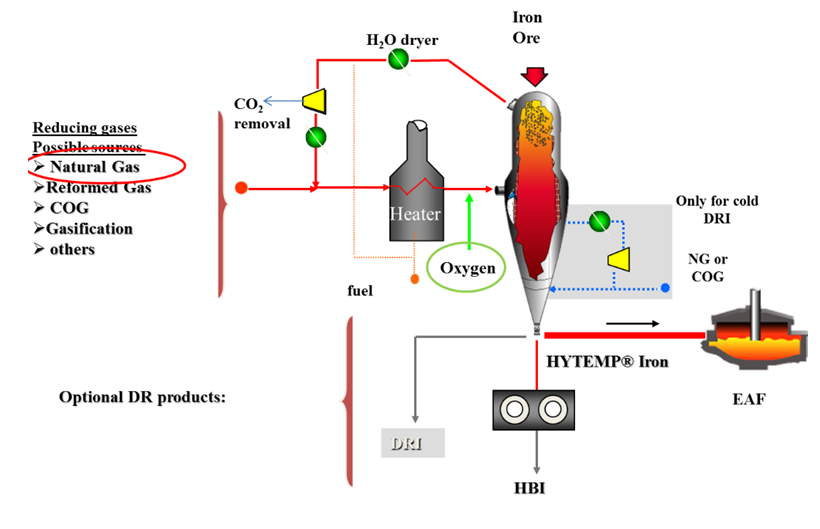
Figures page 4 Reference 053
Potential for new DR-process: Dominating CO2 emissions from DR – EAF route arises from the DR-plant, in this way we use Syngas.
Using of Syngas:
The synthesis gas or syngas is a gaseous fuel obtained from substances rich in carbon (coal, coke, naphtha, biomass) subjected to a chemical process at high temperature. Contains varying amounts of carbon monoxide (CO) and hydrogen (H2), and very often some carbon dioxide (CO2).
It is possible to use:
MIDREX: CO2 reforming: CH4 + CO2+ Heat ↔ 2 CO + 2 H2
-MXCOL: Using Syngas to make DRI in the MIDREX® Process
-MXCOL® can use reducing gas from several sources of syngas: commercial gasifiers using a variety of low cost fuels, export gas from the coal-based COREX® Hot Metal Process by Siemens VAI Metals Technologies GmbH, and the innovative MIDREX® Thermal Reactor System™ (TRS®).
(copy and paste)
https://www.midrex.com/wp-content/uploads/MXCOL.pdf
-HYL : Steam reforming: CH4 + H2O + Heat ↔ CO + 3 H2
-POX : Partial oxidation plant ( Linde ): CH4 + ½ O2 ↔CO + 2 H2+ Heat
The production of synthesis gas, syngas, (a mixture of H2 and CO) through dry reforming of natural gas, means that carbon dioxide (CO2) can be used on an industrial scale as an economical feedstock. The process is also significantly more energy efficient than the conventional method of reforming. The synthesis gas can be used to produce valuable downstream products such as base chemicals or fuels.
Linde develops a new production process for synthesis gas.
Download ( copy and paste )
LKAB:
—————-
MIDREX
054 DRI Production Using Coke Oven Gas (COG): Test Results of Thermal Reactor System™ (TRS®).
Natural gas continues to be the most ideal reducing gas source for the production of direct reduced iron (DRI). However, some areas of the world do not have access to low-cost natural gas in the volumes required for steady, sustained DRI production. For years companies have considered using coke oven gas (COG) to produce DRI. In theory the concept is simple; however, due to the composition of COG, a simple solution has not been readily available.
In June of 2012, Midrex Technologies, Inc. and Praxair, Inc. signed a strategic alliance agreement to develop and market the Thermal Reactor System™ (TRS®), which will allow the production of DRI with a variety of fuels including COG. TRS® will use an innovative partial oxidation technology developed by Praxair to convert hydrocarbon fuels into high quality, high temperature syngas suitable for DRI production in the MIDREX® Direct Reduction Furnace.
This article describes the Thermal Reactor System™ (TRS®) and presents the results of the final phase of development testing involving the operation of a TRS® Demonstration Plant at the Midrex Research & Development Technology Center in Pineville, NC, near Charlotte.
Demonstration Plant at the Midrex Research & Development Technology Center in Pineville, NC, near Charlotte. Pages 1-20
(Copy and paste)
https://www.midrex.com/wp-content/uploads/Midrex_RD_Brochure.pdf
——————-
Below is general information about ULCOS and ULCORED processes from MIDREX.
MIDREX
055 Helping Steelmakers Reduce CO2 Emissions
Present, Transitions, and Future
MIDREX NG (Natural Gas) PRESENT ; NG based DRI + EAF
MIDREX NG (Natural Gas with Hydrogen Additions) NEAR FUTURE (Transitions); NG/H2 based DRI + EAF
MIDREX H2 FUTURE ; H2 DRI + EAF
https://www.midrex.com/technology/midrex-process/midrex-h2/
——————
056 Midrex: Provides a Dependable and Clean Source of Iron to Produce High Grade Steel with Low Emissions.
https://www.midrex.com/technology/midrex-process/
MIXCOL :
Syngas, or synthesis gas, is a gas mixture consisting of hydrogen, carbon monoxide and carbon dioxide resulting from the gasification of a carbon-containing fuel. Midrex commercially offers technology utilizing syngas derived from natural gas and coal sources.
https://www.midrex.com/technology/midrex-process/mxcol/
MIDREX NGTM
Natural gas – the cleanest, greenest ironmaking fuel. Midrex NG is the most widely-used technology for the production of all forms of direct reduced iron (DRI) products because they are known for their reliability and hours of continuous operation. Each year, MIDREX® Plants produce more than 60% of the entire world’s DRI and more than 80% of the DRI produced by all shaft furnace technologies.
https://www.midrex.com/technology/midrex-process/midrex-ng/
(Copy and paste )
https://www.midrex.com/wp-content/uploads/Building_DR_Plants_Brochure.pdf
MIDREX H2 (Future)
The MIDREX® plant is extremely flexible and can accommodate the initial transitions from a carbon to a hydrogen economy.
Estimate:
81,250 Nm3 ( 6,8t ) of hydrogen/per hour for a 1 Millon tons/per year in MIDREX Plant.
Approx. 400 MW of power required for H2 electrolysis.
Information and video:
https://www.midrex.com/technology/midrex-process/midrex-h2/
Impact of Hydrogen DRI on EAF Steelmaking
Dr.Sara Hornby, Prof. Geoff Brooks
Iron &Steel Industry, Jun 2021.
The world steel industry constitutes 8% of the overall energy demand whilst contributing 7% of the total carbon dioxide (CO2) generated by humanity (2.6 GTonne [GTe] CO2 2020; 2.8 GTe CO2 2015) . The great majority of this CO2 generation is due to coal, constituting 75% of the energy used in the steel industry, predominantly in the ironmaking process, where carbon is used chemically to reduce iron oxide and provide fuel for the process. In the case of the Iron Blast Furnace, carbon (in the form of coke) also plays a vital role by providing structure and mechanical support to the bed of materials in the reactor shaft.
WHAT IS MEANT BY GREY, BLUE, AND GREEN HYDROGEN?
Hydrogen is labelled according to the source of underlying energy carrier used to produce the H2 and whether carbon capture and storage (CCS) is employed:
- Grey hydrogen – fossil fuel source with no CCS to remove, store, and stabilize CO2
- Blue hydrogen – fossil fuel source with CCS or electrolysis using non-renewable electricity but at great capital cost for commercially available CCS and H2 generation equipment
- Green hydrogen – water electrolysis using renewable electricity coupled with renewably-sourced electrical energy, which is challenged by the cost and scale of current commercial plants
https://www.midrex.com/tech-article/impact-of-hydrogen-dri-on-eaf-steelmaking/
——————-
056.01 MIDREX H2 – The Road to CO2-free Direct Reduction (Article very interesting).
Robert Millner1, Johannes Rothberger1, Barbara Rammer1, Christian Boehm1, Wolfgang Sterrer1, Hanspeter Ofner1, Vincent Chevrier2
1Primetals Technologies Austria GmbH
2Midrex Technologies Inc.
The iron and steel industry is responsible for a portion of 7-10% of the global CO2 emissions, it has to reduce its CO2
emissions drastically during the next 30 years. The EU target is a reduction of CO2 emissions by 80% until 2050, which can
only be achieved by switching to different iron & steel production processes. This can be either the scrap-EAF route for
certain quality grade steels or the H2 based direct reduction – EAF route for high grade steels. The use of hydrogen sources
in the existing BF-BOF route can only contribute to a small reduction of CO2 emissions, but will not be sufficient to achieve
the CO2 reduction targets. In order to prepare for the future, many steel producers have projected the integration of a direct
reduction plant in their existing steel works in their strategy.

-TECHNO-ECONOMIC ANALYSIS OF THE HYDROGEN DIRECT REDUCTION PROCESS
-Definition of Calculation Basics
Table 1: Main unit cost and typical consumption figures for CASE 1 (base case)
Table 2: Specific hydrogen consumption and requirements for direct reduction.
-Emission reduction potential for hydrogen-based direct reduction processes
Table 3: Cases for direct reduction plant operation
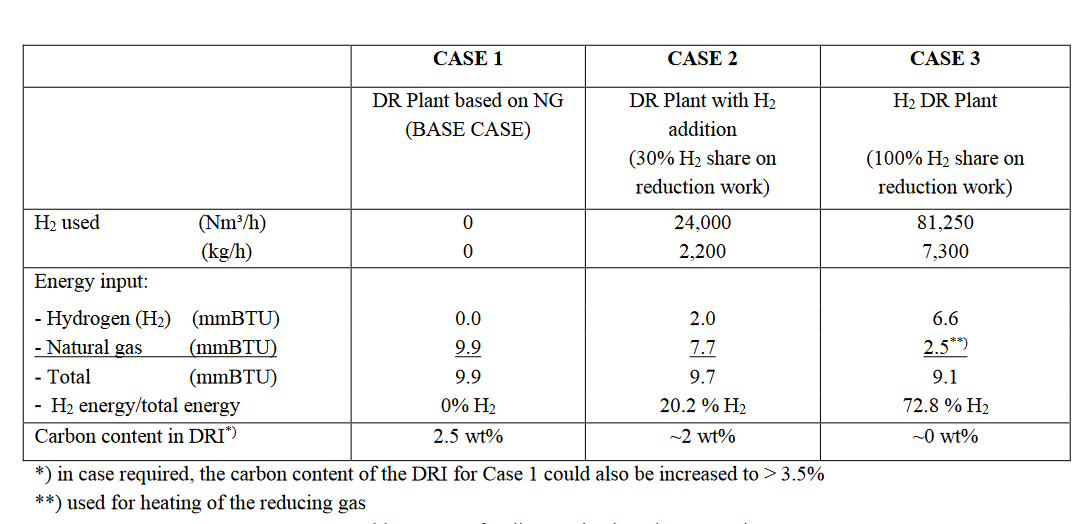
The DRI sector in steelmaking experiences rapid growth and allows for many options in “green” steelmaking. Especially
hydrogen-based reduction as used in the MIDREX H2TM technology is winning support due to the thriving interest in green
technologies.
Natural gas based Midrex plants can be converted in stages to a Midrex H2 plant at low additional expenditure, allowing
steelmakers to reduce CO2 emissions immediately when low-carbon low-cost hydrogen becomes available. New plants are
being built ‘transition-ready’, minimizing stranded asset risk as policies on emission reduction become increasingly strict.
https://www.primetals.com/fileadmin/user_upload/landing_pages/2021/Green_Steel/Publications/downloads/AISTech_2021_MIDREX_H2_Final.pdf
——————-
056.02 Ultra-Low CO2 Ironmaking: Transitioning to the Hydrogen Economy (Article very interesting different steps)
Vincent F. Chevrier, PhD General Manager – Business Development
MIDREX Tech. Article Mars 2020
MOVING TOWARD A HYDROGEN ECONOMY
The Hydrogen Economy is a proposed system of delivering energy using hydrogen. It has been put forth to solve some of the negative effects of using hydrocarbon fuels, which release carbon to the atmosphere as CO2, CO, unburnt hydrocarbons, etc. Proponents of a world-scale Hydrogen Economy argue that hydrogen can be an environmentally cleaner source of energy to end-users without the release of pollutants, such as particulate matter or carbon dioxide at the point of end use. The only emission from using hydrogen as fuel or in fuel cells is water.
IRONMAKING USING HYDROGEN

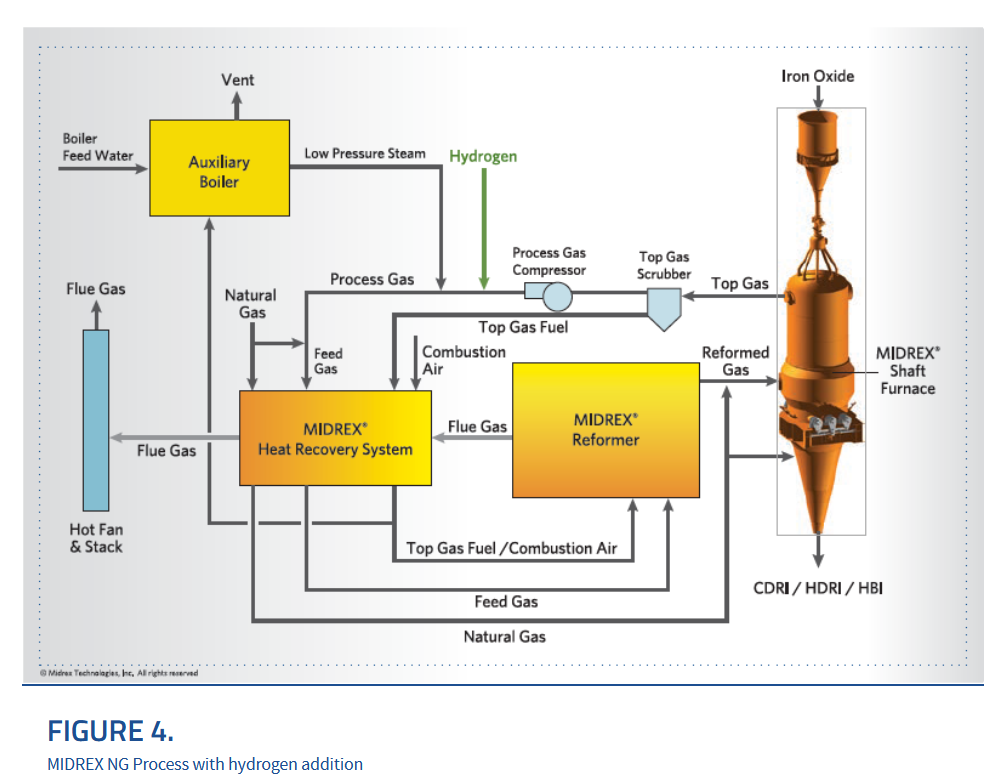

——————–
Specific and Complete Information about ULCORED:
057 ULCORED Process
Satyendra Kumar Sarna
The objective of the ULCORED process was to reduce the NG consumption needed to produce DRI. It was achieved by replacing traditional reforming technology with partial oxidation (POx) of NG. Combined with CCS device, ULCORED can reduce 70 % CO2 emission compared with the average in the BF route.
The concept of the ULCORED process involves separating CO2 out of the process gas. It is characterized by an effort to adopt gas based DR process to a minimized emission of Green-House Gases (GHG), using CO2 capture and storage (CCS) technology and at the same time to a minimized use of energy. The process is designed in a way which allows for the extraction and storage of CO2. The process is therefore also dependent on CCS with a similar in-process capture.
https://www.ispatguru.com/ulcored-process/
https://www.ispatguru.com/about/
——————–
058 ULCORED SP 12 Concept for minimized CO2 emission
K.Knop, M. Halling and E. Burström
Rev. Met. Paris, Vol. 106, N°10 (October 2009), pp. 419-421
Selected papers from 4th ULCOS SEMINAR (Part 2)
Abstract
ULCORED is the concept suggested by SP 12 to meet the demand of reduced CO2 emission using iron ore and gas based direct reduction for steelmaking. The concept includes the use of 100% oxygen, POX (partial oxidation) instead of reformers, shifter for production of CO2 free reduction/excess gas and the reducing agent being either natural gas or syngas from coal/biomass.
https://www.metallurgical-research.org/articles/metal/abs/2009/09/metal09419/metal09419.html
——————-
059 HSC Simulations of coal based DR in ULCORED
L.Bergman and M. Larsson
Rev. Met. Paris, Vol. 106, N°10 (October 2009), pp. 422-428
Selected papers from 4th ULCOS SEMINAR (Part 2)
Abstract
The ULCORED coal based concept is simulated based on the production of syngas using existing coal gasification technology. The shifter gives the option to produce CO2-lean H2 from coal/biomass for in plant use. Large CO2 emissions arise on site from the use of natural gas in heating ovens and from the use of electricity in EAF melting. In the case of these coal based systems, production of “excess gas” to be used as fuel gas in various processes will reduce the CO2 emission for the total site.
https://www.metallurgical-research.org/articles/metal/abs/2009/09/metal09422/metal09422.html
———————-
———————-
3.3-Direct Reduction in liquid phase (Smelting Process)
Maximises the CO2 content of the off-gases through pure oxygen operation, facilitating CO2 capture. Pilot trials currently underway. Avoids the need for coke or sinter.
060 HIsarna
-The HIsarna project testing of an enhanced smelt-reduction technology that could be combined with CCS ( Carbon Capture and storage ).
HIsarnaTM represents a new phase in the global direct smelting development cycle. It is, in essence, a merger between Tata Steel-developed smelt cyclone technology and HIsmeltTM (Rio Tinto) developed bath smelting technology. A pilot plant at IJmuiden, Netherlands with a nominal capacity of 60,000 t/a has been installed.
HIsarna is HISmelt with the addition of a cyclone converter furnace (CCF).
Cyclone Converter Furnace (CCF).
https://www.totalmateria.com/page.aspx?ID=CheckArticle&site=kts&NM=423
This technology is based on smelting and uses considerably less coke. This reduces CO2 emissions. The coke can be replaced by biomass for example.
HIsarna can reduce the CO2 emissions of the steel production by 20 % without CCS ( Carbon Capture and Storage ) by 80% with CCS, provided economic viability of these technolgie.
.
HIsarna see and (copy and paste) :
https://ec.europa.eu/clima/sites/clima/files/docs/0095/tata_steel_en.pdf
Hisarna Process

Smelt reduction vessel (SRV)

——————————
Specific bibliography about Hisarna:
1.- K Meijer(1), C Guenther(2) and R J Dry(3).
(1)Tata Steel, Netherlands, (2) Saarstahl AG, Volklingen, Germany, (3) HIsmelt Corp, Kwinana, Australia.
HIsarna Pilot Plant Project.
http://dl.iran-mavad.com/sell/trans/en/HIsarna%20Pilot%20Plant%20Project.pdf.pdf
2.- Theodore Leczo
HIsmelt Technology : The Future of Ironmaking
Iron and Steel Technology (AIST publisher ), Vol 6, nº 3, 2009, pp. 33-49
https://www.osti.gov/biblio/21176745
3.- Environmental Clean Technologies Ltd.
HIsarna, like Hismelt not a threat to Mamtor, 25 September 2018.
https://ectltd.com.au/hisarna-like-hismelt-not-a-threat-to-mamtor/
4.- Koen Meijer, ULCOS/HIsarna Project Coordinator, R&D Ironmaking, Tata Steel.
Hisarna – Developing a sustainable steel production process. Pages 1-30
( Copy and paste )
5.- Hisarna Experimental Campaigns B and C (HISARNA B and C): Final Report
Koen Meijer, Chris Treadgold, Christiaan Zeilstra, Guus Keilman, Cor Teerhuis, Maarten Ouwehand.
Publications Office of the European Union, 2015 – pag 1-28
6.- Videos
HISarna – A Radical New Steel Making Process at Tata Steel | The Tomorrow Series. 5.10.2020
https://www.youtube.com/watch?v=kdmjrO4sroA
Hisarna: Developing Breakthrough Technology to Meet Climate & Circularity Targets for Steel Industry. #SteelMintWebinars #HIsarna. 24.09.2020
https://www.youtube.com/watch?v=UR-P5mPQG_g
——————-
——————-
3.4.-Biomass as a reducing agent – Can partially substitute coal for biomass, such as charcoal, or others.
061 Achieving carbon-neutral iron and steelmaking in Europe through the deployment of bioenergy with carbon capture and storage.
Hana Mandova, Piera Patrizio, Sylvain Leduc, Jan Kjärstad, Chuan Wang, Elisabeth Wetterlund, Florian Kraxner, William Gale.
Journal of Cleaner Production Volume 218, 1 May 2019, Pages 118-129
( 70 Bibliographic References. Direct access via Web )
(Very good study about the possibilities of using biomass in the EU)
Abstract.
The 30 integrated steel plants operating in the European Union (EU) are among the largest single-point CO2 emitters in the region. The deployment of bioenergy with Carbon Capture and Storage (bio-CCS) could significantly reduce their fossil based CO2 emissions. In detail, the results demonstrate that CO2 emission reduction targets of up to 20% can be met entirely by biomass deployment. A slow CCS technology introduction on top of biomass deployment is expected as the requirement for emission reduction exceeds 20%. Bio-CCS could then be a key technology, particularly in terms of meeting targets above 50%, of CO2 avoidance cost ranging between €60 and €100/ tCO2 at full-scale deployment. The future of bio-CCS and its utilisation on a larger scale would therefore only be viable if such CO2 avoidance cost were to become economically appealing. Small and medium plants in particular, would economically benefit from sharing CO2 pipeline networks. CO2 transport, however, makes a relatively small contribution to the total CO2 avoidance cost. In the future, the role of bio-CCS in the European iron and steelmaking industry will also be influenced by non-economic conditions, such as regulations, public acceptance, realistic CO2 storage capacity, and the progress of other mitigation technologies.
https://www.sciencedirect.com › science › article › pii
http://pure.iiasa.ac.at/id/eprint/15731/1/1-s2.0-S0959652619302720-main.pdf
——————-
061.01 Worldsteel Association
Fact sheet | Biomass in steelmaking
—————————–
062 Possibilities for CO2 emission reduction using biomass in European integrated steel plants
H.Mandova, S. Leduc, C. Wang , E. Wetterlund , P. Patrizio, W. Gale, F. Kraxner
Biomass and Bioenergy, 115, 2018, pages 231-243
Iron and steel plants producing steel via the blast furnace-basic oxygen furnace (BF-BOF) route constitute among the largest single point CO2 emitters within the European Union (EU). As the iron ore reduction process in the blast furnace is fully dependent on carbon mainly supplied by coal and coke, bioenergy is the only renewable that presents a possibility for their partial substitution. Using the BeWhere model, this work optimised the mobilization and use of biomass resources within the EU in order to identify the opportunities that bioenergy can bring to the 30 operating BF-BOF plants……….
http://www.diva-portal.org/smash/get/diva2:1209175/FULLTEXT01.pdf
——————-
063 Economic potential for substitution of fossil fuels with liquefied biomethane in Swedish iron and steel industry – Synergy and competition with other sectors
Johan Ahlström, Jonas Zetterholm, Simon Harvey, Elisabeth Wetterlund, Karin Pettersson.
Energy Conversion and Management 209, April 2020, 112641
In Sweden, the iron and steel industry (ISI) is a major source of greenhouse gas (GHG) emissions. Most of the emissions result from the use of fossil reducing agents. Nevertheless, the use of fossil fuels for other purposes must also be eliminated in order to reach the Swedish emissions reduction targets.
In this study, we investigate the possibility to replace fossil gaseous and liquid fuels used for heating in the ISI, with liquefied biomethane (LBG) produced through gasification of forest residues.
We hypothesize that such utilization of fuels in the Swedish ISI is insufficient to independently drive the development of large-scale LBG production, and that other sectors demanding LBG, e.g., for transportation, can be expected to influence the economic potential for the ISI to switch to LBG. The paper investigates how demand for LBG from other sectors can contribute to, or prevent, a phase-out of fossil fuels used for heating purposes in the ISI under different future energy market scenarios, with additional analysis of the impact of a CO2 emissions charge………
——————-
064 Study of Biomass Utilisation in the Iron Ore Sintering
Lina Kieush, Maksym Yaholnyk, Maksym Boyko, Andrii Koveria, Vladyslav Ihnatenko.
Acta Metallurgica Slovaca 25,(1) June 2019, 55
28 References
Dominating globally and within Ukraine, the blast-furnace practice for iron production requires iron ore sintering preparation wherein the significant amount of fossil fuel is consumed, accompanied by harmful emissions into the environment. Pursuing the purpose to mitigate this negative impact, we address the promising direction of biomass utilisation for a partial replacement of fossil fuels in iron ore sintering. This paper considers the benefits of fossil fuels substitution with biomass, the world practice of biomass utilisation in iron ore sintering and the scope of the biomass energy potential in Ukraine………..
——————–
065 Carbon Allocation in Multi-Product Steel Mills That Co-process Biogenic and Fossil Feedstocks and Adopt Carbon Capture Utilization and Storage Technologies
Maximilian Biermann, Rubén Mocholí Montañés, Fredrik Normann, Filip Johnsson.
Front. Chem. Eng., 09 December 2020
80 References. (Direct access via Web)
This work investigates the effects of carbon allocation on the emission intensities of low-carbon products cogenerated in facilities that co-process biogenic and fossil feedstocks and apply the carbon capture utilization and storage technology. Thus, these plants simultaneously sequester CO2 and synthesize fuels or chemicals. We consider an integrated steel mill that injects biomass into the blast furnace, captures CO2 for storage, and ferments CO into ethanol from the blast furnace gas. We examine two schemes to allocate the CO2 emissions avoided [due to the renewable feedstock share (biomass) and CO2 capture and storage (CCS)] to the products of steel, ethanol, and electricity (generated through the combustion of steel mill waste gases)…….
Renewable Output» (Torero) project for the co-processing of fossil and biogenic feedstocks in the blast furnace (Torero Consortium, 2017), with subsequent fuel synthesis from the steel mill gases (Steelanol Consortium, 2015).
The injection of biomass into the blast furnace has been extensively studied (Mousa et al., 2016; Suopajärvi et al., 2017, Suopajärvi et al., 2018, as has been the application of CCS to steel mill gases (Ho et al., 2013;IEAGHG, 2013; Ramírez-Santos et al., 2018;Sundqvist et al., 2018). Although studies of the life cycle emissions of fuel from steel mill gases have been performed (Ou et al., 2013;Handler et al., 2016), quantification of the renewable content of cogenerated fuel and steel product due to a preceding biomass injection according to the abovementioned allocation principles is unprecedented and explored in detail in this study. …….
https://www.frontiersin.org/articles/10.3389/fceng.2020.596279/full
This article is part of the Research Topic :
————————–
066 Biomass as a Source of Renewable Carbon for Iron and Steelmaking
Terry Norgate, Nawshad Haque, Michael Somervill, Sharif Jahanshahi.
ISIJ International, 52, 8, Jan. 2012, pages 1472-1481.
43 References
Fossil fuel-based carbon is widely used in iron and steelmaking in a number of forms, and the replacement of these materials with renewable carbon derived from biomass is seen as offering the greatest potential to reduce the greenhouse gas footprint of steel production.
Life cycle assessment methodology has been used to estimate the greenhouse gas footprint of charcoal production from biomass, as well as the potential reductions in greenhouse gas emissions from the use of charcoal from biomass in the integrated, mini-mill/EAF and direct smelting steelmaking routes. The results indicated that the use of charcoal in the integrated steelmaking route in likely applications and substitution rates has the potential to reduce the greenhouse gas footprint of steel by 0.69–1.21 t CO2e/t steel (or 31–57%) without any charcoal production by-product (bio-oil and electricity) credits, and by 0.91–1.61 t CO2e/t steel (42–74%) with these by-product credits included.
The corresponding reductions for the mini-mill/EAF and direct smelting routes were 0.028–0.056 t CO2e/t steel (5.5–11%) and 0.34–1.70 t CO2e/t steel (16–80%) without by-product credits, and 0.037–0.075 t CO2e/t steel (7.3–14.7%) and 0.45–2.25 t CO2e/t steel (21–106%) with by-product credits respectively…..
https://www.jstage.jst.go.jp/article/isijinternational/52/8/52_1472/_article/-char/en
https://www.jstage.jst.go.jp/article/isijinternational/52/8/52_1472/_pdf/-char/en (pdf)
——————
066.01 Demonstration of Zero-Coke Operation and Biomass Charcoal Performance Verification in High-Temperature Gasifying and Direct Melting Furnace
Okuyama Keiichi, Watanabe Junya, Kawabata Hidetoshi
Special Issue on Ironmaking Technology. JFE Technical report nº 29 Mar. 2022. Pp 20 – 27
Abstract:
The high-temperature gasifying and direct melting furnace uses coal-derived coke as an auxiliary fuel to melt ash. The performance of biomass charcoal as a substitute for coke was studied using a demonstration facility in Singapore. The results showed that biomass charcoal can successfully be fully substituted for coal-derived coke at comparable consumption rates. A maximum charcoalconsumption ratio of 1.5 was obtained through the evaluation of four different types of biomass charcoal from suppliers across Southeast Asia. This study also found the following minimum requirements for suitable biomass charcoal: Apparent density of more than 0.94 g/cm 3 (dry basis), volatile matter content of less than 7 %wt. (dry basis) and weight per piece of more than 90 g (dry basis). In addition, when two types of charcoal are mixed, it was found that the total consumption rate is no the mean value between the two types of charcoal, but decreased toward the value of the higher performance charcoal. These results represent an encouraging step toward zero-coke operation aimed at carbon neutrality, as well as the diversification of suitable biomass charcoal in order to secure its stable sourcing in the commercial stage.
https://www.jfe-steel.co.jp/en/research/report/029/pdf/029-05.pdf
———————-
066.02 Rio Tinto’s BioIron™ proves successful for low-carbon iron-making.
MELBOURNE, Australia–(BUSINESS WIRE)– Rio Tinto has proven the effectiveness of its low-carbon iron-making process using ores from its mines in Australia in a small-scale pilot plant in Germany, and is now planning the development of a larger-scale pilot plant to further assess its potential to help decarbonise the steel value chain.
The process, known as BioIron™, uses raw biomass instead of metallurgical coal as a reductant and microwave energy to convert Pilbara iron ore to metallic iron in the steelmaking process. BioIron™ has the potential to support near-zero CO2 steel-making, and can result in net negative emissions if linked with carbon capture and storage.
“The results from this initial testing phase show great promise and demonstrate that the BioIron process is well suited to Pilbara iron ore fines. BioIron is just one of the pathways we are developing in our decarbonisation work with our customers, universities and industry to reduce carbon emissions right across the steel value chain.”
University of Nottingham’s partnership with Rio Tinto takes next step towards decarbonising steelmaking
Chris Dodds.
Head of the Department of Chemical and Environmental Engineering at the University of Nottingham
Developed to a commercial scale, has the potential to have an immense impact on decarbonisation within the steel production process.
Over the past 18 months, the university’s research group has been working with Rio Tinto to advance an innovative new technology to deliver low-carbon steel. The process uses sustainable biomass, in place of coking coal, as a reductant and microwave energy to convert Pilbara iron ore to metallic iron in the steelmaking process, providing a potentially cost-effective option to cut industry carbon emissions.
——————–
066.03 TorrCoal (Torrefaction)
TorrCoal once started with a dream. Or better said: with a firm belief. A belief in a process to make the world cleaner and more sustainable: torrefaction. Torrefaction turns wood and agro residuals into bio-carbon, that can replace fossil coal to power industrial installations and petrochemical processes.
TorrCoal believes bio-carbon should replace fossil coal, because it is one of the most polluting energy sources we have. We want to avoid climate-damaging CO2 emissions from fossil fuels. Because the world needs an eco-friendly alternative to energize our industries: torrefaction
https://www.torrcoal.com/
https://www.torrcoal.com/applications-of-torrcoal-technology/
———————–
067 Biomass applications in iron and steel industry: An overview of challenges and opportunities
Elsayed Mousa, Chuan Wang, Johan Riesbeck,
Renewable and Sustainable Energy Reviews, 65, Nov 2016, Pages 1247-1266.
119 References
The iron and steel industry accounts for about 20% of the annual industrial energy utilization. The intensive fossil fuel consumption in steel industry is associated with CO2 emission. In the absence of economically feasible and efficient methods for capture and storage of enormous quantities of CO2 emissions from steel industry, the use of biomass products as a source of energy and reducing agents provides a promising alternative solution for green steel production.
However, the biomass application in iron and steel industry is still limited and it suffers strong competition from fossil fuels. The challenges of biomass usage in steel industry are included technical and economic aspects which required synergy between steelmaking and bioenergy sectors. Although intensive work has been carried out separately, there is a lack of link between these two vital sectors. The present article provides a comprehensive review of recent research progresses which have been conducted on biomass upgrading and analysing the opportunities and obstacles for biomass implementation in iron and steel industry……….
——————-
068 Using Biomass for Pig Iron Production: A Technical, Environmental and Economical Assessment.
G. fick, O. Mirgaux, P.Neau and F. Patisson
Waste and Biomass Valorization, 5, 2014, pages 43–55.
33 References
The classical route for iron- and steel-making today is based on massive use of fossil coal, which is responsible for most of the large CO2 emissions of the steel industry. Biomass, as a renewable carbon resource, is a good candidate to substitute for fossil coal and even partial substitution could lead to a significant reduction in CO2 emissions. Depending on the type of biomass, its processing, and the way it is used in the iron making process, many different scenarios may be considered. Those scenarios should be evaluated and compared from technical, environmental, and economical points of view in order to figure out the best options…….
https://link.springer.com/article/10.1007/s12649-013-9223-1
———————
069 BIOENERGY AND CARBON CAPTURE AND STORAGE
Christopher Consoli
Global CCS Institute 2019 Perspective, pages 1-14
Negative emissions technologies will be needed to meet targets; BECCS is the best option
The evidence makes it clear. CO2 needs to be removed from the atmosphere, known as Carbon Dioxide Removal (CDR), using Negative Emissions Technologies (NETs) to meet global warming targets. BioEnergy with Carbon Capture and Storage (BECCS) is emerging as the best solution to decarbonize emission-intensive industries and sectors and enable negative emissions……..
Copy and paste
https://www.globalccsinstitute.com/wp-content/uploads/2019/03/BECCS-Perspective_FINAL_PDF.pdf
———————
070 Energy saving technologies and mass-thermal network optimization for decarbonized iron and steel industry: A review.
R.Q. Wang, L. Jiang, Y.D. Wang, A.P. Roskilly
Journal of Cleaner Production 274, 20 Nov 2020,122997
228 References
General review of the optimization of energy consumption and its impact on the environment.
https://www.sciencedirect.com/science/article/pii/S0959652620330420
————————
————————
3.5.- Recycling and Circular Economy.
This varies greatly from one country to another
Overall, the United States Environmental Protection Agency (EPA), estimated the recycling of ferrous metals from durable goods (large and small appliances, furniture, and tires) to be 27.8 percent (4.7 million tons) in 2018.
https://www.worldsteel.org/steel-by-topic/sustainability/materiality-assessment/recycling.html
https://europa.eu/european-union/about-eu/agencies/eea_en
Advantage
Steel is a permanent material that can be infinitely recycled and is 100% recyclable without loss of quality.
Steel scrap from lower value can be converted into high value steels by using appropriate processing and metallurgy.
A basic oxygen furnace can be charged with as much as 30% steel scrap.
An electric furnace can be charged with 100% steel scrap.
On average new steel products contain 37% recycled steel.
Today’s steel products become tomorrow’s cans, trains, bridges or buildings.
071 World Steel Recycling in Figures 2014 – 2018,
Bureau of International Recycling. Ferrous Division, pages 1 – 44
https://www.bdsv.org › fileadmin › user_upload › Wo…
(statistics)
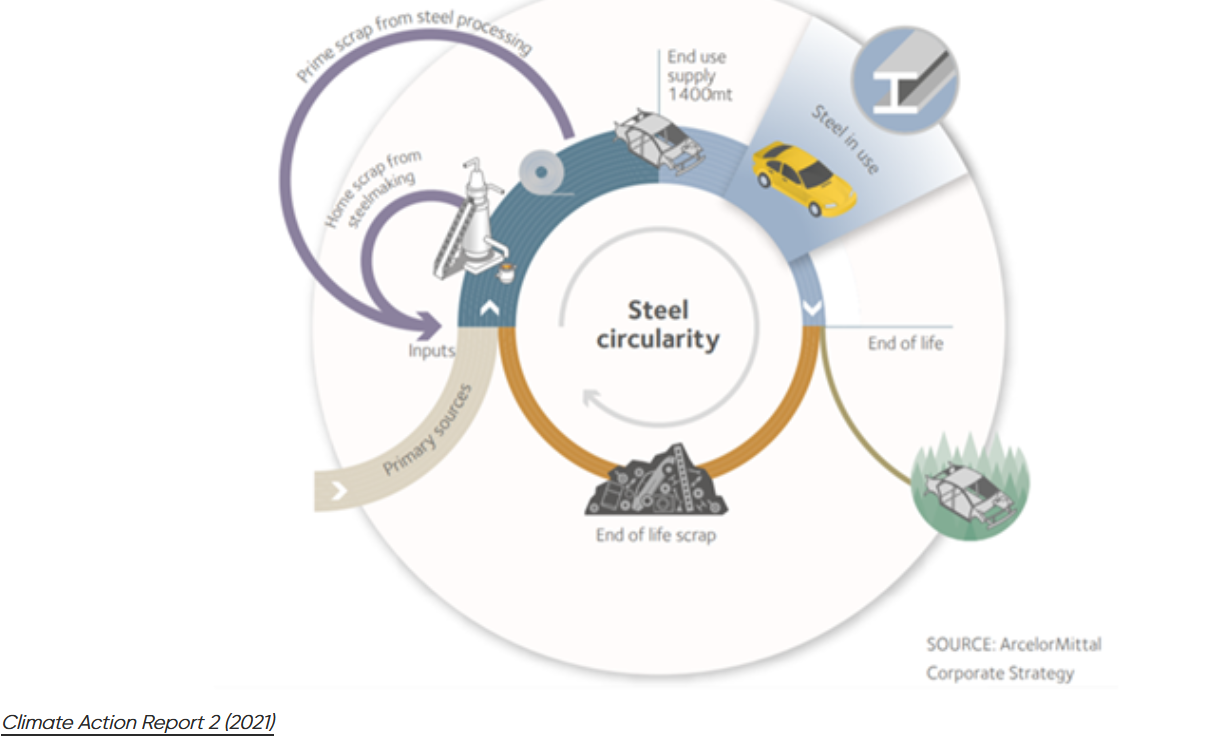
——————
071.01 TMS International
Preserving and Protecting the Environment
TMS International (formerly known as Tube City IMS) leads our industry with a comprehensive and pioneering array of pre- and post-production mill services for global steelmakers. We are experts in on-site services, including scrap purchasing and optimization, inventory management, logistics, metal recovery, slag processing, steel scarfing, surface conditioning, refractory removal and maintenance.
https://www.tmsinternational.com/Services/EPS
https://tmsinternational.com/brochures/TMS_brochure_English.pdf
————————-
072 Others:
(The Steel Recycling Process): See in internet
The process of metal recycling involves four stages. … Scrap metal centres then sell the scrap to larger super collectors where it is shredded and then melted in furnaces at high temperatures to produce blocks, ingots or sheets to be sold to manufacturers of metal products.
(Sustainable in Steel )
https://www.sustainableinsteel.eu/p/536/recycling_example.html
(Steel Recycling Institute)
https://www.steelsustainability.org/recycling
(Worldsteel Association): Scrap use in the steel industry
(Worldsteel Association): Scrap use in the steel industry
https://www.worldsteel.org/en/dam/jcr:2a96b408-325e-4691-ae50-10c43c3a90fd/scrap_vf.pdf (pdf)
(Sustainable Business. Metal recycling)
https://www.thebalancesmb.com/an-introduction-to-metal-recycling-4057469
(ArcelorMittal)
https://corporate.arcelormittal.com/sustainability/our-10-outcomes/resources/recycling-steel
(TATA Steel)
https://www.tatasteeleurope.com/ts/sustainability/circular-economy
(Nucor)
https://assets.ctfassets.net › aax1cfbwhqog › Recycled_…
(Sweden steel Industry)
https://www.jernkontoret.se/en/the-steel-industry/
(Sweden steel Industry)
https://www.jernkontoret.se/en/vision-2050/
(American Iron and Steel Institute)
https://www.steel.org/sustainability/recycling
(Nipon Steel Engineering)
https://www.eng.nipponsteel.com/english/whatwedo/keywords/recycling/
(The Institute of Scrap Recycling Industries, Inc. (ISRI)
(The British Metals Recycling Association)
https://www.recyclemetals.org/
(In the Construction Sector)
https://www.steelconstruction.info/Recycling_and_reuse
(In the Automobile Sector)
https://www.worldautosteel.org/life-cycle-thinking/recycling/
(In the Naval Sector)
https://www.worldshipping.org/industry-issues/environment/recycling-reuse-and-waste-management
(Lidner : Scrap Metal Recycling )
https://www.lindner.com/system-solutions/metalrecycling/light-scrap
————-
073 The impact of climate targets on future steel production – an analysis based on a global energy system model.
Johannes Morfeldt, Wouter Nijs, Semida Silveira
Journal of Cleaner Production, 103, (2015), 469-482
This paper addresses how a global climate target may influence iron and steel production technology deployment and scrap use. A global energy system model, ETSAP-TIAM, was used and a Scrap Availability Assessment Model (SAAM) was developed to analyse the relation between steel demand, recycling and the availability of scrap and their implications for steel production technology choices. Steel production using recycled materials has a continuous growth and is likely to be a major route for steel production in the long run.
https://www.sciencedirect.com/science/article/pii/S0959652614004004
————
074 Innovative methodologies for the utilisation of wastes from metallurgical and allied industries.
Sanjay Kumar, Rakesh Kumar, Amitava Bandopadhyay.
Resources, Conservation and Recycling, 48 , 4, October 2006, 301-314.
53 References
This paper is an overview on the utilisation of solid wastes with focus on blast furnace slag, red mud and fly ash generated in large quantities from iron and steel industry; primary aluminium production and coal fired power plants, respectively…………
———————–
————————
4.- Prospects for Future Radical Change:
4.1- Hydrogen Use as a Reducing Agent.
4.1.1.-Possibility of Hydrogen Reduction in Iron-making Process (Course 50 Programs in Japan)
074.01 Hydrogen (H2)-based ironmaking
Worldsteel Association June 2022 https://worldsteel.org/
The transition to a low-carbon world requires a transformation in the way we manufacture iron and steel. There is no single solution to CO2-free steelmaking, and a broad portfolio of technological options is required, to be deployed alone, or in combination as local circumstances permit. This series of fact sheets describes and explores the status of a number of key technologies and issues.
Items
What is hydrogen-based reduction?
H2 production and use now
H2 in the steel industry now
State of on the ground development
Challenges
Infrastructure
https://worldsteel.org/wp-content/uploads/Fact-sheet-Hydrogen-H2-based-ironmaking.pdf (Copy and paste )
https://www.worldsteel.org/en/dam/jcr:2f02dcdb-9ae8-46e1-ae05-a9797b03d6bd/Hydrogen_vf.pdf (Pdf)
—————
075 Proceedings of the Ironmaking, Iron Ore and Agglomeration Seminars
Authors: Matsuzaki, Shinroku; Higuchi, Kenichi; Shinotake, Akihiko; Saito., Koji.
42º Seminário de Redução de Minério de Ferro e Matérias-primas / 13º Seminário Brasileiro de Minério de Ferro / 6th International Congress on the Science and Technology of Ironmaking — vol. 6, nº 6, (2012), pp 977-983.
Japan’s COURSE 50 project to develop lower-emissions steel production, based on the blast furnace 1) but with several emissions-reducing features to recover gases from the blast furnace to reduce fuel input needs, 2) reform coke oven gas into hydrogen to be used as fuel, and integrate carbon capture. The first phase of testing in an experimental blast furnace was completed in 2017, and the programme is aiming for commercial-scale demonstration by 2030.
—————-
076 The way to a carbon free steelmaking
Axel Sormann, Johannes Schenk, Masab Naseri Seftejani, Daniel Spreitzer
Conference: Multidiciplinary International Conference Advances in Metallurgical Processes and Materials (AdMet), Kiev, Ukrain June 2018.
There are two possibilities to decrease the greenhouse gas emissions from steelmaking processes: Smart Carbon Usage (SCU) and Carbon Direct Avoidance (CDA). The SCU way means mainly process integration with reduced use of carbon and using CO/CO2 from steel plants as raw material (chemical conversion). The CDA way replaces carbon as reducing agent by hydrogen (no CO2 emissions). The use of a hydrogen plasma gives the opportunity to reduce and melt iron oxides in one step (direct steelmaking)……
https://www.researchgate.net/publication/328075380_The_way_to_a_carbon_free_steelmaking
—————
076.01 Worldsteel Association
Hydrogen (H2)-based ironmaking
The transition to a low-carbon world requires a transformation in the way we manufacture iron and steel. There is no single solution to CO2-free steelmaking, and a broad portfolio of technological options is required, to be deployed alone, or in combination as local circumstances permit. This series of fact sheets describes and explores the status of a number of key technologies and issues.
https://www.worldsteel.org/en/dam/jcr:2f02dcdb-9ae8-46e1-ae05-a9797b03d6bd/Hydrogen_vf.pdf (Pdf)
—————–
4.1.2- Blast Furnace and Direct Reduction (DRI) by Hydrogen. ( Solid Phase )
Hydrogen is enjoying a renewed and rapidly growing attention in Europe and around the world. Hydrogen can be used as a feedstock, a fuel or an energy carrier and storage, and has many possible applications across industry, transport, power and buildings sectors. Most importantly, it does not emit CO2 and almost no air pollution when used. It thus offers a solution to decarbonise industrial processes and economic sectors where reducing carbon emissions is both urgent and hard to achieve. All this makes hydrogen essential to support the EU’s commitment to reach carbon neutrality by 2050 and for the global effort to implement the Paris Agreement while working towards zero pollution.
Yet, today, hydrogen represents a modest fraction of the global and EU energy mix, and is still largely produced from fossil fuels, notably from natural gas or from coal, resulting in the release of 70 to 100 million tonnes CO2 annually in the EU. For hydrogen to contribute to climate neutrality, it needs to achieve a far larger scale and its production must become fully decarbonised.
In the past, there have been peaks of interest in hydrogen, but it did not take off. Today, the rapid cost decline of renewable energy, technological developments and the urgency to drastically reduce greenhouse emissions, are opening up new possibilities.
Many indicators signal that we are now close to a tipping point. Every week new investment plans are announced, often at a gigawatt scale. Between November 2019 and March 2020, market analysts increased the list of planned global investments from 3,2 GW to 8,2 GW of electrolysers by 2030 (of which 57% in Europe) and the number of companies joining the International Hydrogen Council has grown from 13 in 2017 to 81 today.
There are many reasons why hydrogen is a key priority to achieve the European Green Deal and Europe’s clean energy transition. Renewable electricity is expected to decarbonise a large share of the EU energy consumption by 2050, but not all of it. Hydrogen has a strong potential to bridge some of this gap, as a vector for renewable energy storage, alongside batteries, and transport, ensuring back up for seasonal variations and connecting production locations to more distant demand centres. In its strategic vision for a climate-neutral EU published in November 2018, the share of hydrogen in Europe’s energy mix is projected to grow from the current less than 2% to 13-14% by 2050. Furthermore, hydrogen can replace fossil fuels in some carbon intensive industrial processes, such as in the steel or chemical sectors, lowering greenhouse gas emissions and further strengthening global competitiveness for those industries. It can offer solutions for hard to abate parts of the transport system, in addition to what can be achieved through electrification and other renewable and low-carbon fuels.
(All the information shown below are very important in order to know the future possibilities and plans of the European Union)
077 CDA (Carbon Direct Avoidance) Steelmaking without carbon (General Overview)
Axel Sormann. Metallurgical Competence Center
The EU Commissions Low Carbon Roadmap suggested a reduction of CO2 emissions of 80 % by 2050 compared to 2005 levels.
The transition towards a competitive low carbon Europe requires the transfer of the energy system, new technologies and large investments in new infrastructure
CDA –Steelmaking without carbon
-Technological pathways to CO2 reduction in Steel
-EU roadmap for a low carbon economy
-CO2 intensity of different production routes
-Process routes for steel production
-Hydrogen Plasma Smelting Reduction (HPSR process)
-H2 generation by PEM electrolysis
https://europa.eu › sinapse › dsp_export_attachement
—————–
European Commission :
078 Powering a climate-neutral economy: Commission sets out plans for the energy system of the future and clean hydrogen.
Press reléase Brussels, 8 July 2020
To become climate-neutral by 2050, Europe needs to transform its energy system, which accounts for 75% of the EU’s greenhouse gas emissions. The EU strategies for energy system integration and hydrogen, adopted today, will pave the way towards a more efficient and interconnected energy sector, driven by the twin goals of a cleaner planet and a stronger economy.
The two strategies present a new clean energy investment agenda, in line with the Commission’s Next Generation EU recovery package and the European Green Deal. The planned investments have the potential to stimulate the economic recovery from the coronavirus crisis. They create European jobs and boost our leadership and competitiveness in strategic industries, which are crucial to Europe’s resilience.
Download Full Report:
https://ec.europa.eu/commission/presscorner/detail/en/IP_20_1259
And proposals, question and answer, factsheet and contacts about :
1-EU Energy System Integration Strategy
Hydrogen strategy
In an integrated energy system, hydrogen can support the decarbonisation of industry, transport, power generation and buildings across Europe. The EU Hydrogen Strategy addresses how to transform this potential into reality, through investments, regulation, market creation and research and innovation.
Hydrogen can power sectors that are not suitable for electrification and provide storage to balance variable renewable energy flows, but this can only be achieved with coordinated action between the public and private sector, at EU level. The priority is to develop renewable hydrogen, produced using mainly wind and solar energy. However, in the short and medium term other forms of low-carbon hydrogen are needed to rapidly reduce emissions and support the development of a viable market.
This gradual transition will require a phased approach:
-From 2020 to 2024, we will support the installation of at least 6 gigawatts of renewable hydrogen electrolysers in the EU, and the production of up to one million tonnes of renewable hydrogen.
-From 2025 to 2030, hydrogen needs to become an intrinsic part of our integrated energy system, with at least 40 gigawatts of renewable hydrogen electrolysers and the production of up to ten million tonnes of renewable hydrogen in the EU.
-From 2030 to 2050, renewable hydrogen technologies should reach maturity and be deployed at large scale across all hard-to-decarbonise sectors.
A complete study of Energy System Integration Strategy and Hydrogen Strategy in the European Union can be seen in the following reports of the EU.
Download Full Reports:
A hydrogen strategy for a climate-neutral Europe. COM/2020/301 8 July 2020
https://knowledge4policy.ec.europa.eu/publication/communication-com2020301-hydrogen-strategy-climate-neutral-europe_en
Questions and answers: An EU Strategy for Energy System Integration. 8 July 2020
https://ec.europa.eu/commission/presscorner/detail/en/qanda_20_1258
Questions and answers: A Hydrogen Strategy for a climate neutral Europe. 8 July 2020
https://ec.europa.eu/commission/presscorner/detail/en/qanda_20_1257
Factsheet: EU Energy System Integration Strategy. 8 July 2020
https://ec.europa.eu/commission/presscorner/detail/en/fs_20_1295
Factsheet: EU Hydrogen Strategy. 8 July 2020
https://ec.europa.eu/commission/presscorner/detail/en/fs_20_1296
Factsheet: European Clean Hydrogen Alliance. 8 July 2020
https://ec.europa.eu/commission/presscorner/detail/en/fs_20_1297
———————-
European Commission:
079 A hydrogen strategy for a climate-neutral Europe
Communication from the Commission to the European Parliament, the Council, the European Economic and Social Committee and the Committee of the Regions. Brussels, 8.07.2020 – COM (2020) 301 final.
(Very important in order to know the future possibilities and plans of the European Union)
—————-
080 Europe’s steel industry at a crossroads:
The steel industry must change its production technology to meet the new environmental standards, and to make huge investments to reach Europe’s environmental targets.
Focus
Roland Berger 04.2020
Download Full Report :
https://www.rolandberger.com/en/Publications/Europe%27s-steel-industry-at-a-crossroads.html
Authors:
Akio Ito Senior Partner, Bernhard Langefeld Partner, Nicolas Götz Senior Consultant, Ambroise Lecat Partner, Gareth Hayes Partner, Youye Chen Principal.
The future of steelmaking – How the European steel industry can achieve carbon neutrality
According to these authors and experts:
Conventional steel production is one of Europe’s biggest sources of CO2 emissions. The continent’s steel industry currently contributes approximately 4% of total European CO2 emissions, and 22% of industrial CO2 emissions. It is under growing public, economic and regulatory pressure to become carbon neutral by 2050, in line with EU targets. About 60% of European steel is produced via the so-called primary route, an efficient but highly carbon-intensive production method. The industry already uses carbon mitigation techniques, but these are insufficient to significantly reduce or eliminate carbon emissions. The development and implementation of new technologies is underway.
With limited investment cycles left until the 2050 deadline, the European steelmaking industry must decide on which new technology to invest in within the next 5-10 years. We assess the most promising emerging technologies in this report. They fall into two main categories: carbon capture, use and/or storage (CCUS), and alternative reduction of iron ore. CCUS processes can be readily integrated into existing steel plants, but cannot alone achieve carbon neutrality. If biomass is used in place of fossil fuels in the steelmaking process, CCUS can result in a negative carbon balance.
Alternative reduction technologies include hydrogen-based direct reduction processes and electrolytic reduction methods. Most are not well developed and require huge amounts of green energy, but they hold the promise of carbon-neutral steelmaking.
One alternative reduction process, H2-based shaft furnace direct reduction, offers particular promise due to its emissions-reduction potential and state of readiness. It is the technology that we envisage steelmakers will pursue in order to achieve carbon neutrality. H2-based shaft furnace direct reduction is ready to use and can be introduced step-by-step into brownfield plants. This ensures operational continuity and reduced emissions during the transition from conventional steelmaking methods.
A full transition is only achievable through high CAPEX ( Capital Expenditure) and a plentiful supply of green electricity. To switch the approximately 30 million tons per annum of steel produced via the primary route in Germany to H2-based shaft furnace direct reduction would require estimated capital expenditure of about EUR 30 billons at current prices. In addition, electricity production of 120 TWh per annum would be required, a figure roughly equal to half the amount of green electricity Germany produced in 2019. Political support is therefore vital if the European steel industry is to achieve carbon neutrality. Without it, large parts of the steelmaking value chain may move abroad.
The financial costs of realizing carbon-neutral steelmaking are undeniably huge. However, with a shift in market conditions brought about by having the right policies in place, European steelmakers will be able to unlock the means to reduce emissions from steel globally, while also ensuring the European steel industry remains competitive.
In this report :
1.-The climate challenge facing european steelmakers
2.-Cutting Carbon: The most promising new technologies are compared
Emerging technological solutions designed to reduce or eliminate carbon emissions from the steelmaking process can be divided into two distinct categories:
A.- Carbon capture, use and/or storage; CCUS, (items 2.1, 2.2 )
B.- Alternative reduction of iron ore; (items 2.3 to 2.7 )
In this work can see seen a description of each of the procedures, as well as a graphic scheme and pilot plants, of the same:
2.1 / Carbon capture, use and/or storage; (CCUS)
2.2 / Biomass-based ironmaking with CCUS
2.3 / H2-based direct reduced iron – Shaft furnace
2.4 / H2-based direct reduced iron – Fluidized bed
2.5 / Suspension ironmaking
2.6 / Plasma direct steel production
2.7 / Electrolytic processes
3.- Recommendations and conclusions
https://www.rolandberger.com/en/Publications/Europe%27s-steel-industry-at-a-crossroads.html
——————-
EUROFER : The European Steel Association
081 Successful implementation of bold new 2030 climate target urgently needs tangible framework:
(Very important 081 and 082 in order to know the future possibilities and plans of the European Union Steelmakers)
In this web page can be seen the general targets in:
-European policy in climate change.
-Videos
-Publicatios and issues about :
Climate change and energy.
Environment.
Circular economy.
EUROFER
European Steel Manifesto 2019-2024
With the EU elections having taken place in May 2019, Europe is setting new priories and direction for the future. As an industry at the heart of the EU economy, the European steel industry is saying to policy makers: we need to innovate, trade, sustain and upskill to ensure a prosperous future for Europe and its citizens.
In the light of slowing demand, both generally and specifically for steel, persistently high global overcapacity of 550 million tonnes – 25% of global production capacity – high and volatile raw material and carbon prices, and surging imports, the European steel industry is facing potential crisis.
This manifesto sets out the footprint and importance of European steel to the EU economy, and explains why we need to make the industry more innovative, skilled and sustainable while also ensuring there is a robust trade policy that defends the sector against the challenges posed by overcapacity and trade surges.
https://www.eurofer.eu/publications/brochures-booklets-and-factsheets/european-steel-2019-2024
Manifesto Pdf pag 1-4 (very interesting)
https://www.eurofer.eu/assets/Uploads/20190514_Eurofer_Manifesto-A4-2.pdf
Low-CO2 emissions projects in the EU steel industry
Overview including emissions abatement potential, financing and energy needs
Climate and Energy:
https://www.eurofer.eu/issues/climate-and-energy
European Map :
https://www.eurofer.eu/issues/climate-and-energy/maps-of-key-low-carbon-steel-projects
Map: Pdf pag 1
https://www.eurofer.eu/assets/Maps/eurofer-low-carbon-projects-map.pdf
A Green Deal on Steel
Europe has the opportunity before it to lead the transformation of its economy to a future in which it is carbon-lean, environmentally responsible, circular and able to compete internationally. Steel is central to the EU economy, and it underpins the development of major manufacturing sectors right along the value chain.
European steel’s transition to carbon-lean, ‘green’ steel requires a fundamental change in the way steel is made, because our current processes are already at the technical and thermodynamic limits.
The breakthrough technologies that we need mean using hydrogen and renewable electricity to produce steel; they also mean capturing and either storing or using carbon that is emitted to bring the environmental footprint of our production as close to zero as possible.
The technical demands are enormous: our sector alone will require 400 terawatt hours of renewable electricity, of which 250 terawatt hours for the production of 5.5 million tonnes of hydrogen. This is the same as the current electricity demand of Germany, and this quantity will be needed every year from 2050 at the latest.
VIDEO
https://www.eurofer.eu/issues/climate-and-energy/a-green-deal-on-steel
—————-
082 Climate Change & The Steel Industry A Proposal for A Sector Approach (EUROPEAN UNION
Moving towards Zero-Emission Steel (Very important)
Technologies Available, Prospects, Timeline and Costs
Policy Department for Economic, Scientific and Quality of Life Policies
Directorate-General for Internal Policies
Authors: Liliana GUEVARA OPINSKA, Marwa MAHMOUD, Csinszka BENE, and Koen RADEMAEKERS, Trinomics
PE 695.484- December 2021 pag 1 – 48
Abstract
This study is assessing the European steel industry’s possibledecarbonisation pathways in ligh t of the European Commission’,“Fit for 55” package, by evaluating available technology optionsand the adequacy of available funding streams. The paper shows that options based solely on existing production processes have limited potential to achieve the requiredemission reductions. Full decarbonisation options will require the widespread availability of green electricity, hydrogen and/or CCS/CCUS infrastructure. It is important that flexibility in the choice of technology decarbonisation options is maintained to account for differences in regional characteristics including natural resources and infrastructure.
This document was providedby the Policy Department for Economic, Scientific and Quality of Life Policies at the request of the committee on Industry, Research and Energy (ITRE)
https://www.europarl.europa.eu/RegData/etudes/STUD/2021/695484/IPOL_STU(2021)695484_EN.pdf (copy and paste)
On the path to a climate-neutral Europe by 2050
https://ec.europa.eu/clima/sites/clima/files/docs/0067/4g_en (copy and paste)
Making Europe the first climate-neutral continent in the world is a binding commitment under the EU Climate Law.
We set out proposals in July 2021 to make all sectors of the EU economy fit to meet this challenge, starting by reducing emissions by at least 55% by the end of this decade. The ‘Fit for 55’ legislation, now fully adopted, sets the EU on a path to reach its climate targets by 2030 in a fair, cost effective and competitive way.
This comes ahead of the crucial COP28 UN Climate Conference, and next year’s European elections. It also shows that Europe is delivering on its promises made to citizens and international partners to lead the way on climate action and shape the green transition for the benefit of citizens and industries.
Climate Action :
https://climate.ec.europa.eu/index_en (copy and paste)
Climate action highlights of 2023
https://climate.ec.europa.eu/news-your-voice/news/climate-action-highlights-2023-2023-12-21_en (copy and paste)
European Climate Pact
https://climate-pact.europa.eu/index_en (copy and paste)
————————
In the same way:
082.01 Germany’s National Hydrogen Strategy:
Sören Amelang
Journalism for the energy transition 17.07. 2020
In the fight against climate change, hydrogen made with renewable electricity is increasingly seen as a silver bullet for sectors with particularly stubborn emissions, such as heavy industry and aviation. Germany has set out to become a global leader in the associated hydrogen technologies, and the government has penned a National Hydrogen Strategy to fulfil these ambitions. This factsheet summarises the strategy, which was approved by government on Wednesday 10 June.2020.
https://www.cleanenergywire.org/factsheets/germanys-national-hydrogen-strategy
Complete pdf in :
082.01 Climate Change & The Steel Industry A Proposal for A Sector Approach
Dr Paul Brooks
Director, Environment, Corus
Representing Eurofer
Climate Change:
A Global Challenge Requires a Global Response
Steel Industry Progress in Reducing CO2 Emmisions
https://ec.europa.eu/clima/sites/clima/files/docs/0067/4g_en.pdf
—————————
The German Federal Government Full Plan :
https://www.bmbf.de/files/bmwi_Nationale%20Wasserstoffstrategie_Eng_s01.pdf
Engagement :
German government agrees on national hydrogen strategy.
Frank Jordans, Associated Press 10.06.2020
The German government agreed Wednesday on a long-term strategy for increasing production and use of hydrogen as part of a plan to cut the country’s greenhouse gas emissions.
While hydrogen is currently produced almost exclusively from fossil fuels, the government wants to encourage its production from excess electricity generated by renewable energy sources.
Experts say this so-called green hydrogen could help smooth out the problem of solar and wind power’s fluctuating supply, and replace fossil fuels in industrial processes that require high temperatures such as steel making.
The government plans to invest 9 billion euros ($10.2 billion) to promote hydrogen production and use, including 2 billion euros that will go toward projects in developing countries such as Morocco.
German Federal Government to Provide €55 Million for ArcelorMittal’s Hydrogen DRI Plant 7 Sept 2021
https://www.midrex.com/company-news/german-federal-government-to-provide-e55-million-for-arcelormittals-hydrogen-dri-plant/
———————
083 French Government agrees on national hydrogen strategy.
Plan for the Introduction of Hydrogen by the French Government in Order to Minimize Carbon Dioxide Emissions.
Le Monde: Friday 4 September 2020
Like the German government, the French government has included research and development on the use of hydrogen as an energy source within the future industrial renewal plan.
France plans to convert to hydrogen as an alternative energy source for reducing carbon monoxide, similar to what the German government has done, which has allocated 9 billion euros for a 10-year plan. Within the economic relaunch chart presented on Thursday, September 3, 2020 by the French Prime Minister, the government plans an investment of 2 billion euros to investigate this energy in the course of the next two years.
This indicates of course the importance that is attached by the French government to this aspect since we are at the doors, if not already within itself ,of a new industrial revolution in which the sources of energy will be decisive in the course of it. Inside this plan to procure the production of hydrogen but without increasing carbon dioxide emissions.
Currently, the hydrogen used in industry is obtained almost entirely using fossil fuels, which carry a high degree of polluting emissions. However, this hydrogen can also be obtained from electricity thanks to wind or solar energy, which ar considered green energy.
Therefore, making it possible to obtain hydrogen production from non-fossil energies at the lowest possible price is the objective of this program. The plan therefore includes aid for research and development as well as the financing of electrolysis, this procedure makes it possible to produce hydrogen from electricity.
Obviously in separating ourselves from the academic world and trying to produce it at an affordable and reasonable price.
Currently, hydrogen production is not very competitive if we compare it with the use of oil or gas. And it also risks being uncompetitive if we take into account the policies aimed at favoring the development of wind or solar energy, for which approximately 3.6 billion euros are planned to be allocated in the next 10 years
Council agrees on the Carbon Border Adjustment Mechanism (CBAM) 15 March 2022
Today, the Council reached agreement (general approach) on the Carbon Border Adjustment Mechanism (CBAM) regulation, which is one of the key elements of the European Union’s ‘Fit for 55’ package.
The main objective of this environmental measure is to avoid carbon leakage. It will also encourage partner countries to establish carbon pricing policies to fight climate change.
The products of the following sectors will be covered by CBAM: cement, aluminium, fertilisers, electric energy production, iron and steel.
The agreement in the Council on the Carbon Border Adjustment Mechanism is a victory for European climate policy. It will give us a tool to speed up the decarbonisation of our industry, while protecting it from companies from countries with less ambitious climate goals. It will also incentivize other countries to become more sustainable and emit less. Finally, this mechanism responds to our European ambitious strategy that is to accelerate Europe’s energy independence.
— Bruno Le Maire, French Minister for Economic Affairs, Finance and Recovery
https://presidence-francaise.consilium.europa.eu/en/news/council-agrees-on-the-carbon-border-adjustment-mechanism-cbam/
——————–
083.01 France: GravitHy consortium Plans €2.2B Investment & Use Low-Carbon Hydrogen to Produce Direct Reduced Iron (DRI).
FuellCellsWorks 30.06.2022
A consortium composed of EIT InnoEnergy, the innovation engine for sustainable energy supported by the European Institute of Innovation & Technology, a body of the European Union (EU), Engie New Ventures, Plug, FORVIA, GROUPE IDEC through GROUPE IDEC INVEST INNOVATION and Primetals Technologies as a partner of the consortium, today launch GravitHy – a future market leader in green steel. The fully sustainable iron and steel company will support the growing demand for zero carbon steel, whilst contributing to Europe’s “Fit for 55” package ambitions to decarbonize hard-to-abate industries. The project, which plans to mobilize 2.2 billion Euro worth of investment at commissioning, will build its first plant in the area of Fos sur Mer, Southern France, with construction commencing in 2024. The company aims for the plant to be fully operational by 2027, subject to any required regulatory approvals. GravitHy has an ambition to produce an annual throughput of 2 million tons of Direct Reduced Iron (DRI) and to create over 3,000 direct and indirect jobs for the region
The steel sector is responsible for 8% of the global energy demand and 7% of the energy sector CO2 emissions (including process emissions) annually – making it one of the biggest carbon emitting industries. GravitHy will support in easing emissions from this industry by generating and using green and low carbon hydrogen to produce DRI. The DRI will be used either on-site as a feedstock for green steel or traded globally under the form of Hot-Briquetted Iron (HBI). This directly contributes to the decarbonization of the hard-to-abate value chain of steelmaking and supports the EU’s ambition of carbon neutrality by 2050.
GravitHy, pioneer in the low-carbon iron market reveals its progress related to its future plant in Fos-sur-Mer
InnoEnergy 03.05.2023
GravitHy’s objective is to accelerate the decarbonization of the iron and steel industry
By 2028, GravitHy will be producing low-carbon metallic iron in the form of DRI pellets (Direct Reduced Iron (DRI) pellets). The DRI pellets produced by GravitHy will be marketed globally after the DRI has been processed on site into Hot Briquetted Iron (HBI). DRI into Hot Briquetted Iron (HBI).
These low-carbon pellets and briquettes will supply the fast-growing market for carbon-free steel driven by steelmakers to produce low-carbon steel and end-users of steel who want to reduce their carbon footprint in the carbon footprint in the automotive, wind power and construction industries, for example.
Eit European institute of Steel Technology
Vale and the French DRI producer GravitHy have signed a Memorandum of Understanding (MoU) to jointly evaluate the construction of a plant co-located in GravitHy’s site in Fos-sur-Mer (France) to produce direct reduction briquettes from Vale’s high-quality iron ore feedstock.
15.05.2023
https://eit.europa.eu/news-events/news/vale-and-gravithy-jointly-evaluate-hydrogen-powered-plant
———————–
083.02 With Support From the EU, Italian Engineering Firm to Build Pilot Hydrogen Steel Plant 26.10.2023
|
The European Commission and the Italian Ministry of Enterprises are throwing support behind a research project that aims to establish a fully hydrogen-fueled steelmaking plant. |
With EUR88 million in funding from the European Commission, the six-year Hydra project will be located at RINA’s Centro Sviluppo Materiali (CSM) in Castel Romano, Italy. RINA is a multinational testing, inspection, certification and engineering specialist.
The pilot facility, which is to open in 2025, will include a direct iron ore reduction (DRI) tower, which will use hydrogen as its primary reducing agent, as well as an electric furnace and a reheating furnace.
Through a testing and qualification hub, the project will also characterize the materials, equipment and internal infrastructure required, including transportation and storage, by steel producers to transition to 100% hydrogen steel production.
https://www.aist.org/news/steel-news/2023/october/23-27-october-2023/with-support-from-the-eu,-italian-engineering-firm
Multinational engineering consultancy company RINA has announced the European Commission will back its six-year research Hydra project to build a 100% hydrogen-fuelled pilot plant.
STEEL TIMES INTERNATIONAL
Catherine Hill 12.10. 2023
The €88m project is funded by the European Commission’s NextGenerationEU plan and backed by the Italian Ministry of Enterprises and Made in Italy through RINA’s Centro Sviluppo Materiali (CSM) in Castel Romano, Italy, and is part of the Important Projects of Common European Interest (IPCEI) scheme.
The project is expected to produce up to seven tonnes of different grades of steel per hour, with an aim to reduce CO2 emissions in the steel production industry.
Hydra will involve the design and construction of an operational pilot plant utilising hydrogen in every stage of the steel production cycle, which is scheduled for completion by 2025 and will consist of a 30m high direct iron ore reduction (DRI) tower using hydrogen as a reducing agent, an electric furnace, and a reheating furnace.
https://www.steeltimesint.com/news/european-commission-backs-green-steel-hydrogen-project
———————
084 The Use of Hydrogen in the Iron and Steel Industry (USA)
Presented by Ed Green,
Berry Metal Company Advanced Iron & Steelmaking Technologies
U.S. Department of Energy H2 Scale Workshop August 1, 2018
General review about the Use of Hydrogen in the Iron and Steel Industry:
-Chemical Processes to Reduce Iron Oxide: Reduction by CO and Reduction by H2
-Blast Furnace
-Electric Arc Furnace Scrap and Direct Reduced Iron
DRI Technology Competing with BF/BOF: MIDREX and HYL III-The use of Hydrogen in the Iron and Steel Industry: Established
-Flash Ironmaking Technology Using Hydrogen: Flow Diagram for Flash Ironmaking Plan.
All graphics are very clear
https://www.energy.gov › prod › files › 2018/08 › f54
—————-
084.01 Biden-Harris Administration Announces $7 Billion For America’s First Clean Hydrogen Hubs, Driving Clean Manufacturing and Delivering New Economic Opportunities Nationwide.
Department of Energy. October 13, 2023
Advancing clean hydrogen is essential to achieving the President’s vision of a strong clean energy economy that strengthens energy security, bolsters domestic manufacturing, creates healthier communities, and delivers new jobs and economic opportunities across the nation. The announcement is part of the third installment of the Investing in America tour, during which President Biden will travel to Philadelphia, Pennsylvania to announce the historic investment in manufacturing and jobs.
The seven selected regional clean hydrogen hubs will catalyze more than $40 billion in private investment and create tens of thousands of good-paying jobs – bringing the total public and private investment in hydrogen hubs to nearly $50 billion
https://www.energy.gov/articles/biden-harris-administration-announces-7-billion-americas-first-clean-hydrogen-hubs-driving
https://www.whitehouse.gov/briefing-room/statements-releases/2023/10/13/biden-harris-administration-announces-regional-clean-hydrogen-hubs-to-drive-clean-manufacturing-and-jobs/
————-
084.01.01 Hydrogen in steel production: what is happening in Europe – part one (very interesting both parts)
Bellona Europa 4.March 2021
The steel industry accounts for 4% of all the CO2 emissions in Europe and 22% of the industrial carbon emissions in Europe. Several options for its decarbonization are possible: increasing the efficiency of current production methods, recycling of steel, carbon capture and storage (CCS) and hydrogen. Hydrogen as a solution to decarbonize industry has been receiving increasing amounts of attention. There are two ways in which hydrogen can be used in steel production: as an auxiliary reducing agent in the BF-BOF route (H2-BF) or as the sole reducing agent in a process known as direct reduction of iron or DRI (H2-DRI). This article will focus on H2-BF, while H2-DRI will be discussed in a future article.
There are two ways in which hydrogen can be used in steel production:
- Hydrogen can be used as an auxiliary reducing agent in the BF-BOF route (H2-BF)
- Hydrogen can be used as the sole reducing agent in a process known as direct reduction of iron or DRI (H2-DRI)
This article will focus on H2–BF, while H2–DRI will be discussed in a future article.
It Contains Projects for hydrogen use in BF-BOF
https://bellona.org/news/climate-change/2021-03-hydrogen-in-steel-production-what-is-happening-in-europe-part-one
084.02 Hydrogen in steel production: what is happening in Europe – part two
Bellona Europa 26.May. 2021
It is clear that we need more action to increase the share of renewables and call out “hydrogen-ready” plants that are using grey hydrogen or natural gas. While there are some promising projects, it seems unlikely that DRI production with green hydrogen will account for 100% of EU steel production in 2050. There is a race for producing the first truly climate-neutral steel and Sweden looks set to win it.
Using hydrogen in the Direct Reduction – Electric Arc Furnace route (DR-EAF)
The article shows the process of steelmaking using the DR-EAF route. Iron ore is reduced with hydrogen while in a solid state, hence the name direct reduction, to produce direct reduced iron (DRI) called sponge iron.
There are also some other ways DRI can be used:
- DRI can also be used in combination with the BF-BOF (blast furnace – basic oxygen furnace) route where compacted DRI (known as hot briquetted iron or HBI) is fed into the blast furnace reducing coke use.
- DRI can be coupled to a Basic Oxygen Furnace (BOF) via a melting unit
It Contains Projects for hydrogen use in DRI in Europe and other reducing agents.
https://bellona.org/news/industrial-pollution/2021-05-hydrogen-in-steel-production-what-is-happening-in-europe-part-two
————
OTHER COUNTRIES:
084.03 Japan steelmakers lay out road map for a hydrogen-electric future
Decarbonizing the industry expected to cost more than $70 billons
The Japan Times
Major Japanese steelmakers face high bar for decarbonization
12.06.2023
Major Japanese steel manufacturers are speeding up technology development and investment in a push to decarbonize their operations.
According to statistics compiled by the National Institute for Environmental Studies, carbon dioxide emissions from the steel industry account for roughly 50% of the total from the domestic industry sector. Decarbonization by steelmakers, therefore, is essential to Japan’s bid to achieve carbon neutrality by 2050.
The top three steelmakers operate blast furnaces, which produce steel by burning iron ore and coking coal. They are making efforts to expand the size of electric furnaces — which emit less CO2 than blast furnaces — and to develop a method for substituting hydrogen for coking coal in steel production.
JFE Steel, a subsidiary of JFE Holdings, has decided to shut down a blast furnace at its West Japan Works Kurashiki in Okayama Prefecture, as early as 2027 and replace it with a large-scale electric furnace. CO2 emissions from electric furnaces, which melt and recycle scrap steel, are only about one-quarter of those from blast furnaces per production amount.
The company will close the No. 2 blast furnace, the oldest of the three units at the steelworks in the city of Kurashiki. It will continue to use the remaining two blast furnaces in order to maintain production at the plant. «We will be able to reduce CO2 emissions by about 3 million tons annually,» President Yoshihisa Kitano said.
Industry leader Nippon Steel is also putting efforts into making use of large-scale electric furnaces.
In October last year, the company started commercial operations of a new electric furnace at its Setouchi Works Hirohata Area in Himeji, Hyogo Prefecture, western Japan.
With an annual production capacity of 700,000 tons, the new furnace mainly produces electrical steel sheets for automobiles. It is the world’s first electric furnace capable of integrated production of high-quality electrical steel sheets.
Nippon Steel will also work on technological innovation for blast furnaces.
Furthermore, Nippon Steel is developing a new method for iron ore reduction, a process to remove oxygen from iron ore, by using only hydrogen and doing without coking coal. The company’s president, Eiji Hashimoto, said, «We aim to be the first to decarbonize steel production in order to help Japanese manufacturers regain the top position in the world.»
Ahead of its two industry competitors, Kobe Steel received an order from a Swedish steel venture company for an iron ore reduction facility that uses only hydrogen as a reducing agent. Kobe Steel hopes that the facility, with an annual production capacity of 2.1 million tons, will start operating in 2025.
The facility is expected to use hydrogen produced from renewable energy sources, raising hopes that it will slash CO2 emissions by about 95% compared with conventional processes for making iron and steel.
According to an estimate by the Ministry of Economy, Trade and Industry, the Japanese steel industry alone will have to spend about ¥10 trillion to put innovative decarbonization technologies to practical use.
———————
084.04 THE REPUBLIC OF KOREA
2050 Carbon Neutral Strategy
Towards a Sustainable and green Society pag 1-131
December 2020
https://unfccc.int/sites/default/files/resource/LTS1_RKorea.pdf
————————
084.05 BHP signs Carbon Capture and Utilisation pilot agreement with China’s HBIS Group
27.03.2023
BHP has signed an agreement for piloting of carbon capture and utilisation technology with China’s HBIS Group Co., Ltd (HBIS), one of the world’s largest steelmakers and a major iron ore customer of BHP.
As part of this new project, HBIS and BHP will trial pilot-scale demonstrations of carbon capture and utilisation technologies at HBIS’ steel operations in China. The trial will develop and test technologies that can be integrated into steel production processes to reduce the CO2 emissions. These include Vacuum Pressure Swing Adsorption, VPSA, an alternative technology to capture the CO2, and two utilisation technologies (slag mineralisation and biological conversion to protein) to sequester the CO2. In addition, BHP will support HBIS in developing and deploying absorptive desulfurisation at HBIS ZXHT Hydrogen Metallurgy Demonstration Project in Xuanhua, Hebei, intended to enable the utilisation of ~60,000 tonnes per year of captured CO2 from the Direct Reduced Iron process in the food or industrial sectors.
https://www.bhp.com/news/media-centre/releases/2023/03/bhp-signs-carbon-capture-and-utilisation-pilot-agreement-with-chinas-hbis-group
———————
084.05.01 First Hydrogen-based DRI Plant in China
Stefano Maggiolino Tenova HYL President & CEO 23.11.2023
The world’s first DRI production plant powered by hydrogen enriched gas will be implemented in China by the HBIS Group with the ENERGIRON technology.
Tenova has signed a contract with the HBIS Group for the implementation of the Paradigm Project, a High Tech Hydrogen Energy Development and Utilization Plant. The project includes a 600,000 ktpy ENERGIRON DRI plant.
This will be the world’s first DRI production plant powered by hydrogen enriched gas, which will make use of the most advanced, competitive, eco-friendly and reliable technology of the Tenova process portfolio, which includes advanced digital models for equipment and metallurgical behavior prediction.
This is also an important breakthrough for the Chinese steel industry as it will be the first gas-based DRI plant in China
https://tenova.com/newsroom/latest-tenova/first-hydrogen-based-dri-plant-china
—————-
084.05.02 Green iron and steel offer MENA a chance to shina.
Institute for Energy Economics and financial Analysis
Soroush Basirat and Simon Nicholas 16.11.2023
https://ieefa.org/resources/green-iron-and-steel-offer-mena-chance-shine
Download Full Report Pdf pp 1-51
https://ieefa.org/sites/default/files/2023-11/Green%20iron%20and%20steel%20offer%20MENA%20a%20chance%20to%20shine_nov23.pdf
——————–
084.06 SAIL Steel Authority of India Ltd. , SMS group to Explore Decarbonization Solutions
India’s state-controlled steel producer Steel Authority of India Ltd. (SAIL) has signed an initial deal with Germany’s SMS group as a step toward reducing carbon emissions across its five integrated plants. 9.08.2023
https://www.aist.org/news/steel-news/2023/august/7-11-august/sail,-sms-group-to-explore-decarbonization-solutio
———————-
084.07 Meranti Taps Danieli for Green Steel Plant in Thailand
Singapore’s Meranti Green Steel has contracted Danieli for a direct reduced iron (DRI)-based green steel plant in Thailand, Danieli announced yesterday.
15.08.2023
Energiron DRI, Digimelter and QSP-DUE technologies for flexible, competitive hot-rolled coil production
The new plant will utilize renewable energy solutions and will feature an Energiron direct reduction plant that will be primed for a transition to 90% hydrogen. Also within Danieli’s scope of supply are a Digimelter melting unit featuring a Q-One power feeder and a QSP-DUE thin-slab casting and rolling line
QSP DUE-Danieli Universal Endless: production flexibility and HRC quality
—————–
084.08 ANDRITZ carbon capture plant is now operating successfully at voestalpine
International technology group ANDRITZ has supplied its first carbon capture plant to the steel industry.
The pilot plant started operating at voestalpine’s steel mill in Linz, Austria, in the second quarter of this year (2023).
The plant separates carbon dioxide from the flue gases resulting from iron making using an amine-based process designed by ANDRITZ. The captured CO2 is filled into large industrial gas bottles and delivered to an Austrian energy storage company that is investigating new ways of making it available for re-use in steel production, fostering a sustainable carbon circularity and reducing the need for fossil fuel.
The plant was ordered by the K1-MET metallurgical competence center, a leading research body working with national and international partners like voestalpine to address issues such as energy efficiency, circular economy, and climate-neutral metal production. It helps to gain experience in plant operation, investigate new absorption media, and optimize the process.
https://www.andritz.com/newsroom-en/environmental-solutions/2023-08-17-k1-met-voestalpine
CO₂ Control
Since more than 15 years ANDRITZ is active in the field of decarbonization of flue gases in different industries. Carbon Capture solution were tested in cooperation with universities and other scientific entities. The first approach was the development of solution for the fossil fueled power sector, where ANDRITZ has installed and tested pilot plants for nearly 10 years.
Decarbonization – Carbon Capture, Utilization and Storage Solutions
Together with its customers, ANDRITZ is stepping up its activities to use technologies to reduce carbon dioxide (CO₂) emissions. All solutions feature highly efficient and well-integrated energy cycles, especially for industrial customers, as well as the delivery of the CO₂ at the required purity an pressure.
Download from;
——————-
085 Carbon emissions reduction roadmap: 30% by 2030 and carbon neutral by 2050 (see and download pdf road technical map )
https://corporate.arcelormittal.com/sustainability/climate-action-in-europe
Today, primary (iron-ore based) steel production relies on fossil fuel-based energy sources that emit CO2. We recognise the vital need to transition to clean energy to be carbon neutral.
The DRI route (Hydrogen DRI post-2030)
Using the natural gas DRI – EAF production route initially, we foresee a long term transition to carbon-neutral Hydrogen DRI-EAF steel production.
This will be dependent on when the technology matures, and when enough cost- effective hydrogen is available. ArcelorMittal is in a unique position to leverage its European and global DRI-based steel production footprint.
Reaching carbon-neutral steelmaking via the DRI involves moving from using predominantly natural gas to hydrogen as the key reductant As this hydrogen becomes ‘green’ – made using clean electricity – we will bring the entire steelmaking process close to carbon neutrality.
To achieve full carbon neutrality, however, we will still need to incorporate some circular carbon into the process by using sustainable biomass to produce bioenergy.
We believe with the right funding support we could have one of the first Hydrogen DRI demonstration plant operating in Europe by mid-2020s (real: end 2022)
The plant’s major technological challenge for this route is bringing hydrogen-based DRI production to commercial maturity and so industrial scale production is unlikely to be significant beforethe 2030s.
To ramp up, we could use blue hydrogen, sourced by extracting hydrogen from natural gas and capturing and storing the CO2 generated in the process
In the longer term, we could use green hydrogen: sourced by extracting hydrogen from water through electrolysis, by using clean power and heat.
Unlike the Smart Carbon route, the Hydrogen DRI route doesn’t create any other carbon-neutral products such as cement and bio-materials
A complete description of this Second way can be seen in page number 4 of pdf.
(Very Important to see complete)
( COPY AND PASTE )
https://corporate-media.arcelormittal.com/media/yw1gnzfo/climate-action-in-europe.pdf
——————-
086 Hydrogen steelmaking for a low-carbon economy
Max Åhman, Olle Olsson, Valentin Vogl, Björn Nyqvist, Aaron Maltais, Lars J Nilsson, Karl Hallding, Kristian Skånberg, Måns Nilsson.
A joint LU-SEI ( Lund – University, Stockholm Environment Institute ). Working paper for the HYBRIT project. Supported by the Swedish Energy Agency.
IMES/ESSS report nº 109 September 2018, pages 1-28
ISBN 978-91-86961-35
(Very Important to see complete)
https://www.sei.org › wp-content › uploads › 2018/09
————
087 Adopting hydrogen direct reduction for the Swedish steel industry: A technological innovation system (TIS) study
Duncan Kushnir , Teis Hansen, Valentin Vogl, Max Åhman
Journal of Cleaner Production, 242, 2020, 118185, Available online 11 September 2019. Pages 14.
The Swedish steel industry stands before a potential transition to drastically lower its CO2 emissions using direct hydrogen reduction instead of continuing with coke-based blast furnaces. Previous studies have identified hydrogen direct reduction as a promising option. We build upon earlier efforts by performing a technological innovation system study to systematically examine the barriers to a transition to hydrogen direct reduction and by providing deepened quantitative empirics to support the analysis……..
————-
088 Towards a fossil free steel sector:
Conditions for technology transfer of hydrogen-based iron and steel in Europe. ( Very complete )
Amanda Öhman
Master of Science Thesis TRITA-ITM-EX 2019:335, Pages 1-119
KTH ROYAL INSTITUTE OF TECHNOLOGY, School of Industrial Engineering and Management.
SE-100 44 STOCKHOLM
www.diva-portal.se › diva2:1372050 › FULLTEXT01
————–
089 A Laboratory Study of the Reduction of Iron Oxides by Hydrogen.
Damien Wagner, Olivier Devisme, Fabrice Patisson, Denis Ablitzer
Sohn International Symposium, 27-31 Aug. 2006, San Diego Proceedings edited by F. Kongoli and R.G. Reddy, TMS, vol. 2, pp. 111-120.
A European consortium of steel producers led by Arcelor has launched a research program called ULCOS (Ultra Low CO2 Steelmaking) with the objective of investigating new steel production processes to obtain a 50% reduction in the total greenhouse gases (GHG) emissions from the steel industry [1]. The program involves 48 industry and university partners and is sponsored by the European Commission. One of the processes under study is the direct reduction of iron ore in a shaft furnace using pure hydrogen to produce DRI (Direct Reduced Iron).
The work presented here is part of LSG2M’s task in the ULCOS project. It consisted in a series of laboratory experiments aiming at observing the course of the reduction of hematite by pure hydrogen and the influence of temperature and initial morphology on the reaction rate. Another part of our work, that will not be dealt with here, is to develop a 2-D mathematical model of the hydrogen based shaft furnace process…….
————
Thyssenkrupp:
090 Our climate strategy for sustainable steel production
Steel’s climate strategy for sustainable steel production. ( very complete )
The goal is clear: Steelmaking at Thyssenkrupp is to be climate-neutral by 2050. With its climate strategy the company is stepping up its current activities to reduce emissions, accepting its social responsibility and showing its commitment to the 2015 Paris climate agreement. As an initial target Thyssenkrupp is aiming to reduce emissions from its own production and processes and from the purchase of energy by 30 percent versus the base year 2018 by 2030……
Transformation of steel production
Two technological paths, one goal
-Avoiding CO2, Hydrogen path
-Using CO2, Carbon2Chem
Graphics 2020 – 2030 – 2050
Continual development of the climate strategy:
The test – hydrogen in the blast furnace: As the worldwide first of several tests, hydrogen was injected into one of the 28 tuyeres on blast furnace 9 at the Duisburg-Hamborn site on November 11, 2019. The hydrogen is delivered by Air Liquide by road tanker. The state government of North Rhine-Westphalia is funding this project under its IN4climate initiative.
Complete conversion of the blast furnace to hydrogen:
Dr. Arnd: If the tests on one tuyere are successful, the next step will be to expand the process to all 28 tuyeres of the blast furnace by 2022. The hydrogen will then be supplied from an Air Liquide grid, from which a roughly 6.5 kilometer pipeline will be laid to the blast furnace. “Theoretically, replacing pulverized coal with hydrogen at this stage of the production process has the potential to reduce carbon emissions by up to 20 percent,”
The next key step: Direct reduction: and Integration of DR plants into the existing steel mill
https://www.thyssenkrupp-steel.com/en/company/sustainability/climate-strategy/
https://www.thyssenkrupp-steel.com/en/company/sustainability/sustainability-overview.html
Thyssenkrupp Materials Services: Climate neutral by 2030, 20.10.2021
Thyssenkrupp Materials Services is reaffirming its own sustainability ambitions and significantly increasing the climate protection targets it has set itself: The company will operate on a climate neutral basis worldwide as early as 2030 – around 20 years earlier than originally set. «With this decision, we are taking responsibility in the fight against climate change and making clear our claim to leadership in the industry. After all, as the biggest mill-independent materials distribution and service provider in the Western world, we can exert an influence in over 40 countries around the world,» says Martin Stillger, Chairman of the Executive Board of Materials Services
https://www.thyssenkrupp.com/en/newsroom/press-releases/pressdetailpage/thyssenkrupp-materials-services–climate-neutral-by-2030-122123
211020_thyssenkrupp-Presskit-for-Download—Materials-Services-Climate-neutral-by-2030 (zip)
————
091 ArcelorMittal commissions Midrex to design demonstration plant for hydrogen steel production in Hamburg. 16.09.2019
ArcelorMittal announced today that it has commissioned technology provider Midrex Technologies to design a demonstration plant at its Hamburg site to produce steel with hydrogen.
The first Project Development Agreement is to demonstrate in Hamburg the large – scale production and use of Direct Reduced Iron (DRI) made with 100% hydrogen as the reductant.
The existing Midrex plant at the Hamburg production site is the one with the lowest CO2 – emissions for high quality steel production in Europe. It processes about 980,000 tons of iron ore pellets a year, making it an iron sponge, which is 95 percent metallic iron.
https://corporate.arcelormittal.com/news-and-media/news/2019/sep/16-09-2019
————-
091.01 ArcelorMittal Europe to produce ’green steel’ starting in 2020
Hydrogen technologies at the heart of drive to lead the decarbonisation of the steel industry and deliver carbon-neutral steel
ArcelorMittal Europe today announces details of the CO2 technology strategy that will enable it to offer its first green steel solutions to customers this year (30,000 tonnes), scale up this offering in coming years (to reach 120,000 tonnes in 2021 and 600,000 tonnes by 2022), deliver its 30% CO2 emissions target by 2030, and achieve net zero by 2050.
The strategy is centred around two main technology routes, as introduced in the first ArcelorMittal Europe climate action report published earlier this year:
- The use of hydrogen in DRI-EAF and, also, the blast furnace
- The expansion of its Smart Carbon route, also utilising hydrogen
HYDROGEN
Hydrogen plays a central role in the company’s decarbonisation strategy. ArcelorMittal Europe is developing a series of industrial-scale hydrogen projects for use in blast furnace-based steelmaking that will start to deliver substantial CO2 emissions savings even within the next five years, as well as progressing a project to test the ability of hydrogen to reduce iron ore and form DRI on an industrial scale.
Ultimately to reach zero, this hydrogen will need to be ‘green’ (produced via electrolysis which is powered by renewable electricity). ArcelorMittal is therefore developing new facilities to produce green hydrogen using electrolysers. Teams at ArcelorMittal Bremen in Germany are working on the first large-scale deployment of this technology which can then be deployed in both the blast furnace and the DRI-EAF route. Previously, this emerging technology has only been tested at small pilot plants in Europe.
-
Hydrogen and the blast furnace
- ArcelorMittal Bremen
By installing an electrolyser, hydrogen can be produced and injected in large volumes into the blast furnace tuyeres. The project will reduce the volumes of coal needed in the iron ore reduction process, thereby cutting CO2 emissions.
- IGAR in Dunkirk
At ArcelorMittal Dunkirk, the company is developing a hybrid blast furnace process, which involves using DRI gas injection technology in the blast furnace shaft as well as using gas injection in the blast furnace tuyeres, using plasma technology to create a reducing gas. This is the first large-scale implementation of what is essentially a hybrid BF/DRI technology. In due course it will enable green hydrogen to be injected into the blast furnace as it becomes available.
- Blast furnace injection across Flat Products sites
ArcelorMittal Europe is also implementing projects in almost all its Flat Products sites to use gases from different sources for blast furnace injection. Injecting hydrogen-rich coke oven gas is an efficient, cost effective method that allows steelmakers to reduce CO2 emissions now. ArcelorMittal Asturias has the most advanced coke oven gas project, with injection of grey hydrogen (hydrogen that has been recovered from gases including natural gas and coke oven gas) due to start in early 2021.
- Hydrogen and DRI-EAF
- Testing hydrogen to reduce iron ore and form DRI, at ArcelorMittal Hamburg
ArcelorMittal Europe owns Europe’s only DRI-EAF facility in Hamburg, where a project is planned to test the ability of hydrogen to reduce iron ore and form DRI on an industrial scale, as well as testing carbon-free DRI in the EAF steelmaking process.
- Large-scale DRI plant being studied for Dunkirk
At ArcelorMittal Dunkirk a study has been launched to build a large-scale DRI plant, combined with an electric arc furnace. Initially, the DRI installation would use natural gas but ArcelorMittal’s unique experience in DRI production, together with the results of the DRI-hydrogen project in Hamburg mean the DRI installation will be fully ‘hydrogen-ready’.
https://corporate.arcelormittal.com/media/news-articles/arcelormittal-europe-to-produce-green-steel-starting-in-2020
———————
091.02 Sustainable Aspects of CO2 Ultimate Reduction in the Steelmaking Process (COURSE50 Project), Part 1: Hydrogen Reduction in the Blast Furnace.
Koki Nishioka,Yutaka Ujisawa, Shigeaki Tonomura, Natsuo Ishiwata , Peter Sikstrom
Journal of Sustainable Metallurgy volume 2, pages 200–208 (2016)
Abstract
COURSE50 (CO2 Ultimate Reduction in Steelmaking process by innovative technology for cool Earth 50) aims to increase the proportion of hydrogen reduction in the blast furnace. This objective raises the key issue of heat balance changes in individual regions as well as in the overall blast furnace. In order to compensate for the endothermic reactions of hydrogen, a decrease in direct reduction by carbon, a huge endothermic reaction, is being executed. Among the various hydrogen sources available in the industry, coke oven gas (COG) was chosen because of its availability and stability. However, COG requires reforming for it to be injected into the shaft of the blast furnace because this zone cannot combust the hydrocarbon components of COG. COURSE50 has carried out successful COG and reformed COG injection trials at LKAB’s experimental blast furnace in Luleå, Sweden, in cooperation with LKAB and Swerea MEFOS. Carbon consumption in both the COG and reformed COG injection periods decreased compared with the base period because of the planned increase in hydrogen reduction instead of direct reduction by carbon. These results indicate the possibility of increasing the amount of hydrogen reduction in the blast furnace.

————-
092 Potential transitions in the iron and steel industry in Sweden: Towards a hydrogen-based future?
Emrah Karakaya, Cali Nuur, Linda Assbring. The Swedish Energy Agency
Journal of Cleaner Production 195, 2018, 651-653
This article explores the potential transitions in iron and steel industry in Sweden. ( Very interesting bibliographic references ).
https://www.sciencedirect.com/science/article/pii/S0959652618314823
—————-
093 Assessment of hydrogen direct reduction for fossil-free steelmaking
Valentin Vogl, Max Åhman, Lars J. Nilsson.
Journal of Cleaner Production 203 , 1 Dec. 2018, 736-745
A process design for hydrogen direct reduction (H-DR) steelmaking is proposed. H-DR emits only 2.8% of blast furnace CO2.
https://www.sciencedirect.com/science/article/pii/S0959652618326301
—————
093.01 Hydrogen Ironmaking : How it works
Fabrice Patisson and Oliver Mirgaux
Institut Jean Lamour, CNRS, Université de Lorraine, Labex DAMAS, 54011 Nancy, France
Metals 2020, 10(7), 922;
This article belongs to the Special Issue Challenges and Prospects of Steelmaking Towards the Year 2050
Abstract
A new route for making steel from iron ore based on the use of hydrogen to reduce iron oxides is presented, detailed and analyzed. The main advantage of this steelmaking route is the dramatic reduction (90% off) in CO2 emissions compared to those of the current standard blast-furnace route.
The first process of the route is the production of hydrogen by water electrolysis using CO2-lean electricity. The challenge is to achieve massive production of H2 in acceptable economic conditions.
The second process is the direct reduction of iron ore in a shaft furnace operated with hydrogen only.
The third process is the melting of the carbon-free direct reduced iron in an electric arc furnace to produce steel.
From mathematical modeling of the direct reduction furnace, we show that complete metallization can be achieved in a reactor smaller than the current shaft furnaces that use syngas made from natural gas. The reduction processes at the scale of the ore pellets are described and modeled using a specific structural kinetic pellet model.
Finally, the differences between the reduction by hydrogen and by carbon monoxide are discussed, from the grain scale to the reactor scale. Regarding the kinetics, reduction with hydrogen is definitely faster. Several research and development and innovation projects have very recently been launched that should confirm the viability and performance of this breakthrough and environmentally friendly ironmaking process.
See and Download from
https://www.mdpi.com/2075-4701/10/7/922
—————-
094 Efficiency of hydrogen utilization in reduction processes in ferrous metallurgy
J. Bilik, P. Pustejovska, S. Brozova, S. Jursova.
Scientia Iranica, Transactions B: Mechanical Engineering 20, 2013, 337–342.
Blast furnace production comes about through innovations in the area of injection of alternative fuels as a partial substitute for metallurgical coke. These fuels have one common aspect; when they are used in metallurgical based industries, the hydrogen content in reducing gas is significantly increased.
https://www.sciencedirect.com/science/article/pii/S1026309813000436
—————————–
094.01 Green hydrogen makes low-carbon steel a reality.
The daily Dug 14.10.2021
Steel is one of the core pillars of today’s economy. It’s arguably the most integral engineering and construction material, and it’s present in many facets of our lives.
Steel is also among the top three biggest producers of carbon dioxide in the world. Producing 1.85 tons of carbon dioxide for every ton of steel manufactured, the industry accounts for about 8% of global carbon dioxide emissions. Facing the threat of climate change, the industry is currently adapting to reduce its carbon footprint in order to ensure long-term sustainability.
Using green hydrogen – hydrogen produced using only renewable energy – during the manufacturing process results in green steel. Green steel has a much lower carbon footprint and is one of the ways to decarbonise the industry
https://www.carbonclean.com/blog/steel-co2-emissions
—————————–
094.02 Green Hydrogen for Low-Carbon Steelmaking
Rechberger, A. Sasiain Conde, A. Spanlang, I. Kofler, K1-MET GmbH, Linz, Austria; H. Wolfmeir, C. Harris, T. Buergler.
voestalpine Stahl GmbH, Linz, Austria. pp 1-8
Summary
The iron and steel industry is responsible for approximately 30 % of the global industrial CO2 emissions. Achieving 80 % CO2-reduction by 2050, using the actual production routes without breakthrough technologies, seems to be an
unattainable goal. Since there are multiple technological pathways to reduce CO2-emissions, different steelmaking routes were analyzed in terms of feedstock consumption, energy demand and carbon saving potential.
The direct reduction process may be seen as first step to reduce the CO2-emissions from primary steel production. The high flexibility of this process allows the gradual substitution of syngas derived from natural gas by hydrogen as a single reducing agent. Model-based calculations for the transformation towards a low carbon iron and steel industry were performed in this research. Therefore, process design models for the natural gas as well as a possible design for the hydrogen based DR-process were developed and evaluated.
The goal of this study was to point out possible CO2-reduction potentials of the considered routes and the additional energy demand required for the direct reduction with hydrogen. Hence, the availability of sufficient amounts of
renewable energy to produce green hydrogen plays a dominant role for the decarbonization of the steel industry.
Good paper looking at the two possibilities BF-BOF which is still by far the main source of steel production, as well as the two main direct reduction process routes HYL/Energiron and Midrex. Considering its main chemical reactions; reduction, carbonization and thermochemical aspects of the process.
The direct reduction process based on natural gas and hydrogen as reducing agents is studied based on a modeling process, calculating the gas flows
Gas [m³STP/t DRI] and carbon [kg C/t DRI] flows for DR-NG process
Gas [m³STP/t DRI] and carbon [kg C/t DRI] flows for DR-H2 process
for both cases as well as carbon dioxide emissions for both processes figure 8
Bibliographical references 16
https://www.primetals.com/fileadmin/user_upload/landing_pages/2021/Green_Steel/Publications/downloads/Green_Hydrogen_for_Low Carbon_Steelmaking_.pdf (Copy and paste)
————————
094.03 The potential of hydrogen for decarbonising steel production.
Author: Christian Kurrer
EPRS | European Parliamentary Research Service. PE 641.552 – E. U. December 2020
The iron and steel industry is a major contributor to the overall anthropogenic CO2 emissions worldwide, and therefore a significant driver of climate change.
This paper explores the possible options for decarbonising iron and steel production processes, focusing on the use of renewable hydrogen as an alternative to fossil coal. It explains the basic physical and chemical differences between the two alternative processes, their cost structures and potential for further cost reductions, as well as the larger implications and longer-term
consequences of switching to hydrogen in this key industrial sector
All these items are studied (important)
2.-The overall challenge: iron and steel industry and climate
change
3-The role of carbon in the iron and steel industry
4.- The challenge of green hydrogen production
5.-Effect of rising steel prices
6.-Options for closing the price gap between traditional and
green steel
7.- Coordination of efforts
- -Geo-economic aspects
- -Transport and distribution of hydrogen
10.- Alternative approaches
11.- Conclusion and timeline
https://www.europarl.europa.eu/RegData/etudes/BRIE/2020/641552/EPRS_BRI(2020)641552_EN.pdf (Copy and Paste)
————————-
094.04 Green Hydrogen-Based Direct Reduction for Low-Carbon Steelmaking
Katharina Rechberger, Andreas Spanlang, Amaia Sasiain Conde, Hermann Wolfmeir, Christopher Harris,
Steel research international, 91, 11, nov 2020.
The European steel industry aims at a CO2 reduction of 80–95% by 2050, ensuring that Europe will meet the requirements of the Paris Agreement. As the reduction potentials of the current steelmaking routes are low, the transfer toward breakthrough-technologies is essential to reach these goals. Hydrogen-based steelmaking is one approach to realize CO2-lean steelmaking.
Therefore, the natural gas (NG)-based direct reduction (DR) acts as a basis for the first step of this transition. The high flexibility of this route allows the gradual addition of hydrogen and, in a long-term view, runs the process with pure hydrogen.
Model-based calculations are performed to assess the possibilities for injecting hydrogen. Therefore, NG- and hydrogen-based DR models are developed to create new process know-how and enable an evaluation of these processes in terms of energy demand, CO2-reduction potentials, and so on.
The examinations show that the hydrogen-based route offers a huge potential for green steelmaking which is strongly depending on the carbon footprint of the electricity used for the production of hydrogen. Only if the carbon intensity is less than about 120 g CO2 kWh−1, the hydrogen-based process emits less CO2 than the NG-based DR process.
https://onlinelibrary.wiley.com/doi/epdf/10.1002/srin.202000110
———————
094.05 Green steel through hydrogen direct reduction
A study on the role of Hydrogen in the Indian iron and steel sector pp 1-25
Mrs. Will Hall, Robert Millner, Johannes Rothberger, Amar Singh, Chirag K Shah
The Energy and Resources Institute (Teri). New Delhi 110003 India
This paper is the result of a joint effort between The Energy and Resources Institute (TERI), India,
PrimetalsTechnologies Austria GmbH, Austria and Siemens India.
The Energy and Resources Institute (TERI) is an independent, not-for-profit research organization
working in the fields of energy, environment, and sustainable development. TERI has pioneered
conversations and activities in these areas for over four decades, having a transformative impact
on industries and communities. TERI’s headquarters are located in Delhi, with most of their work
focused in India.
The policy brief analyses the role of steel production through low carbon hydrogen technology as India moves on the path of balancing its development goals with its climate action targets
Download
GREEN STEEL THROUGH HYDROGEN DIRECT REDUCTION.
A study on the role of hydrogen in the indian iron and steel sector. pp 1-36
https://www.teriin.org/sites/default/files/2021-08/policybrief-green-steel.pdf
https://www.teriin.org/policy-brief/green-steel-through-hydrogen-direct-reduction-study-role-hydrogen-indian-iron-and
———————–
———————–
4.1.3 – The HYBRIT process
See also Item 106.02 SSAB
095 Towards fossil-free steel
SSAB, LKAB and Vattenfall (2016) joined forces to create HYBRIT – an initiative that endeavors to revolutionize steel-making. HYBRIT aims to replace coking coal, traditionally needed for ore-based steel making, with hydrogen. The result will be the world’s first fossil-free steel-making technology, with virtually no carbon footprint.
During 2018, work started on the construction of a pilot plant for fossil-free steel production in Luleå, Sweden. The goal is to have a solution for fossil-free steel by 2035. If successful, HYBRIT means that together we can reduce Sweden’s CO2 emissions by 10% and Finland’s by 7%.
https://www.hybritdevelopment.com/
https://www.ssab.com/news/2020/09/ssab-joins-the-european-clean-hydrogen-alliance
The road to sustainable steel
From buildings and bridges to cars and household appliances, modern society is built on steel. Now, SSAB is revolutionizing the industry with its emission-free steels, which will enable a fossil-free future.
The world needs steel. It’s strong, durable, and fully recyclable. However, traditional steelmaking has a heavy environmental impact/footprint. In fact, the steel industry currently accounts for no less than 7 percent of the world’s total CO2 emissions.
But this can – and must – change. SSAB is currently upscaling and commercializing the world’s first fossil-free steelmaking technology, known as HYBRIT, in cooperation with partners LKAB and Vattenfall. By replacing the coking coal traditionally used in iron ore-based steelmaking with fossil-free electricity and hydrogen, the process produces steel with virtually no carbon footprint. SSAB Fossil-free™ steel will be launched on the market in 2026.
Fossil-free vs. zero fossil carbon emission: what’s the difference?
Both SSAB Zero and SSAB Fossil-free steel are produced with no fossil carbon emissions, with production powered entirely by fossil-free electricity and biogas.
The key difference is that SSAB Zero is produced using recycled steel, whereas SSAB Fossil-free™ steel is based on iron-ore without fossil fuels. Currently there is not enough scrap steel available to meet global demand, while the commercialization of fossil-free steel is still a few years away. As such, SSAB Zero™ and SSAB Fossil-free™ are not competing products – in fact, they have been developed to complement each other towards the same goal: zero fossil carbon emission.
“Based on the increasing customer demand for fossil-free steel, we soon realized that we could use more than one technology to meet the challenge of decarbonization,” says Hörnfeldt. “We now have a comprehensive offer of zero carbon emission steels, so that regardless of the ironmaking process – based on iron ore or recycled scrap – SSAB will have the best offering on the market.”
https://www.ssab.com/en/news/2023/03/ssab-launches-new-zeroemission-steel–ssab-zero
https://www.ssab.com/en/fossil-free-steel/ssab-zero/the-road-to-sustainable-steel
Webinar
What is fossil-free steel and when will production start?
SSAB is taking the lead in reducing the carbon footprint of the steel industry and is aiming to launch the world’s first fossil-free steel by around 2026. But how does fossil-free steel production actually work? And what’s the difference between green steel and fossil-free steel? Welcome to a fact-packed webinar to help you learn more about SSAB’s fossil-free steel production.
VIDEO : https://www.youtube.com/watch?v=ow785JBLgfM
SSAB is revolutionizing steelmaking with two unique steels with virtually zero fossil carbon emission – paving the way for a greener future. (very interesting)
https://www.ssab.com/en/fossil-free-steel
1.-The next generation of recycled steel :
SSAB Zero™ is made of recycled steel and produced with fossil-free electricity and biogas – resulting in steels with virtually no fossil carbon emissions
https://www.ssab.com/en/fossil-free-steel/ssab-zero
2.-The future is fossil-free
SSAB Fossil-free™ steel is produced by using HYBRIT® technology, with direct reduction of iron ore using fossil-free hydrogen – emitting water instead of CO2.
https://www.ssab.com/en/fossil-free-steel#ffs
The fossil-free timeline 2016 – 2030 :
https://www.ssab.com/en/fossil-free-steel/timeline
More about this:
The next generation of recycled steel
SSAB is taking the next step towards a more sustainable future, with the world’s first emission-free steel of its kind. SSAB Zero™ is made of recycled steel and produced with fossil-free electricity and biogas – resulting in steels with virtually no fossil carbon emissions.
https://www.ssab.com/en/fossil-free-steel/ssab-zero
FAQs: the big questions answered : ( very interesting )
General
SSAB Zero
SSAB fossil-freeTM steel
https://www.ssab.com/en/fossil-free-steel/faqs-the-big-questions-answered
Technical Background :
To study in greater detail the technical background of this new process, download from https://www.hybritdevelopment.com/ the HYBRIT Brochure (pdf).
and
How is fossil-free steel made?
For thousands of years, steel has been made using coal to remove oxygen from iron ore, emitting vast amounts of CO2 in the process. But now, SSAB is set to revolutionize the industry with HYBRIT® technology, using hydrogen instead of coal in the ore reduction process, and emitting water instead of CO2
https://www.ssab.com/en/fossil-free-steel/insights/hybrit-a-new-revolutionary-steelmaking-technology
Summary:
The HYBRIT concept enables the decoupling of energy carriers and reduction agents generating carbon dioxide.
The ore-based steelmaking value chain starts at the iron ore mine. After mining, the iron ore is processed and a product rich in iron oxides is produced in the form of pellets, or fines. At the steelmaking site, iron ore is converted to metallic iron by reduction of the iron ore pellets with coke in a blast furnace. The iron oxide and carbon then react to form CO and CO2 gases, as well as metallic iron. Now in liquid form, the iron is further processed before a semi-finished steel product is cast.
An alternative to the dominant blast furnace ironmaking route is to use the so-called direct reduction process (DRI) where natural gas replaces coke as the main reductant, and the main product is solid sponge iron. The iron then needs to be melted using an electric arc furnace, before steel is produced. Currently, this gas-based direct reduction process is not used in Sweden, but is an option in other parts of the world where natural gas is in abundance.
Water instead of carbon dioxide:
The reduction reactions in ironmaking represent around 85 to 90 per cent of the total carbon dioxide emissions in the ore-based steelmaking value chain. In addition, the energy-containing gas from coke ovens and blast furnaces has an important role as the main energy source for heating furnaces and materials.
Fossil-free steel production will eliminate the formation of CO2, by using fossil-free reductants and energy sources.
In the case of HYBRIT, iron metal is produced by using hydrogen gas as the main reductant. The production route is similar to existing direct reduction processes, except for the carbon dioxide emissions: hydrogen reacts with iron oxides to form water instead of carbon dioxide. Hydrogen gas (H2) is produced by electrolysis of water using fossil-free electricity, which is already the standard in Sweden, but not in all countries.
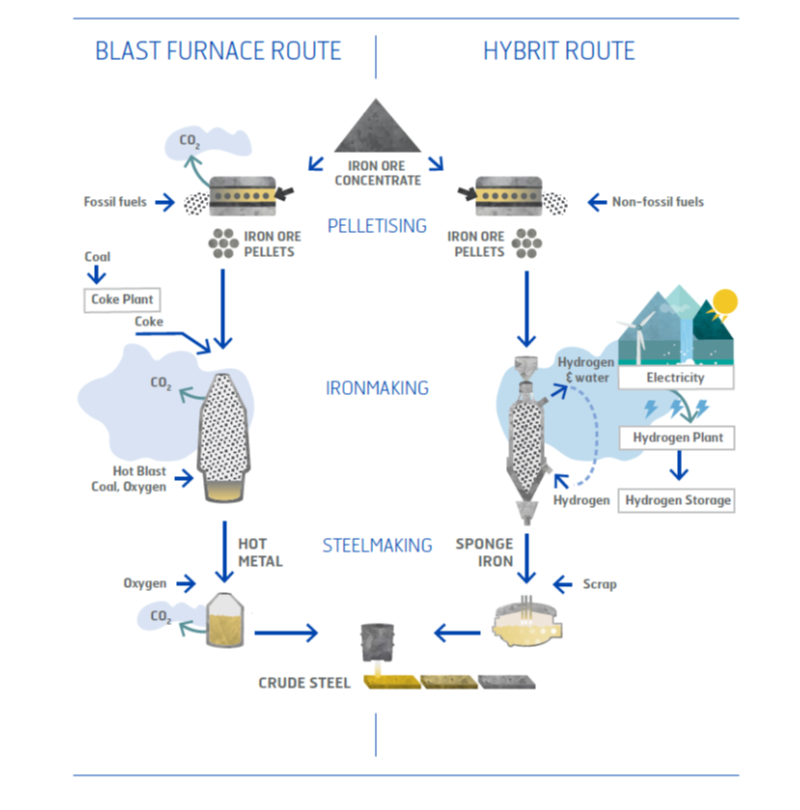
Page 8 of https://www.hybritdevelopment.com
Energy and environmental balance:
Conventional process:
Even though the existing LKAB – SSAB production system is one of the most efficient of its kind worldwide, it emits around 1,6 million tonnes of carbon dioxide per year in Sweden.
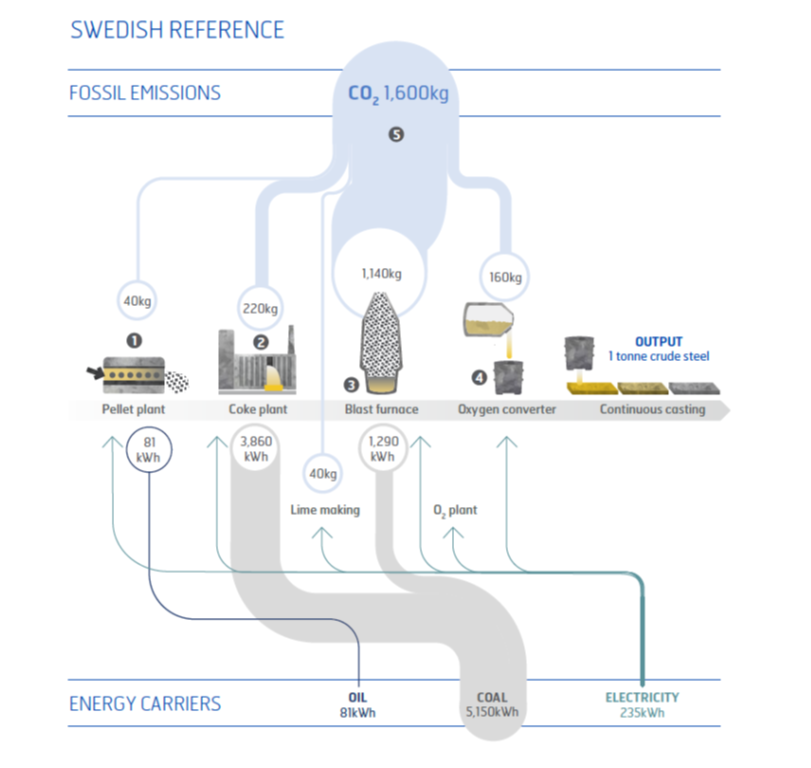
Scheme: Conventional LKAB-SSAB process (All numbers per tonne of crude steel.). Page 14 of https://www.hybritdevelopment.com
Hybrit process:
For thousands of years, steel has been made using coal to remove oxygen from iron ore, emitting vast amounts of CO2 in the process. But now, SSAB is set to revolutionize the industry with HYBRIT® technology, using hydrogen instead of coal in the ore reduction process, and emitting water instead of CO2.
Timeline for HYBRIT and fossil-free steel : All SSAB production sites will be converted.
SSAB aims to create a fossil-free value chain together with our partners and customers and secure our position as the driving force in the green transition of the steel industry. Already in 2021, we delivered the first fossil-free steel, a steel made from hydrogen-reduced iron produced at HYBRIT´s pilot plant in Luleå Sweden, to our customer Volvo Group. In 2026, we plan to bring fossil-free steel to market as a commercial product.
See Phases: 2016-17, 2018-24, 2025-30
https://www.ssab.com/en/company/sustainability/sustainable-operations/hybrit-phases
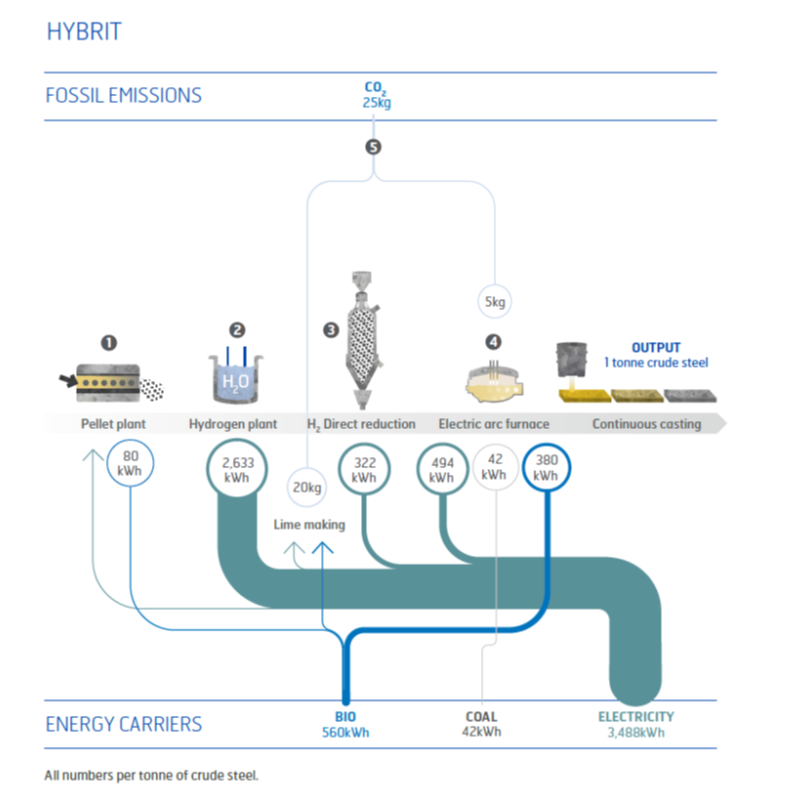
Scheme: Hybrit process, (All numbers per tonne of crude steel.) Page 16 of https://www.hybritdevelopment.com
Assessment of capital and operating expenses:
On page 11/19 of this study can be seen the first considerations on the construction and operation costs of this new plant.
Obviously the amount of hydrogen to be used in this new process makes it necessary to consider the method of obtaining it, as well as the amount of electricity needed and especially the origin of that electricity.
HYBRIT: NEW RESEARCH
HYBRIT: New research shows hydrogen-reduced iron has superior properties 12.10.2022
New research within the HYBRIT project, driven by SSAB, LKAB and Vattenfall, shows superior results on the properties and quality of the hydrogen direct reduced sponge iron (H-DRI) made using HYBRIT technology. Test results prove that the direct reduction of iron ore using hydrogen offers a superior product that is easy to handle, transport and store. It also virtually eliminates CO\2\ emissions in the reduction process.
Stockholm Environment Institute ( SEI )
Hydrogen Breakthrough Ironmaking Technology (HYBRIT) is a groundbreaking effort to reduce CO2 emissions and de-carbonise the steel industry. The goal is to have a solution for fossil-free steel by 2035.
https://www.sei.org/projects-and-tools/projects/hybrit/
ECONOMY
Importance of this new Ironmaking process and Granted support from E.U:
https://www.hybritdevelopment.com
https://www.ssab.com/news/2020/09/ssab-joins-the-european-clean-hydrogen-alliance
Granted support from E.U:
https://www.hybritdevelopment.se/en/hybrit-support-from-eu-innovation-fund/
AUTOMOTIVE and TRANSPORT
Volvo Cars is first carmaker to explore fossil-free steel with SSAB, June 16, 2017
https://www.ssab.com/news/2021/06/volvo-cars-is-first-carmaker-to-explore-fossilfree-steel-with-ssab
Volvo says this is the world’s first vehicle made from fossil-free steel
Volvo says this is the world’s first vehicle made from fossil-free steel
The future is here – the world’s first vehicle made with fossil-free steel
In a world-first, Volvo Group has unveiled the first vehicle made of SSAB’s fossil-free steel. A load carrier for use in mining and quarrying represents the first leg of the journey towards a decarbonized future.
In 2020, 1.87 million tones of crude steel were produced worldwide, 16% of which was destined for the transport sector. With around 70% of a truck’s weight coming from steel and cast iron and the figure for Volvo construction machines even higher, the production will be another step in our journey to net zero.
SSAB and Shape announce partnership on fossil-free steel for automotive applications
Other press releases 21.06.2022
SSAB has entered an agreement with U.S.-based Shape Corp., a tier-one automotive supplier of lightweight body structures, to deliver fossil-free steel crash management and body structure systems to market.
Shape will be testing SSAB’s fossil-free steel, the first steel product made of hydrogen-reduced sponge iron utilizing HYBRIT technology, for use in automotive applications.
https://rmi.org/technology-disruption-in-the-global-steel-industry/
Importance of this new Ironmaking process:
https://www.hybritdevelopment.com
https://www.ssab.com/news/2020/09/ssab-joins-the-european-clean-hydrogen-alliance
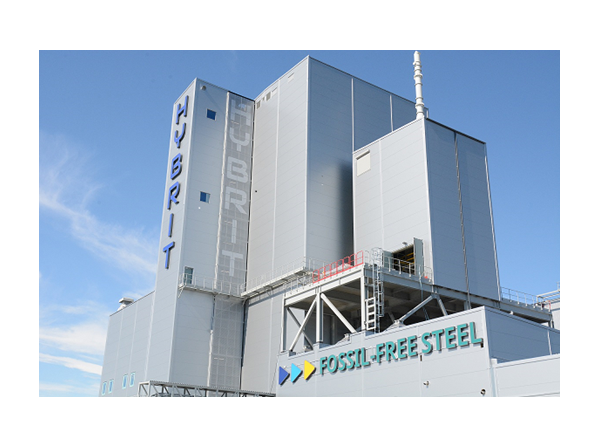 |
First Hybryt ironmaking plant (Fossil Free Steel)
————————-
095.01 AIST Association for Iron & Steel Technology
Ironmaking With Alternative reductants (VIDEO).
https://www.youtube.com/watch?v=ALapmVXoHgM
Production, Storage and Safe Handling of Hydrogen (VIDEO )
https://www.youtube.com/watch?v=Kbwdj418Kxc
—————————
4.1.4.SSAB – Hybrit – Specific Bibliography
https://www.hybritdevelopment.se/en/research-project-1/researchlibrary/
Hydrogen-based reduction of iron ore
-Experimental study of the temperature profile in an iron ore pellet during reduction using hydrogen gas
Brännberg Fogelström, Julia
KTH, School of Industrial Engineering and Management (ITM), Materials Science and Engineering.
2020 (English)Independent thesis Advanced level (degree of Master (Two Years)), 20 credits / 30 HE credits
http://www.diva-portal.org/smash/record.jsf?pid=diva2%3A1389477&dswid=871
—-
-Preliminary experimental study on the affect of water of the hydrogen reduced hematite pellet
Welander, Henrik
KTH, School of Industrial Engineering and Management (ITM), Materials Science and Engineering.
2021 (English)Independent thesis Advanced level (degree of Master (Two Years)), 20 credits / 30 HE credits
Student thesis
https://www.diva-portal.org/smash/record.jsf?pid=diva2%3A1549271&dswid=-4740—-
——
-Effect of Temperature and Gas Mixtures on Cementite Formation During the Carburization of Hydrogen-Reduced DRI
Journal of Sustainable Metallurgy 05 October (2022).
https://doi.org/10.1007/s40831-022-00601-0
https://link.springer.com/article/10.1007/s40831-022-00601-0#citea
——-
-Effect of carbon concentration and carbon bonding type on the melting characteristics of hydrogen-reduced iron ore pellets
Hesham Ahmed T.K.Sandeep Kumar, JohannaAlatalo, BoBjörkman
Journal of Materials Research and Technology.
Volume 21, November–December 2022, Pages 1760-1769
https://www.sciencedirect.com/science/article/pii/S2238785422015575?via%3Dihub
————
Steel production of hydrogen-reduced iron ore
-Experimental Study on Phosphorus Partitions Between Liquid Iron and Liquid Slags Based on DRI
Joar Huss, Martin Berg & Niklas Kojola
Metallurgical and Materials Transactions B volume 51, pages 786–794 (18.02.2020)
https://link.springer.com/article/10.1007/s11663-020-01787-y
——————
-Effect of Reduction Degree on Characteristics of Slag Formed by Melting Hydrogen-Reduced DRI and Partitions of P and V between Slag and Metal
Amanda Vickerfält, Johan Martinsson, Du Sichen
Steel Research International Vol 92 (3),March 2021
https://doi.org/10.1002/srin.202000432
https://onlinelibrary.wiley.com/doi/10.1002/srin.202000432
———————
-Optimizing the slag system for phosphorus removal in a DRI-based EAF-process using the dictionary attack method
Huss, Joar
KTH, School of Industrial Engineering and Management (ITM), Materials Science and Engineering.
2018 (English) Independent thesis Advanced level (degree of Master (Two Years)), 20 credits / 30 HE credits
http://kth.diva-portal.org/smash/record.jsf?pid=diva2%3A1214302&dswid=-7883
—
-The effect of carbonaceous iron on slag foaming
Svensson, Josefin
KTH, School of Industrial Engineering and Management (ITM), Materials Science and Engineering.
2018 (English) Independent thesis Basic level (degree of Bachelor), 10 credits / 15 HE credits
http://kth.diva-portal.org/smash/record.jsf?pid=diva2%3A1237409&dswid=7668
—————–
—————–
4.1.5.- The Future: Smelting by Hydrogen. (Liquid Phase). Hydrogen Plasma Smelting Reduction (HPSR).
LONG TERM FUTURE. Now Academic Interest.
096 Hydrogen Plasma, Smelting Reduction. An Option for Steelmaking in the Future (1).
H. Hiebler, JF. Plaul
Metalurgija, 43, 3, 2004, 155-162
The steel industry is a mayor source of global CO2-emission. Lager reductions of greenhouse gases are the challenge to develop new processes, like Hydrogen Plasma Smelting Reduction (HPSR). The scientific basis and results of HPSR laboratory experiments led to the development of a concept for an HPSR-plant on industrial scale. A technology assessment shows the potential for a cheaper and most environmental friendly steelmaking in the future, when extensive development work has been done.
—————
097 Hydrogen Plasma Smelting Reduction: An Option for Steelmaking In The Future (2).
Kirtan.N. Soni, Jainisha.R.Thakkar.
International Journal for Research in Applied Science & Engineering Technology 5, IX, September 2017, 839 – 848.
The steel industry is a major source of global-CO2 Emission. Larger reductions of green house gases are the challenge to develop new processes, like Hydrogen Plasma Smelting Reduction (HPSR). A technology assessment shows the potential for a cheaper and most environment friendly steel-making in the future, when extensive development work has been done……..
Objectives:
Research and development for new technology solutions to radically reduce the level of CO2 emissions into the atmosphere for each ton of steel produced has been recently undertaken by an EU project called ULCOS. ULCOS (Ultra Low CO2 Steelmaking) is a «concept development» program that explored, fairly extensively, a wide array of steelmaking routes with a high potential for CO2 mitigation. The technologies called for breakthrough innovation within the steel industry, as they will need extensive research & development to mature into commercial processes. The target is to develop new solutions, before the end of the 2010’s, with 50 % less specific CO2 emissions compared to the modern blast furnace. These solutions should be in a position to be rolled out into production plants 15 to 20 years from now.
Many technologies have passed a first pre-screening. The technologies were mainly classified to the following sub-projects: (1) new carbon-based reduction concepts, making use of the shaft furnace but also (2) new smelting reduction processes with less common reactors; (3) natural gas based pre-reduction reactors (4) hydrogen-based reduction using hydrogen from CO2 lean technologies; (5) direct production of steel by electrolysis, and (6) the use of biomass, which circulates carbon rapidly in the atmosphere. (7) CO2 capture and storage will be included in the design. The priorities of the new processes were innovation in design, optimization of energy and the use of carbon lean or renewable resources.
Theoretical Basis:
All iron-based materials are originally produced from iron ore. The Fe-O and Fe3-C phase diagrams are the basis of iron and steel making.
In Fig-1, the areas corresponding to the raw materials, semi-finished products and finished products are indicated on these equilibrium diagrams, along with schematic manufacturing routes.
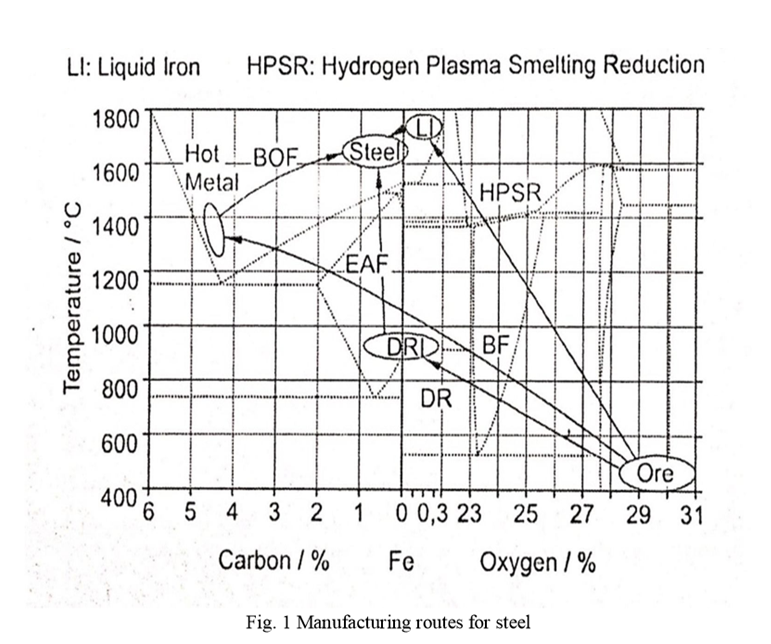
In this research work at the laboratory level :
-Thermodynamics at Plasma Temperature.
-Kinetics of Molten Iron Oxide Reduction.
Are studied
https://www.ijraset.com › fileserve
——————-
098 Hydrogen Plasma Smelting Reduction of Fe2 O
P.R. Behera , B. Bhoi, R. K. Paramguru, P. S. Mukherjee, B. K. Mishra
Metallurgical and Materials Transactions B, 50, 1, 2019, 262-270.
34 references
The paper reports successful smelting reduction of iron ore (hematite) in thermal hydrogen plasma. A specially designed reactor with water cooled copper crucible and a plasma torch was used to demonstrate the process in 1-kg scale. The number of stoichiometric requirement of hydrogen is a better parameter, instead of time, for determining the rate of the process. This parameter, along with the degree of reduction, is also helpful to determine the degree of hydrogen utilization. The ratio of the height of the molten bath to the diameter of the reactor is found to be an important parameter for effective hydrodynamics and the resultant degree of reduction. This is also an important parameter for scaling up of the process…………
https://link.springer.com/article/10.1007/s11663-018-1464-8
——————-
099 Reduction of Fine Ores in Argon Hydrogen Plasma
Jan Friedemann Plaul, Wilfried Krieger, Eduard Bäck.
Steel research International, 76, 8, 2005, 548 -554
The steel industry is a major source of global CO2 emission. Larger reductions of greenhouse gases are the challenge to develop new processes, like Hydrogen Plasma Smelting Reduction (HPSR). The present paper shows physical and chemical fundamentals for the reduction of iron oxides with hydrogen plasma. The behaviour of different hematite iron ores during melting and reduction with hydrogen plasma were investigated with thermogravimetry and a laboratory plasma furnace. The path of iron oxides during smelting and reduction in the Fe-O phase diagram are described. Reduction tests in the laboratory furnace show the possibility to reduce hematite iron ores with hydrogen plasma in a short time with high utilization degrees without direct CO2 emissions………….
https://onlinelibrary.wiley.com/doi/abs/10.1002/srin.200506055
————-
100 Thermodynamic of Liquid Iron Ore Reduction by Hydrogen Thermal Plasma.
Masab Naseri Seftejani, Johannes Schenk.
Metals 2018, 8, 1051
The production of iron using hydrogen as a reducing agent is an alternative to conventional iron- and steel-making processes, with an associated decrease in CO2 emissions. Hydrogen Plasma Smelting Reduction (HPSR) of iron ore is the process of using hydrogen in a plasma state to reduce iron oxides……
————-
101 Preliminary investigation into direct reduction of iron in low temperature hydrogen plasma.
P. Rajput, B.Bhoi, S.Shaoo, R.K. Paramguru, B.K. Mishra.
Ironmaking & Steelmaking; Processes, Products and Applications, 40, 1, 2013, 61 – 68
There has been an increasing interest in reduction of iron ore by hydrogen. This study deals with the reduction of hematite in a microwave assisted non-thermal hydrogen plasma. The plasma is composed of excited hydrogen molecules, hydrogen atoms, and ionic hydrogen among other gaseous species. The reduction in hydrogen plasma occurred even at temperatures as low as 573 K. In contrast, the same could not be achieved by merely introducing hydrogen gas to the reducing environment without creating the plasma. It is only a 1073 K that the extent of reduction by gaseous means is comparable to that of reduction by hydrogen plasma. Based on the experiments, as well as the data available from literature, it was deduced that the reduction of hematite at a low temperature in hydrogen plasma could have been due to the contribution of vibrationally excited hydrogen molecules to the reduction process……
https://www.tandfonline.com/doi/abs/10.1179/1743281212Y.0000000023
——————
101.01 voestalpine Researching Hydrogen Plasma for Green Steel Production
The company announced yesterday that it is researching the use of hydrogen plasma for the carbon-free manufacture of crude steel in a single step at a pilot facility in Donawitz, Austria. 28.04.2022
https://www.voestalpine.com/blog/en/commitment/research-projects-for-green-steel-production/
———-
4.1.6.-Specific bibliography
102 Reduction of Haematite Using Hydrogen Thermal Plasma
Masab Naseri Seftejani1, Johannes Schenk, and Michael Andreas Zarl
Materials 2019, 12, 10, 1608 Pages 22
The development of hydrogen plasma smelting reduction as a CO2 emission-freesteel-making process is a promising approach. This study presents a concept of the reduction of haematite using hydrogen thermal plasma. A laboratory scale and pilot scale hydrogen plasmas melting reduction (HPSR) process are introduced. To assess the reduction behaviour of haematite, a series of experiments have been conducted and the main parameters of the reduction behaviour, namely the degree of hydrogen utilization, degree of reduction and the reduction rate are discussed.
https://www.ncbi.nlm.nih.gov/pmc/articles/PMC6566866/
—————
103 Smelting of Iron Oxides Using Hydrogen Based Plasmas
Karim Badr, B.Sc., M.Sc
An der Montanuniversität Leoben eingereichte Dissertation zur Erlangung des akademischen Grades eines Doktors der Montanistischen Wissenschaften ( Complete and interesting Doctoral These ). Leoben, November 2007, pages 174
As one of the possible innovative steelmaking technologies, hydrogen plasma smelting reduction, HPSR, has been examined over almost two decades at the chair of metallurgy, University of Leoben. HPSR showed a potential due to its defining characteristic of no direct CO2 emissions as a result of replacing fossil fuels by carbon free source (H2-Plasma). The present work aimed at showing the potential of H2/CH4 in an up-scaled process as an alternative to fossil fuel in the conventional processes. Some experiments were done to investigate the influence of gases like CO, CO2 and H2O on the reduction behaviour of hydrogen plasma. Continuous feeding of fines ores through the hollow electrode was also conducted in a series of experiments to assess its influence on the plasma arc stability and the reduction kinetics. The characteristics of the process in terms of thermodynamics and kinetics was also examined and discussed within the thesis…….
———————
104 Reduction of Fine Ores in Argon – Hydrogen Plasma
Jan Friedemann, Plaul Wilfried, Krieger Eduard Bäck
Steel research international. Process Metallurgy–Ironmaking, 13 December 2016.
Contact: Prof. Dr. Mont. Wilfried Krieger
Lehrstuhl f. Metallurgie Montanuniversität Leoben
Franz-Josef-Str. 18, 8700 Leoben / Austria
The steel industry is a major source of global CO2 emission. Larger reductions of greenhouse gases are the challenge to develop new processes, like Hydrogen Plasma Smelting Reduction (HPSR). The present paper shows physical and chemical fundamentals for the reduction of iron oxides with hydrogen plasma. The behaviour of different hematite iron ores during melting and reduction with hydrogen plasma were investigated with thermogravimetry and a laboratory plasma furnace…….
https://onlinelibrary.wiley.com/doi/pdf/10.1002/srin.200506055
——————–
105 Encyclopedia of Iron, Steel, and Their Alloys.
Chapter: ii) Smelting Reduction Processes
S. K. Dutta Rameshwar Sah
March 2016, pages 3208-3236
Editors: Rafael Colas and George E. Totten
Publisher: CRC Press, Taylor and Francis Group, New York
eBook ISBN 9781351254502
https://www.researchgate.net/publication/305351538_ii_Smelting_Reduction_Processes
———————
106 Hydrogen: the future energy carrier ( Introduction)
Andreas Züttel, Arndt Remhof, Andreas Borgschulte, Oliver Friedrichs
Phil. Trans. R. Soc. A. 368, 2010, 3329–3342
Since the beginning of the twenty-first century the limitations of the fossil age with regard to the continuing growth of energy demand, the peaking mining rate of oil, the growing impact of CO2 emissions on the environment and the dependency of the economy in the industrialized world on the availability of fossil fuels became very obvious. A major change in the energy economy from fossil energy carriers to renewable energy fluxes is necessary….
https://royalsocietypublishing.org/doi/full/10.1098/rsta.2010.0113
——————-
106.01 Model processes for hydrogen plasma and direct reduction of iron ore
Prof. Dr.-Ing. Hauke Springer
MAX-PLANK – INSTITUTE FÜR EISENFORSCHUNG GMBH
Hydrogen-based direct reduction (HyDR) is a major contender for the future of green ironmaking without a direct release of CO2 emissions. It relies on a multistep solid-gas reaction, where iron ore in pellet or powder form is subjected to elevated temperatures under a reducing gas atmosphere. The fundamental understanding of such a complex reaction process is necessary from the thermodynamics and kinetics perspectives. The in-house designed thermo-gravimetric analysis (TGA) setup coupled with mass spectrometry at the MPIE ([1]) allows us to precisely measure the reduction kinetics of iron oxides under well-defined gaseous atmospheres (containing e.g. H2, NH3, or CO). The infrared furnace enables extremely fast and well-defined ramping up to 10 K/s and a high operational temperature up to 1000 °C. During the HyDR experiments, the in situ weight change of the iron oxides can be continuously tracked by a sensitive thermo-balance with an accuracy of 0.1 μg to quantify the reduction degree (i.e. loss of oxygen) [2]. Furthermore, the gas composition near the sample surface can be analysed using a fused capillary attached to the quadrupole mass spectrometer. Such an additional technique provides valuable information on the alternation of the gas species during HyDR, indicating the reaction paths and kinetics. With the expansion of the research activities in hydrogen-based metallurgical science and technology at the MPIE, new equipment, such as a TGA setup with the capability of mixing different gases and a fluidised-bed setup is under construction. This development will allow for in-depth investigations and further optimisation of complex industrial processes.
https://www.mpie.de/4674271/model-processes-for-hydrogen-plasma-and-direct-reduction-of-iron-ore
See more bibliographic references by entering data bases with the phrase: Hydrogen Plasma Smelting Reductions or
Hydrogen Plasma Smelting Iron Ores Reductions
——————–
——————-
4.2.- Electrolysis – Reduces iron ore using electricity
-Low-temperature electrolysis:
The Siderwin project, which is developing production via low-temperature electrolysis, known as electrowinning. An engineering-scale pilot is expected to be commissioned in 2020.
Siderwin, targeting radically new steel production without CO2 emissions
What if in the future we produced steel by electrolysis and therefore without CO2 emissions? Electrolysis is one of the long-term options being explored by ArcelorMittal to make steel production more environmentally friendly. The Siderwin project is the enactment of this commitment, bringing together 12 European partners.
Launched in October 2017, Siderwin falls within the framework of long-term step-change projects. It seeks to develop a radically new steel production process without CO2 emissions, based on electrolysis technology. It follows an initial project launched in the early 2000s, one of whose missions was to lay the foundations for electrolytic steel production at the laboratory stage.
Siderwin :
https://automotive.arcelormittal.com/news_and_stories/news/2019Siderwin
Video:
https://www.youtube.com/watch?v=0SG421hiKXA
Nucor Corp.:
Nucor Investing in Start-Up Company Developing Zero-Carbon Iron Technology.
08.12.2022
CHARLOTTE, N.C., Dec. 8, 2022 /PRNewswire/ — Nucor Corporation (NYSE: NUE) announced today that it has made an equity investment in Electra, a Colorado-based start-up developing a process to produce carbon-free iron that can be used to make steel. The company uses renewable energy to refine low-grade iron ores into high-purity iron through electrochemical and hydrometallurgical processes. This material will be used in the steelmaking process to offset other high-quality metallics that come with higher greenhouse gas emissions.
The process developed by Electra produces Low-Temperature Iron (LTI) from commercial and low-grade ores using zero-carbon intermittent electricity.
The company electrochemically refines iron ore into pure iron at 60 degrees Celsius (140 degrees Fahrenheit) using renewable electricity. That iron can be turned into steel using existing electric arc furnaces, which account for 70% of steel production in the U.S.
Electra’s process results in zero carbon dioxide emissions.
By comparison, approximately 70% of the steel produced globally is made with blast furnace technology, an extractive process fed by iron ore, coal, and limestone that emits about two tons of carbon dioxide for every ton of steel produced.
Using primarily recycled scrap as raw material, Nucor is already one of the cleanest steelmakers in the world.
The circular nature of remelting recycled scrap in electric arc furnaces, combined with steel’s ability to be infinitely recycled, means that Nucor’s steelmaking facilities generate roughly one-third of the carbon dioxide of extractive steelmaking plants. Its investment in Electra is one of several investments the company is making that furthers Nucor’s status as a sustainability leader and builds on the innovation that has already led to cleaner steel production in the United States.
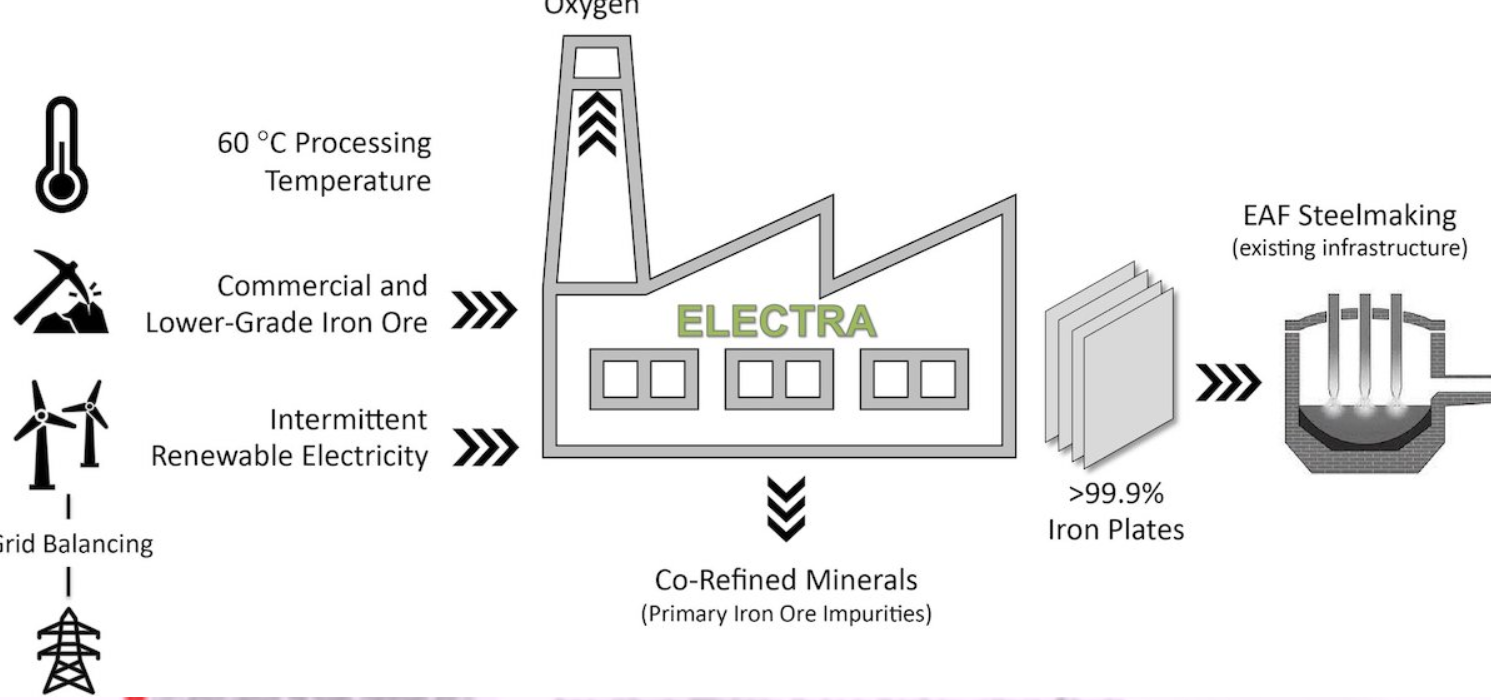
https://www.greencarcongress.com/2022/12/20221211-electra.html
-High-temperature electrolysis:
-Boston Metal’s work on high-temperature electrolysis, with a prototype cell commissioned in 2014 and plans to test full-scale cells by 2024.
The Molten Oxide Electrolysis process:
Fe2O3 + e– ——- 2 Fe + 3/2 O
————————–
————————–
5.- ACTIONS UNDERTAKEN BY INTERNATIONAL COMPANIES.
Due to climate change and stringent environmental regulations, energy efficiency, resource saving and climate protection are becoming more important than ever.
106.02 Climate Action: worldsteel organization member initiatives in 2021 (Very complete).
Climate change is a global issue that requires global solutions. The reduction of CO2 from steel production is an established priority.
——————-
106.03 SSAB
Reinventing the future of steel
Our upcoming breakthrough fossil-free technology is the first true steelmaking transformation for centuries. SSAB customers around the world will get premium high-strength steel, adapted to the future.
Sustainability (very complete)
We strive to create a stronger, lighter and more sustainable world. Sustainability is a key business driver for both us and our customers. We want to be the first to place fossil-free steel on the market by 2026 and largely eliminate CO₂ emissions in our own operations around 2030.
https://www.ssab.com/en/company/sustainability
Decarbonizing the steel industry: SSAB is taking the lead in decarbonizing the steel industry.
SSAB is taking the lead in decarbonizing the steel industry, which today generates 7% of global greenhouse gas emissions. HYBRIT is a new revolutionary steelmaking technology. With HYBRIT technology, SSAB aims to be the first steel company in the world to bring fossil-free steel to the market already in 2026. SSAB will be practically fossil free by 2045.
https://expoupdate.se/decarbonizing-the-steel-industry/
https://www.ssab.com/en/fossil-free-steel
https://www.ssab.com/en-gb/fossil-free-steel
https://www.ssab.com/es-es/fossil-free-steel/hybrit-a-new-revolutionary-steelmaking-technology
Download center SSAB
————–
107 JFE (Japan)
Environmental Conservation and Energy Saving Activities in JFE Steel.
Ogura Shigeru, Tezuka Hiroyuki, Yunde Takao, Tamura Nozomu.
JFE Technical Report No. 19, (Mar.2014).
www.jfe-steel.co.jp › research › report › pdf
(copy and paste)
https://www.jfe-steel.co.jp/en/research/report/019/pdf/019-19.pdf
——–
Recent Progress in Ironmaking Technology for CO2 Mitigation at JFE Steel
Sato Michitaka, Yamamoto Tetsuya, Sakurai Masaaki
JFE Technical Report No. 19, (Mar.2014).
——-
Development of PSA Technology for the Separation of Carbon Dioxide from Blast Furnace Gas
Saima Hitoshi, Mogi Yasuhiro, Haraoka Takashi.
JFE Technical Report No. 19, (Mar.2014).
www.jfe-steel.co.jp › research › report › pdf
——-
Protecting the Environment
JFE Group CSR REPORT 2018, page 31 – 36
https://www.jfe-holdings.co.jp › csr › pdf
JFE Group GROUP REPORT 2021, page 65 – 69
https://www.jfe-holdings.co.jp/en/investor/library/group-report/2021/pdf/all.pdf
and
https://www.jfe-holdings.co.jp/en/csr/environment/climate/ (Very Complet)
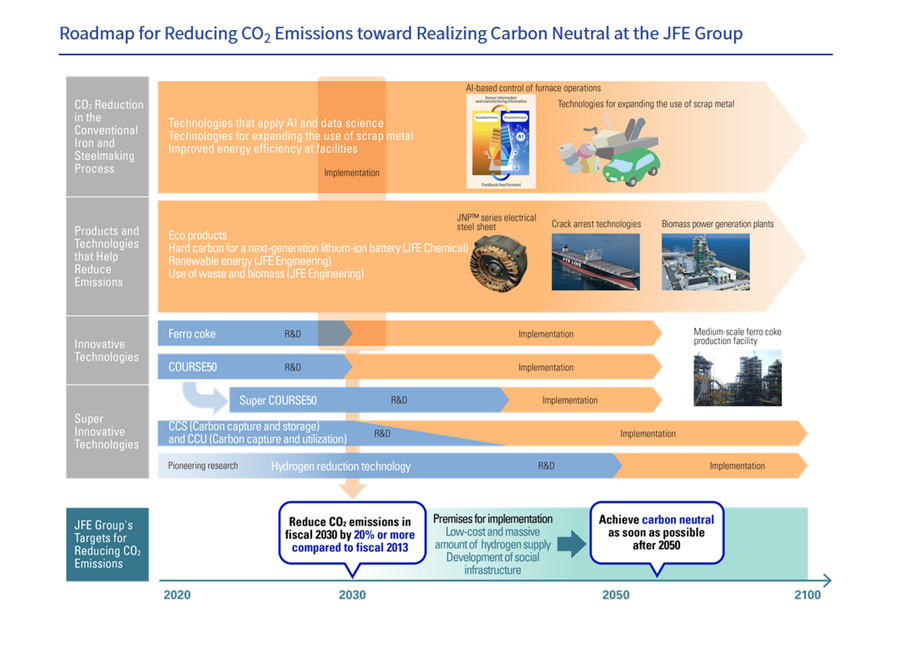
——-
Protecting the Environment
JFE Group CSR Report, 2018, page 25 – 47
https://www.jfe-holdings.co.jp › csr › pdf
JFE Steel Corporation Carbon Neutrality Strategy Briefing (Very Complete and Interesting)
https://www.jfe-holdings.co.jp/en/investor/climate/presentation/index.html
Environmental Vision 2050 JFe Steel Corporation 1.09.2022
–Presentation Material of JFE Steel Carbon Neutrality Strategy Briefing
CONTENTS (COMPLETE)
1.-Carbon Neutrality Plan
・Carbon Neutrality Plan for Japanese Steel Industry(METI)
・JFE Steel’s Transition to Low-carbon Processes
・JFE Steel’s Carbon Neutrality Vision 2050
2.-Carbon Neutrality Action Plan
・Carbon Neutrality Action Plan
3.-30% Less CO2 Emissions by 2030
・Transition to Low-carbon Steel Processes
・Expand Use of Scrap in Converters
・Expand Use of Scrap in EAFs
・Direct-reduced Iron Feasibility Study
4.-Multitrack R&D Targeting Ultra-innovative
Technologies
・Challenges in Developing CO2 Reduction for Steelmaking
・Development Project Supported by Green Innovation Fund
・Overall Scale of GI Fund Projects
・GI Fund Project for Reducing CO2 via CR Blast Furnaces
・GI Fund Project for Direct Hydrogen Reduction
・GI Fund Project for Large, High-efficiency EAFs
5.-Initiatives for Effective Use of CO
・CCUS and Green Infrastructure Initiatives
・Port Initiatives Carbon Neutral
・CO2 -based Methanol Synthesis
・Storing CO2 in Steel Slag
6 Collaborating with Society on Carbon Neutrality
・Stimulating Demand for Green Steel
・Initiatives for Collaborating with Society
・New Teams Overseeing Carbon-neutrality Promotion
https://www.jfe-holdings.co.jp/en/investor/climate/presentation/index.html
JFE Steel Carbon Neutrality Strategy Briefing September 1, 2022—Q&A Session (Very complete and interesting)
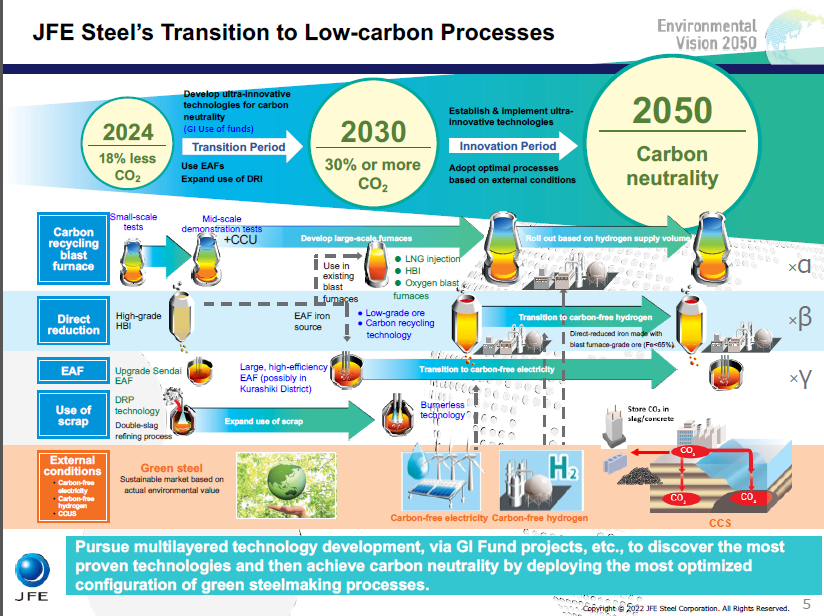
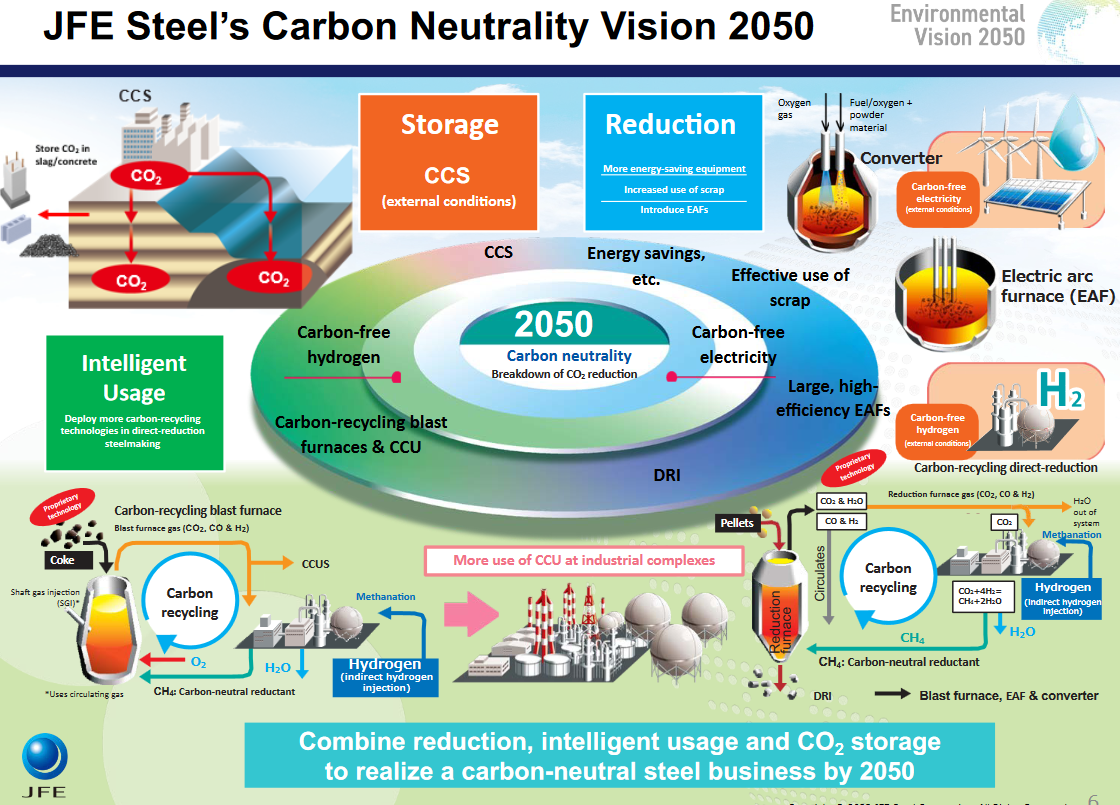
https://www.jfe-holdings.co.jp/en/investor/climate/presentation/index.html
JFE Steel Carbon Neutrality Strategy Briefing September 1, 2022—Q&A Session
https://www.jfe-steel.co.jp/en/company/pdf/carbon-neutral-strategy_220901_2.pdf
JFE Carbon Neutral Initiatives (VIDEO)
https://www.jfe-steel.co.jp/en/movie/gx.html
JFE Steel Moves Ahead with Testing CO2-utilization Technologies Aimed at Achieving Carbon Neutrality
JFE Steel Corporation New reléase 20.06.2022
-System for Methanol Synthesis Using CO2
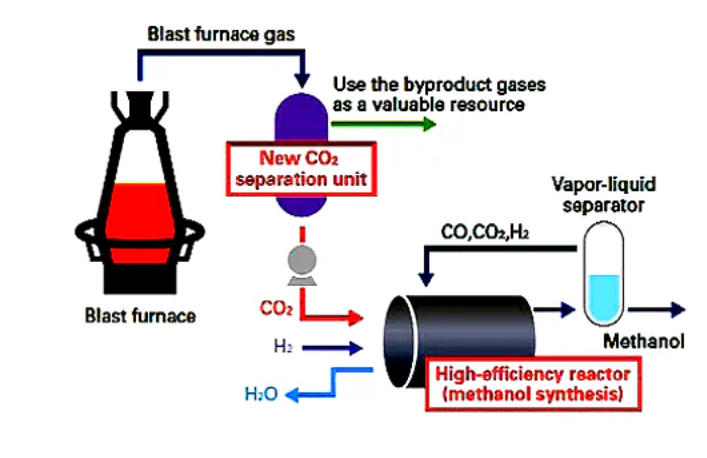
https://www.challenge-zero.jp/en/casestudy/391
-CO2-fixing through Fast, Large-quantity Carbonation of Steel Slag
R&D will focus on the fixation (assimilation) of CO2 generated by steelmaking processes, such as those involving carbon-recycling blast furnaces, and also by thermal power plants, to produce CO2-fixed steel slag for use in road construction.
https://www.jfe-steel.co.jp/en/release/2022/220620-2.html
—–
JFE Group Protecting the Global Environment Pag. 25-57
C S R REPORT 2019
(copy and paste)
https://www.jfe-holdings.co.jp/en/csr/pdf/csr2019e.pdf
——————–
108 NIPPON STEEL:
Environmental Activities:
Nippon Steel’s Three Eco-Friendly Initiatives
https://www.nipponsteel.com/en/csr/env/eco/index.html
Basic Environmental Policy
https://www.nipponsteel.com/en/csr/env/policy/index.html
Not wasting any energy
https://www.nipponsteel.com/en/csr/env/balance/index.html
Promotion of Countermeasures to Global Warming
Activities For Reducing CO2 and Conserving Energy During Production
https://www.nipponsteel.com/en/csr/env/warming/production.html
CO2 Reduction Efforts in Logistics
https://www.nipponsteel.com/en/csr/env/warming/logistics.html
Research & Development for Global Warming Prevention
https://www.nipponsteel.com/en/csr/env/warming/future.html
https://www.nipponsteel.com/en/csr/env/
Nippon Steel Carbon Neutral Vision 2050. March 30, 2021
Very Interesting and complete
https://www.nipponsteel.com/en/ir/library/pdf/20210330_ZC.pdf (copy and Paste)
Nippon Steel, Mitsubishi and Exxon will jointly study carbon capture and storage (CCS).
https://gmk.center/en/news/nippon-steel-mitsubishi-and-exxon-will-jointly-study-carbon-capture/
https://www.nipponsteel.com/en/news/20230126_100.html
Japan’s top steelmaker eyes $700 million ‘green steel’ project.
By Masumi Suga
Bloomberg
Japan’s biggest steelmaker is considering a major investment in a green steel project powered by hydrogen as a global push to decarbonize one of the world’s most polluting industries gathers pace.
Nippon Steel is exploring a project outside its home market that may cost an estimated ¥100 billion ($733 million) or more, according to Takahiro Mori, executive vice president who oversees global operations. Australia and Brazil are among possible sites, where high-grade iron ore is accessible along with cheaper electricity than in Japan, he said in an interview.
https://www.japantimes.co.jp/news/2023/03/03/business/nippon-steel-green/
—————-
109 KOBE Steel
Environmental Conservation
Water Pollution Measures, Air Pollution Measures, Promotion of Resource Recycling (Reduction of waste). Controlling Waste Generation and Promoting Recycling.
https://www.kobelco.co.jp/english/sustainability/protection.html
—————–
110 POSCO:
Energy | Climate Change / Energy | Environmental … – Posco
https://www.posco.co.kr/homepage/docs/eng6/jsp/sustain/s91s2000110c.jsp
—-
Improving Sustainable Competitiveness in Preparation for a Circular Economy: The Case of POSCO
Towards the Circular Economy: What it Means to the Steel Industry
Yoon-Gih Ahn. Senior Vice President
Asian Steel Watch Vol 5, 2018.6, Pages 14 – 22
https://www.posri.re.kr › files › file_pdf › 59_342_69
—-
POSCO: Environmental Management
Toward a Green Economy
POSCO declared the POSCO Low-carbon, Green Growth Vision and announced a voluntary reduction goal in February 2010. The plan calls for us to reduce our CO2 emission intensity by 9 % from the average emission level reported in the past three years (2007-2009) by the year 2020.
VERY COMPLETE ABOUT POSCO ENVIRONMENTAL POLICY
https://www.poscoenc.com:446/eng/sustainability/environmental_management.asp
Primetals Technologies and POSCO to develop new green steel demonstration plant. 31.08.2022
HyREX – a new technology for hydrogen-based hot metal production.
On July 26th, Primetals Technologies and South Korean leading steel producer POSCO signed a Memorandum of Understanding (MOU) to develop a demonstration plant for hydrogen-based hot metal production in South Korea. Startup of the plant is scheduled for early 2027.
https://www.youtube.com/watch?v=9u3I2lfuDnc
—-
POSCO HyREX:
Carbon Neutral HyREX Hydrogen Reduction Ironmaking
Breakthrough hydrogen reduction ironmaking technology with near-zero emission.
Ironmaking Technology by Hydrogen Reduction and Electrical Smelting
The conventional method for producing iron involves using heat and gas generated from coal. However, HyREX uses hydrogen to convert fine iron ore into Direct Reduced Iron (DRI). Then, they are charged into an Electric Smelting Furnace (ESF) to produce hot metal. HyREX also aims to achieve near-zero emissions by using green hydrogen and power produced by CO2-free renewable energy.
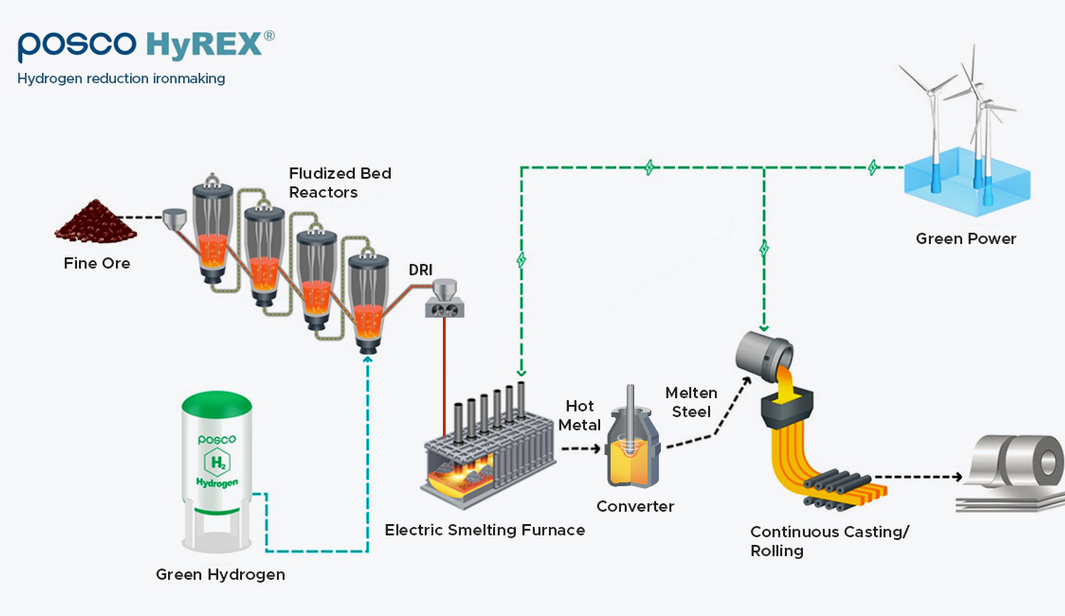
https://www.posco.co.kr/homepage/docs/eng7/jsp/hyrex/
—-
POSCO to make all steel via hydrogen route by 2050 27.11.2023
Steel Times International Catherin Hill
South Korean steelmaker POSCO is planning to produce all its steel via the hydrogen reduction method by 2050.
The company is currently looking to finalize the commercialization of its HyREX technology by 2030, and hopes to convert its Pohang and Gwangyang steel plants to those based on hydrogen technology by 2050.
POSCO will replace existing production methods such as the blast furnace method with the HyREX 1 method at Pohang Works in 2033, according to a company announcement. By 2050, the company will complete hydrogen reduction steel production systems at Pohang Works and Gwangyang Works (three systems at each and six systems in total).
https://www.steeltimesint.com/news/posco-to-make-all-steel-via-hydrogen-route-by-2050
—-
POSCO to break ground on hydrogen-based steel plant
1.06.2023
Steel Times International Catherin Hill
South Korean steelmaker POSCO is preparing to break ground this month on a pilot facility for hydrogen-based steelmaking, with a capacity of 300kt/yr at its Pohang steel complex in North Gyeongsang Province.
Scheduled for completion in 2026, the facility will begin testing the production of low-carbon steel, which the company hopes will ultimately reduce its carbon emissions by up to 90%.
POSCO said the pilot plant will be the world’s first of its kind to use fluidized bed reduction reactors (HyREX) and widen its gap with rival steelmakers. It aims to reach carbon neutrality by 2050.
The fluidized bed reduction reactor is based on an original fine iron ore reduction technology which produces direct reduced iron (DRI) by combining iron ore fines and hydrogen.
https://www.steeltimesint.com/news/posco-to-break-ground-on-hydrogen-based-steel-plant
—-
POSCO Revolutionizes Steel Industry with Hydrogen Reduction Ironmaking for Carbon Neutrality
H2 energy news. Anela Dokso 13.07.2023
POSCO, the driving force behind Korea’s manufacturing industry for the past 50 years, is embarking on a groundbreaking journey to develop hydrogen reduction Ironmaking technology.
With a goal of achieving carbon neutrality by 2050, POSCO aims to transform the steel industry and establish a new paradigm by shifting from coal to hydrogen. Let’s delve into the history and future of POSCO as it sets the stage for a sustainable ironmaking legacy.
https://gmk.center/en/news/posco-to-launch-the-production-of-green-steel-by-2030/
—-
POSCO’s Initiative for a Clean Earth:
POSCO’s action on 1.5℃: risks and opportunities
The UN IPCC special report published in 2018 stated that the average temperature rise must be kept within 1.5℃ above pre-industrial levels to prevent climate change-induced catastrophes.
Reducing direct operational CO2 emissions 10% by 2030
See and download complete information from pdf pag 1- 43
https://www.posco.co.kr/homepage/docs/eng7/jsp/climate/s91c6000010a.jsp
—————-
111 NUCOR:
Nucor Environment 2020
https://nucor.com/environmental/
https://www.nucor.com/sustainability/
https://www.nucor.com/news-release/#item=18156
Nucor Launches Econiq™ Net-Zero Steel
CHARLOTTE, N.C., Oct. 5, 2021 /PRNewswire/ — Nucor Corporation (NYSE: NUE) announced today the launch of Econiq™, a line of net-zero carbon steel products. Building the green economy and the necessary infrastructure requires clean, advanced steel products. By introducing Econiq, Nucor is providing confidence for steel consumers to know they are purchasing the lowest greenhouse gas (GHG) emissions steel product available. A first of its kind at scale for the United States steel industry, Econiq will be available across Nucor’s steelmaking product lines, the broadest and most diversified offerings in the U.S. market.
«The green economy is being built on steel, and Nucor is proving that it can be produced in a sustainable way that can help the world meet its climate goals,» said Leon Topalian, President & Chief Executive Officer of Nucor Corporation. «For more than 50 years, Nucor has been built on a sustainable model of recycling steel to produce new steel and steel products. The addition of Econiq is a logical extension to our innovation legacy in the steel industry. Further, we are pleased to announce that General Motors, an iconic American manufacturer, will be Nucor’s first customer for Econiq beginning in the first quarter of 2022.»
https://www.prnewswire.com/news-releases/nucor-launches-econiq-net-zero-steel-301392712.html
Econiq™ is the world’s first net-zero carbon steel at scale, introduced to offer steel consumers emissions-free steel products to help meet their sustainability goals. The Econiq certification will cover all of Nucor’s steelmaking product line, the most comprehensive in the U.S. market.
AND
GREENHOUSE GAS REDUCTION TARGET STRATEGY
INCLUDES
Increased utilization of renewable energy,
Energy efficiency projects
Carbon capture
Supply chain greenhouse gas reductions
Long term transformative technology evaluation
https://ent-prod-nucordotcom-ui-01.azurewebsites.net/greenhouse-gas-reduction-target-strategy
—-
NUCOR CORPORATE SOCIAL REPONSABILITY 2021
Environmental performance pp 31 – 40
https://indd.adobe.com/view/publication/e35d4c57-9b26-4186-8115-6c95cb4c2f4b/qks6/publication-web-resources/pdf/2021_Sustainability_Report_DRAFT.pdf
Sustainability : Biggest US steelmaker enters partnership for green steel
Cameron Saunders 08.12.2022
Nucor Corporation, the largest steel producer, will work with Electra, a company which has developed an emission-free Low-Temperature Iron method
The United States is entering a new era of green steelmaking after the announcement of a partnership between Electra, a green iron company, and Nucor Corporation, the largest steel producer and steel scrap recycler in the country.
Electra has developed a Low-Temperature Iron solution that has no carbon dioxide emissions while using low-grade ores and renewable electricity.
The partnership with the American behemoth will allow the smaller company to scale its trademark product. In addition to an equity investment, Nucor’s executive vice president of raw materials, Doug Jellison, will join Electra’s market advisory board.
https://sustainabilitymag.com/articles/us-biggest-steelmaker-enters-partnership-for-green-steel
———————–
112 U. S. Steel:
U.S. Steel Environment : United States Steel Corporation Announces Goal to Achieve Carbon Neutrality by 2050
Reducing our greenhouse gas emissions is key to becoming a sustainable, carbon-free steel producer. (Information for the future)
https://www.ussteel.com/sustainability/environmental/ghg
U.S. Steel to Work with Equinor to Assess Hydrogen, Carbon Capture and Storage Development
https://www.businesswire.com/news/home/20210629005981/en/
—————-
113 STEEL DYNAMICS:
Steel Dynamics Environment
https://www.steeldynamics.com/Heartland/About/Environment.aspx
Shaping Sustainability – Steel Dynamics, Inc. 2017
Section 07, Pages 33 – 42
https://www.steeldynamics.com › PDFs › SteelDynami…
Steel Dynamics Sets Goal to Achieve Carbon Neutrality by 2050
——————
114 AK Steel
Steelmaking and Sustainability
https://www.aksteel.com/about-us/corporate-citizenship/sustainability
2018 Sustainability Report, Pages 11 – 24
https://www.aksteel.com/sites/default/files/2020-04/ak-steel-2018-sustainability-report-web.pdf
——————
115 GERDAU:
Environment: Recycling, Air, Water
https://www2.gerdau.com/environment
Environment | Gerdau Website
Integrated Report 2019 – Gerdau
https://www2.gerdau.com › downloadable-resource
Environment | Gerdau Metals Recycling
https://www2.gerdau.com/metals-recycling
———————
116 THYSSENKRUPP:
Environment and energy – thyssenkrupp
https://www.thyssenkrupp.com › environment › envir…
bluemint® Steel: thyssenkrupp Steel launches steel with an allocated low CO2 intensity
- Up to 70 per cent lower allocated CO2 intensity with newly introduced bluemint® Steel
- Allocation approach for reduction of carbon dioxide emissions per tonne of bluemint® pure steel at the Duisburg site with independent assurance by the international certification body DNV
- Separate certificate from TÜV Süd validates scrap recycling via blast furnace allowing for a considerable reduction in carbon dioxide emissions
Duisburg, October 6th. thyssenkrupp Steel has successfully attained a significant milestone along the green transformation path towards climate-neutral steel. Today, the first batches were delivered under the new brand name bluemint® Steel. The first customer to be supplied with flat steel products of the bluemint® family is the Ahlen-based premium bathroom builder Kaldewei. The approach to reducing the CO2 emissions at the blast furnace, which has been independently assured by the international certification body DNV, allows for the allocation of the carbon emission savings to a specific quantity of the product bluemint® pure. The carbon emission intensity per tonne of steel produced is thus reduced by 70 per cent. The benefits that can be achieved using this approach were also confirmed by Wuppertal Institute for Climate, Environment and Energy – thyssenkrupp Steel’s advisor to the project.
—-
With hydrogen to climate-neutral Steel productions
https://www.thyssenkrupp-steel.com/en/company/sustainability/climate-strategy/
Investment : thyssenkrupp plans to invest EUR 10 billion in an effort to transition from coal and coke to hydrogen in its steelmaking process.
Reports Germany’s Handelsblatt n e w s p a p e r . 24.01.2019
—-
Industry has a duty to make its contribution to protecting the climate.
Andreas Goss
Steel news – AIST
—-
Advanced water electrolysis by thyssenkrupp
https://www.youtube.com/watch?v=g243uT_r4ZQ (VIDEO )
—-
Turning greenhouse gases into valuable chemicals thyssenkrupp Steel
https://www.youtube.com/watch?v=33IcUQQyZwg (VIDEO)
—-
One of the largest green hydrogen projects in the world: thyssenkrupp signs contract to install over 2GW electrolysis plant for Air Products in NEOM. DIC 2021
—–
Thyssenkrupp Steel awards a contract worth billions of euros to SMS group for a direct reduction plant: one of the world’s largest industrial decarbonization projects gets underway
01.03.2023
Thyssenkrupp Steel places an order with SMS group, Düsseldorf, for the engineering, delivery and construction of the first hydrogen-powered direct reduction plant at the Duisburg location. This marks the start of one of the biggest industrial decarbonization projects worldwide, which at one stroke will avoid more than 3.5 million metric tons of CO2 per year in the future. The order volume for SMS amounts to over 1.8 billion euros, and also marks the largest single order in the history of the company. Moreover, significant additional structural building services will be required in addition to infrastructure and media connections.
The preliminary tasks can be started immediately, under the scope for an earlier start to work that has been approved. The plant will have a capacity of 2.5 million metric tons of directly reduced iron (DRI), and is scheduled for completion by the end of 2026. The overall project remains subject to European Union approval under state aid provisions, as well as the final funding decision. Both are expected in the coming months. The state of North Rhine-Westphalia and the German government have already signaled substantial financial support for the project.
https://renewablesnow.com/news/thyssenkrupp-picks-sms-group-to-build-h2-powered-steel-plant-816293/
———————————–
117 JERKONTORET
https://www.jernkontoret.se/en/
Vision 2050: Steel shapes a better future
The Vision of Swedish steel industry «Steel shapes a better future» is leading up to 2050 and it implies three undertakings: we lead technical development, we nurture creative individuals and we create environmental benefits
https://www.jernkontoret.se/en/vision-2050/
Energy and environment
The production of iron and steel is resource and energy intensive. Sweden’s steel industry has come a long way in the efficient utilisation of raw materials and energy while minimising its environmental impact on water, land and air.
https://www.jernkontoret.se/en/energy–environment/
Climate issues and carbon emissions trading
The issue of climate change is a global problem that demands global solutions. Compared to many other nations, steel production in Sweden is able to cut CO2 emissions through high process efficiency. Efforts to reduce carbon dioxide emissions from steel production must consequently take place through joint action at the international level. And it must be done in a way that does not distort competition between producers in different parts of the world.
https://www.jernkontoret.se/en/energy–environment/climate-issues-and-carbon-emissions-trading/
———————–
118 ARCELORMITTAL:
Smarter steels for people and planet
https://corporate.arcelormittal.com/
Low-carbon emissions steel standard
Establishing a low-carbon emissions steel standard has an important role to play in the decarbonisation of our industry
https://corporate.arcelormittal.com/climate-action/low-carbon-emissions-steel-standard
Corporate library:
See:
Integrated annual reviews, Annual reports, Climate action reports, Country sustainability reports, Climate policy alignment reports. ETC……
All information by Types Topics and Years
https://corporate.arcelormittal.com/corporate-library
https://corporate.arcelormittal.com/corporate-library/reporting-hub?type=Country%20sustainability%25
Environment
https://corporate.arcelormittal.com/sustainability/approach/environment
Climate action
https://corporate.arcelormittal.com/climate-action
1.- Making net-zero steel a reality
Part 1. Leading our industry’s transition to carbon neutrality
Part 2. Accelerating progress;making net-zero steel a reality
Part 3.Driving change system-wide
By working in pan-industry partnership to deliver pathfinder investments, we can make progress faster and take whole systems with us.
Very Interesting
2.-Decarbonisation investments plants
https://corporate.arcelormittal.com/climate-action/decarbonisation-investment-plans
2.1.- Spain: A €1 billion investment to halve our carbon emissions and create the world’s first full-scale zero-carbon emissions steel plant
Note : this investment as of 16.01.2024 is on standby due to the policy of Arcelor Mittal in Europe and specially in relation with Spainish Government. Very expensive energy, Etc….
https://www.lne.es/economia/2012/02/29/arcelor-suspende-inversiones-asturias-amenaza-20938845.html
https://www.elcomercio.es/economia/arcelor-acometera-horno-electrico-mantiene-frenado-resto-20231022004401-nt.html?ref=https%3A%2F%2Fwww.google.es%2Fh
ttps://www.elcomercio.es/economia/falta-financiacion-arcelor-acuerdo-social-inversion-gijon-20220724001133-ntvo.html
—-
Arcelor Mittal Gijon (Spain):
https://spain.arcelormittal.com/que-hacemos/productos-largos/gijon/
Arcelor Mittal Gijon – Sestao (Spain ): H2 plant
The roadmap for decarbonization in Spain
HyDeal España será la primera implementación industrial de la plataforma HyDeal Ambition en España y Europa, suministrando hidrógeno renovable para la producción de acero verde, amoniaco verde, fertilizantes verdes y otros productos industriales bajos en carbono.
HyDeal Spain will be the first industrial implementation of the HyDeal Ambition platform in Spain and Europe, supplying renewable hydrogen for the production of green steel, green ammonia, green fertilizers and other low-carbon industrial products
https://spain.arcelormittal.com/comunicados/hydeal-espana-hub-hidrogeno/
https://www.youtube.com/watch?v=Dq56GrCVpIA
https://www.youtube.com/watch?v=dCg_ZW3ZGmI
—-
2.2.- Partnering with the Canadian government towards a common decarbonisation agenda. October 2022.
The CAD$1.8 billion investment will enable the Hamilton plant to transition away from the blast furnace-basic oxygen furnace steelmaking production route to the DRI – EAF production route. This will carry a significantly lower carbon footprint, reducing the Hamilton plant’s annual CO2e emissions by 60%, within the next seven years, with the new DRI and EAF installations coming into production before the end of 2028.
—-
2.3.- Belgium: Showcasing the full spectrum of our decarbonisation technologies
In September 2021 we announced a €1.1 billion project to build a 2.5 million-tonne DRI and two new electric furnaces, which will operate alongside Gent’s blast furnace B, which restarted production in March 2021 following a significant relining investment of €195 million which means the blast furnace is ready to take waste wood and plastics as a substitute for fossil carbon.
The hybrid model approach of Smart Carbon and Innovative-DRI steelmaking in Gent fits into ArcelorMittal Belgium’s CO2 roadmap which sits on three axes:
- Further improvement of material and energy efficiency as well as increased scrap usage
- The implementation of Smart Carbon technologies, including our flagship Carbalyst® and Torero projects
- Integrating hydrogen as a replacement for natural gas as the reductant to make DRI
https://corporate.arcelormittal.com/media/press-releases/arcelormittal-signs-letter-of-intent-with-the-governments-of-belgium-and-flanders-supporting-1-1-billion-investment-in-decarbonisation-technologies-at-its-flagship-gent-plant
—-
2.4.- Germany Hamburg H2 :
Working towards the production of zero-carbon emissions steel with hydrogen
Our innovative DRI pathway uses green hydrogen as a replacement for natural gas to make direct reduced iron (DRI)
At our plant in Hamburg, Germany we operate Europe’s only DRI-EAF facility. The site is therefore a natural home for our flagship Innovative DRI technology pilot. Hamburg is already one of Europe’s most energy efficient steel plants, using natural gas to reduce iron ore to make DRI, which is then fed into an EAF alongside scrap.
The process of reducing iron ore with hydrogen will first be tested using grey hydrogen generated from the capture of waste gases at the steel plant which then goes through a process called pressure swing absorption. We intend the plant to become operational before the end of 2025, initially producing an annual volume of 100,000 tonnes of DRI.
In the future, we anticipate the plant to run on green hydrogen when it is available in sufficient quantities at affordable prices, with the clean energy for hydrogen production potentially coming from wind farms off the coast of Northern Germany.
—–
Hydrogen
—–
Arcelor Mittal : Decarbonisation roadmap
https://corporate.arcelormittal.com/climate-action/leading-our-industry-s-efforts-to-decarbonise
—–
ArcelorMittal Climate Action Report – ArcelorMittal
See the first Climate Action Report 1 May 2019
https://annualreview2018.arcelormittal.com › Files › A…
See the second Climate Action Report July 2021 ( Very complete )
https://corporate.arcelormittal.com/media/press-releases/arcelormittal-publishes-second-group-climate-action-report
Section 1 Progress overview
Section 2 Our decarbonisation strategy
2.3 Our plans: the DRI-based route.
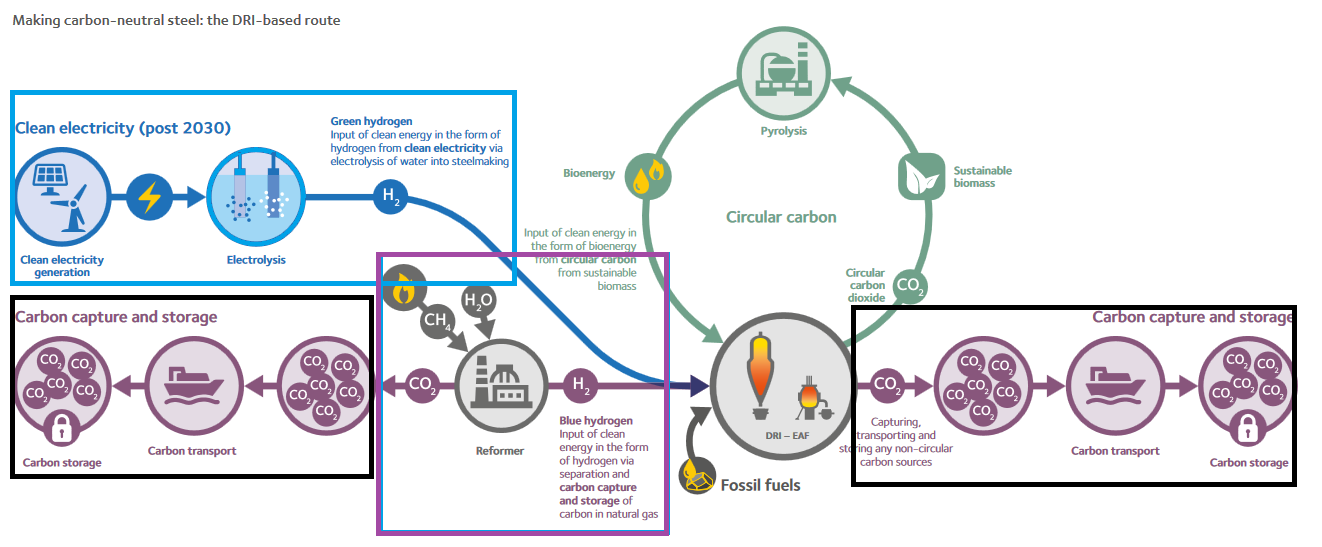
DRI (Direct reduction-based route) and EAF (Electric Arc Furnace )

Innovative DRI
Whereas our Smart Carbon pathway is applicable to the blast furnace – basic oxygen furnace steelmaking route, our Innovative DRI pathway applies to the direct reduced iron (DRI) – electric arc furnace route (EAF). In addition to scrap, the other metallic input in EAFs is direct reduced iron (DRI). This is made through the direct reduction of iron ore using natural gas. The heart of our Innovative DRI route involves replacing the natural gas (which acts as the reductant in the DRI process) with an alternate, clean energy source – hydrogen. We already know that hydrogen holds great potential as a reducing agent – today’s use of natural gas to make DRI implies that over 55% of the reduction process is done with hydrogen, as natural gas is split into hydrogen and carbon monoxide before the reaction chamber.
If hydrogen was produced via the electrolysis of water, with the electricity used for the electrolysis process derived from renewable sources, you could make zero-carbon DRI. If you then fed that into an EAF, along with scrap, and that EAF ran on renewable electricity you would be making zero-carbon steel. Fundamentally, that is what we are seeking to achieve with our Innovative DRI pathway – steelmaking which removes carbon in its entirety from the production process.
https://corporate.arcelormittal.com/climate-action/technology-pathways-to-net-zero-steel
https://corporate.arcelormittal.com/climate-action/technology-pathways-to-net-zero-steel
See also article
Hydrogen in steel production: what is happening in Europe – part two
—-
2.3 Our plans: the Smart Carbon Route BF – BOF
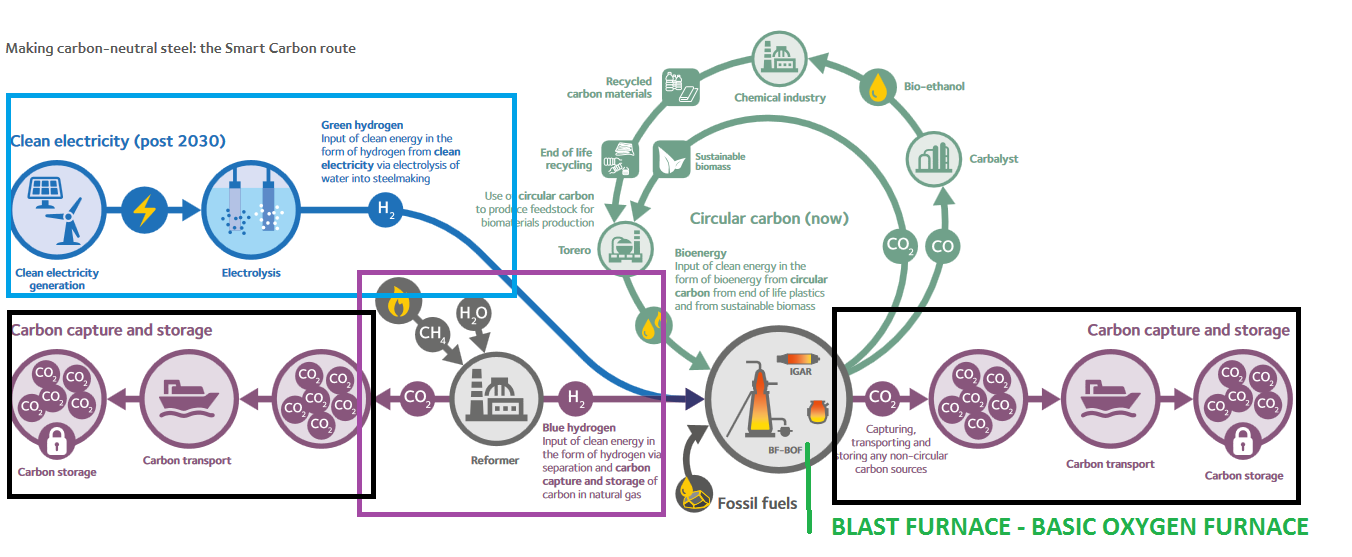
https://corporate-media.arcelormittal.com/media/ob3lpdom/car_2.pdf
See also article :
Hydrogen in steel production: what is happening in Europe – part one
Smart Carbon
Central to the Smart Carbon route is partially replacing the use of coal in a blast furnace with alternate sources of circular carbon from waste streams, such as sustainable biomass from agricultural waste or waste plastic. By making this change, we would be reducing the levels of CO2 in the atmosphere as fossil coal would remain in the ground. Using sustainable biomass from agricultural waste as the energy input would continue to lead to CO2 emissions, but these waste products would already emit CO2 as part of the natural, circular carbon cycle, as they decompose at the end of their natural life, hence this energy source is classified as carbon-neutral.
The Smart Carbon route also allows us to integrate carbon capture and re-use (CCU) or storage (CCS) technologies, meaning we would capture carbon emitted during the steelmaking process, therefore potentially making the route carbon-negative (i.e. the process has a net effect of removing CO2 from the atmosphere).
Furthermore, the end-of-process carbon which is captured could then be recycled and utilised by the chemicals industry, helping to produce carbon-neutral biomaterials.
https://corporate.arcelormittal.com/climate-action/technology-pathways-to-net-zero-steel
Webinar: Reducing the carbon footprint thanks to greener steel production and smart steel solutions (Video).
ArcelorMittal is actively exploring pathways to make steel production more sustainable, with pilot projects in areas such as: clean-power steelmaking and circular, low-emission carbon steelmaking……in VIDEO
https://www.youtube.com/watch?v=r2QT-AGpOms (VIDEO)
ArcelorMittal plans major investment in German sites, to accelerate CO2 emissions reduction strategy and leverage the hydrogen grid. 29.03.2021
ArcelorMittal is planning to build a large-scale industrial plant for the direct reduction of iron ore (DRI) and electric arc furnace (EAF)-based steelmaking at its site in Bremen, as well as an innovative DRI pilot plant in addition to an electric arc furnace (EAF) in Eisenhüttenstadt, following the announcement of the planned expansion of Germany’s hydrogen infrastructure.
Using green hydrogen, up to 3.5 million tonnes of steel could be produced by the Bremen and Eisenhuttenstadt sites by 2030, with significantly lower CO2 emissions. Depending on the amount of hydrogen available, CO2 savings of more than 5 million tonnes could be possible. The technology conversion requires investments in the range of €1-1.5 billion.
ArcelorMittal joins Shell, Vattenfall in green hydrogen network 28.04.2021
ArcelorMittal has joined Shell, Vattenfall and other cross-industry companies to form the so-called Hamburg Hydrogen Network, Kallanish learns from the company.
https://corporate.arcelormittal.com/sustainability/climate-action-in-europe
https://eurometal.net/arcelormittal-joins-shell-vattenfall-in-green-hydrogen-network/
https://corporate.arcelormittal.com/media/press-releases/arcelormittal-joins-breakthrough-energy-s-catalyst-program-as-anchor-partner
XCarb™ green steel certificates
XCarb™ green steel certificates are specifically designed for ArcelorMittal’s flat steel products made from iron ore in a blast furnace.
We have several decarbonisation initiatives underway – from our breakthrough technologies such as our Torero and Carbalyst projects, to projects to capture hydrogen-rich waste gas and re-inject it into the blast furnace. These investments are resulting in significant CO2 savings. We can add up these savings and then pass them onto our customers in the form of a certificate, which has been verified by an independent auditor. When a customer buys an XCarb™ certificate from us, they effectively ‘own’ the CO2 saving and can report that saving as a reduction in their Scope 3 emissions. This approach is in accordance with the GHG Protocol Corporate Accounting and Reporting Standard.
600,000 tonnes of XCarb™ green steel certificates available by the end of 2022
https://corporate.arcelormittal.com/climate-action/xcarb/xcarb-green-steel-certificates
https://corporate.arcelormittal.com/climate-action/xcarb/xcarb-green-steel-certificateshttps://corporate-media.arcelormittal.com/media/tpgclbid/xcarb_bookq_2110.pdf
—-
Futurising Videos : Specially nº 3 : Futurising – episode three: The steel plant of the future – Deploying the technology of tomorrow, today .
https://open.spotify.com/show/3yDafVJL1DWogZCbDMRKHh (copy and paste )
Regarding Arcelor Mittal, the information has been placed in previous sections.
———————–
119 TATA Steel
Green steel
While the critical role of steel to help build the net zero world of the future is clear – renewable energy projects, electric vehicles and sustainable buildings to name just a few – we recognise the current steel making process creates substantial CO2 emissions.
-Tata Steel’s UK business is committed to reducing its emissions, with the ambition of achieving CO2 neutral steel making by 2045 and achieving at least a 30% reduction in CO2 emissions by 2030 (compared to 2018 levels). To achieve this we are looking at a range of technology options and are holding detailed discussions with the UK Government.
-In the Netherlands we are committed to reducing our CO2 emissions with 35 – 40% by 2030 and being CO2-neutral by 2045.
https://www.tatasteeleurope.com/sustainability/carbon-neutral-steel
Focusing on circular economy for greener and better future
Committed to the conservation of natural resources, preservation of biodiversity and the abatement of climate change impact, Tata Steel aspires to set the Steel industry benchmark in ‘Environment Performance’.
https://www.tatasteel.com/corporate/our-organisation/environment/
https://www.tatasteeleurope.com/ts/sustainability
Tata Steel Netherlands opts for hydrogen route at IJmuiden steelworks. 15.09.2021
Tata Steel Netherlands, part of the global iron and steel major Tata Steel Group (Tata Steel), has announced plans to pursue a fully sustainable future for its steelworks in IJmuiden by adopting a hydrogen route. This involves the introduction of direct reduced iron (DRI) technology which can make iron using natural gas or hydrogen before it is converted to steel in one or more electric furnaces to be invested in the future.
Tata Steel UK’s journey to net-zero for a brighter, greener future
https://www.tatasteeleurope.com/sustainability/green-steel-solutions/optemis
——————-
120 JSW Steel
Steel & Sustainability – The Future is Green
https://www.jsw.in/steel/sustainability-everyday-responsibility
JSW STEEL LTD. and Environment Management
—-
JSW STEEL LTD readies for CBMA (Carbon Border Adjustment Mechanism) era with 4mt green steel unit.
Naman Suri , Mihir Mishra 24.10.2023
The EU’s CBAM transition, in effect from 1 October to 31 December 2025, will require companies to furnish extensive production and emission data for goods destined for the EU.
JWS Steel Ltd, India’s second-largest maker of the alloy, plans to establish a green steel manufacturing facility by 2030 as part of its response to the European Union’s (EU’s) Carbon Border Adjustment Mechanism (CBAM), said Jayant Acharya, joint managing director and chief executive.
“We are looking to set up a lower carbon-emitting facility for steel in the western part of India, subject to board approval. With this, we will be able to provide low-carbon steel for both the international and domestic markets,»
“It will have a capacity of 4 million tonnes (mt), and the plan is to start production by 2030. We are trying to complete it in two parts. We will do phase I (up to 2 mt) just before 2030, and the remaining construction will be going on and may spill over by one or two years.»
——————-
121 Essar Steel
Environmental Intersting Magazines
——————
122 MIDREX
Environmental
https://www.midrex.com/direct-from-midrex/?topic=environmental
(Copy and Paste)
https://www.midrex.com/wp-content/uploads/MIdrex_Process_Brochure_4-12-18.pdf
—-
MIDREX H2 – Midrex Technologies, Inc
The MIDREX® plant is extremely flexible and can accommodate the initial transitions from a carbon to a hydrogen economy.
As “green” hydrogen becomes available and cost effective, the MIDREX NG can be converted to MIDREX H2 in stages, allowing steelmakers to reduce CO2 emissions immediately and further reduce them in the future without major capital expenditure.
https://www.midrex.com/technology/midrex-process/midrex-h2/
Environmental (many articles in this Topic)
https://www.midrex.com/direct-from-midrex/?topic=environmental
Regarding MIDREX, the information has been placed in previous sections.
————————–
123 Big River Steel
Leed and Sustainability
https://bigriversteel.com/about/leed/
2018 Corporate Social Responsability Report, Pages 4-6
(Copy and Paste)
https://bigriversteel.com/wp-content/uploads/2018/10/BRS1809-CSR-Report-R15.pdf
————————-
123.01 Cleveland Cliffs
Environment
The Cleveland-Cliffs Commitment to Reduce greenhouse Gas Emissions THE CLEVELAND-CLIFFS COMMITMENT
China, the Environment, and the Next Decade (VIDEO)
Lourenco Goncalves, Chairman, President & CEO of Cleveland-Cliffs, presented the keynote speech at the Steel Success Strategies industry conference in June 2016. Mr. Goncalves provides an overview of the global iron ore and steel markets.
https://www.youtube.com/watch?v=FeZIohZB4u4
——————————–
124 Algoma Steel Inc.
Environment
https://www.algoma.com/environment/
https://www.algoma.com/environment/reporting/
——————-
125 EVRAZ
As one of the top steel producers in the world, EVRAZ is
committed to integrating the principles and values of
sustainable development into our daily operations.
https://www.evraz.com/en/sustainability/
https://www.evraz.com/en/sustainability/environmental-stewardship/approach-and-policies/
Our approach to climate change Pdf pp 1-16
https://www.evraz.com/upload/iblock/ce1/ce1e55ad49856e0fe2563b0599e3f073.pdf
——————–
126 SEVERSTAL
Sustainable development: Environment
https://www.severstal.com/eng/sustainable-development
with;
Climate Change
Greenhouse gas emissions
Biodiversity
https://severstal.com/eng/sustainable-development/environment/
Greenhouse gas emissions with graphics
Methodological approach to GHG emission accounting
https://severstal.com/eng/sustainable-development/climate/greenhouse-gas-emissions/
———————-
127 Novolipetsk Steel NLMK
Environmental management system
https://lipetsk.nlmk.com/en/responsibility/ecology/environmental-management-system/
Environmental programme 2020
https://lipetsk.nlmk.com/en/responsibility/ecology/environmental-programme-2020/
————————-
128 Ternium
Environment and Energy Efficiency
https://www.ternium.com/en/sustainability
https://www.ternium.com/en/sustainability/environment-and-energy-efficiency
————————-
129 Companhia Siderurgica Nacional
Environment, Circular Economy….very complete
http://www.csn.com.br/conteudo_eni.asp?idioma=1&conta=46&tipo=59594&prSv=1
————————-
130 Altos Hornos de Mexico (AHMSA)
Green AHMSA: Environmental Facts
In 2009 AHMSA was recognized by the Environmental and Natural Resources Department (Semarnat) for its leadership in the control of greenhouse gasses emissions.
In the last 18 years, all the steelworks and mining equipment at AHMSA and its companies have included advanced antipollution systems, reinforced with training of its personnel.
https://www.ahmsa.com/en/green-ahmsa/environmental-facts/
———————
131 Voestalpine
Environmentally friendly company
https://www.voestalpine.com/group/en/group/environment/
Core topics environment ( Copy and paste )
Environmental Report 2019, Pages 1 – 72
Voestalpine supplies first CO2-reduced premium steel. 2021
———————-
132 Arvedi Steel technology
Relationship with the environment
Accieria Arvedi becomes world´s first steel mill with net-zero emissions
SteelOrbis Wednesday 13 July 2022
——————-
133 ACCIAI SPECIALI TERNI (AST)
CLOSE ATTENTION TO THE ENVIRONMENT
https://www.acciaiterni.it/en/sustainability/ast-for-the-environment/
———————–
134 Baosteel Group
Environment management: Green Management System
https://www.baosteel.com/group_en/contents/2792/36264.html
CRS 2011 Baosteel Group Report, Environment, pages 37 – 49
http://tv.baosteel.com/web/plc/csr/2011CSR_E.pdf
———————–
135 HIBIS Hesteel Group
Environment Protection
http://www.tangsteel.com.cn/en/Type/SecondType1/43/0/0
———————–
136 Ansteel Group
2017 Sustainability Report: Page 51 – 62
http://en.ansteel.cn/upload/pdf/2017.pdf
—————–
137 Jiangsu Shagang Group
Environmental protection
(Copy and paste )
http://eng.shasteel.cn/shzr/lshb/index.shtml
———————-
137.01 Liberty Steel Group.
LIBERTY is seeking to transform steel manufacturing into a global product and technology leader through its GREENSTEEL strategies.
https://libertysteelgroup.com/delivering-cn30/greensteel/
LIBERTY, Paul Wurth and SHS – Stahl-Holding-Saar to develop major hydrogen-based steel making plant in France
Acciaio all’idrogeno: progetto di Liberty Steel
Memorandum d’intesa, in Francia, con Paul Wurth e SHS – Stahl-Holding-Saar per produrre DRI e HBI 22.02.2021
https://www.siderweb.com/articoli/news/709128-acciaio-all-idrogeno-progetto-di-liberty-steel
LIBERTY makes historic investment in Ostrava’s GREENSTEEL transformation
-LIBERTY Ostrava signs contract with Danieli for two hybrid electric arc furnaces
-New furnaces will reduce LIBERTY Ostrava’s emissions by over 80% by 2027
-LIBERTY to invest CZK 8.6 billion (EUR 350 million) in Ostrava, the largest investment in the steelworks in a generation
-Renewable energy partnership signed with ČEZ ESCO and GFG Foundation launched in Czech Republic
————-
137.02 John Cockerill
Green hydrogen:
As a player committed to the energy transition, John Cockerill Energy invests and innovates in the production, storage and distribution of green hydrogen.
- Electrolyzers
- Storage and Distribution
https://johncockerill.com/en/energy/green-hydrogen/
A pioneer in green hydrogen
Answering today’s ecological urgency and the need to reduce CO2 emissions, John Cockerill brings you a promising sector that could help decarbonise transport and industry: hydrogen. In this pioneering industry, we have already manufactured electrolysers and storage solutions for nearly 1,000 customers in different industries. Today, John Cockerill Hydrogen offers the most powerful electrolysers on the market, capable of producing up to 1000Nm³ per hour (equivalent to 5 megawatts (MW).
https://h2.johncockerill.com/en/
—————
137.02.01 ArcelorMittal and John Cockerill announce plans to develop world’s first industrial scale low temperature, iron electrolysis plant. 14.06.2023
Volteron™ plant targeted to start-up in 2027
ArcelorMittal, the world’s leading steel company, and John Cockerill, a group leading the development of steel processing facilities and electrolysers, today announce plans to construct the world’s first industrial-scale low temperature, iron electrolysis plant. The Volteron™ plant, which in a first phase will produce between 40,000 and 80,000 tonnes a year of iron plates, is targeted to start production in 2027. Once the technology has been proven at this scale, the intention is to increase the plant’s annual capacity to between 300,000 and 1 million tonnes.
ArcelorMittal and John Cockerill have been working together on an innovative electrochemical process to transform iron oxide into iron plates for the last few years. The successfully completed project, formerly known as SIDERWIN, has to date been publicly funded through the EU’s Horizon 2020 programme. In addition to ArcelorMittal and John Cockerill, project partners have included EDF, Tecnalia, Quantis, University of Aveiro, National Technical University of Athens, Norwegian University of Science and Technology, Dynergie, Recoy, CFD Numerics and Mytilineos. This next phase of the project will be carried forward as an exclusive partnership between ArcelorMittal and John Cockerill.
Volteron™ is a carbon free, cold direct electrolysis process that extracts iron from iron ore using electricity. On a pilot scale plant, the process has proved to be highly efficient using standard iron ore. The iron plates created during the electrolysis process are then processed into steel in an electric arc furnace.
——————————-
137.03 Swedish steel mill to install 17-MW hydrogen plant.
Renewables Now Plamera Thiseva 24.06.2021
Several Swedish and Norwegian companies have teamed up to build a 17-MW fossil-free hydrogen facility at Ovako AB’s steel mill in Hofors, Sweden, it was announced on Tuesday.
Ovako said the project will make it the first in the world to heat steel with hydrogen prior to rolling as a step towards climate-neutral steel production. The project will also create opportunities for the development of hydrogen infrastructure for the transport sector.
Besides Ovako, the partners include Nel Hydrogen Electrolyser, a division of Norway’s Nel ASA (OSE:NEL), which will supply the electrolyser equipment, Volvo AB (STO:VOLV-B), Hitachi ABB Power Grids Sweden and H2 Green Steel.
Ovako said this will be the largest fossil-free hydrogen facility in Sweden. The SEK-180-million (USD 21m/EUR 18m) project is supported by the Swedish Energy Agency.
Subject to securing permits, the electrolyser is expected to be completed by the end of 2022. It will reduce Ovako’s carbon dioxide (CO2) emissions for steel production in Hofors by 50% from already low levels.
The hydrogen facility could be used flexibly, thereby supporting grid stability and allowing for more renewables. The residual heat could also be used for district heating.
https://renewablesnow.com/news/swedish-steel-mill-to-install-17-mw-hydrogen-plant-745424/
Ovako Pledges to Go Carbon-Neutral in 2022
Reducing global C02 emissions demands smarter product solutions and requires rethinking on many levels: more performance benefits per kilogram of product, less raw materials, and substituting fossil fuel energy sources with primarily fossil-free electricity.
https://www.h2bulletin.com/ovako-to-produce-carbon-neutral-steel-from-jan-2022/
https://www.ovako.com/en/sustainability/environment/carbon-neutrality/
Ovako’s path to carbon-neutrality – some basic facts and figures
Ovako’s production is fully scrap-based, with over 97% of all iron and alloys used as input material being recycled. The electricity we consume comes entirely from fossil-free sources. Taken together with efficient processes and many other actions, such as conversion of our heat treatment, these factors mean that our carbon footprint from crude steel production is 95% below the global average. At present,
global emissions for the industry are estimated at 1700 kg of CO 2 per tonne of crude steel. By contrast, the Ovako figure is on average around 90 kg of CO 2 per tonne – vastly lower
https://www.ovako.com/globalassets/downloads/sustainability/ovako_path_to_carbon-neutrality.pdf (copy & paste )
—————————-
137.04 Energy live News
Sweden moves one step closer to green steel
Dimitris Mavrokefalidis 6 August 2020
Energy firm Vattenfall, steel company SSAB and mining group LKAB are working on a project which aims to deliver the ‘world’s first’ fossil-free iron ore pellets
https://www.energylivenews.com/2020/08/06/sweden-moves-one-step-closer-to-green-steel/
H2 scheme to create 5m tonnes of ‘green steel’ by 2030. The initiative is supported by Bill Gates-led coalition
————————-
137.05 PRIMETALS TECHNOLOGIES
Green steel for a zero-carbon world
Climate change is the defining environmental challenge of our times. Primetals Technologies has the expertise to make zero-carbon steel a reality
As of today, the steel industry’s number one product is not metals — it’s carbon. The sector is responsible for 7–10% of global CO2 emissions and about one-third of total emissions from industry. Tackling this situation is not only a moral imperative, it is an absolute necessity for businesses, as new emissions trading schemes are implemented, carbon prices are rising, and regulators are cracking down on polluting production facilities.
With decades of experience in the ironmaking, steelmaking, and continuous casting, Primetals Technologies has the expertise, the tools, and the experience to guide you toward a green and nonetheless profitable future — whether you are only looking to increase energy efficiency or are already aiming for a gradual transition to hydrogen-based, zero-carbon production routes.
To check out the CO2 emissions of steel plants, our experts developed the simulation tool “m.simtop”, operating on mass and energy balances.
https://www.primetals.com/
Agglomeration https://www.primetals.com/portfolio/agglomeration
·
Mini Mills https://www.primetals.com/portfolio/mini-mills
Get the latest research on green steel
https://www.primetals.com/landing-pages/decarbonization/publications
Decarbonization
https://www.primetals.com/landing-pages/decarbonization
– Carbon Direct Avioidance: MIDREX H2 and HYFOR (Hydrogen-based fine-ore reduction)
https://www.primetals.com/landing-pages/decarbonization/carbon-direct-avoidance
-Carbon Capture, Utilization and Storage: Gas Fermentation and Kansai Mitsubishi Carbon Dioxide Recovery Process (KM CDR Process™)
https://www.primetals.com/landing-pages/decarbonization/carbon-capture-utilization-and-storage
-By-Products Recicling
https://www.primetals.com/portfolio/eco-solutions/by-product-recycling
-Reducing Carbon in Existing Plants
https://www.primetals.com/landing-pages/decarbonization/reducing-carbon-in-existing-plants
– The minimill of the future
Cristiano Tercelli
Primetals Technologies Austria GmbH
Turmstraße 44, Linz, Austria, 4031 SEASI CONFERENCE 2020 pag 1-8
https://www.primetals.com/fileadmin/user_upload/landing_pages/2021/Green_Steel/Publications/downloads/The_Minimill_of_the_Future.pdf
——————–
137.06 Mitsubishi HeavyIndustries
Mitsubishi Heavy Industries Engineering, together with Kansai Electric Power Co., have already established and commercialized its own post combustion CO2 capture technology, so called KM-CDR Process™.
https://www.mhi.com/products/engineering/co2plants.html
https://www.mhi.com/products/engineering/projectrecords/co2plants.html
https://www.mhi.com/products/environment/carbon_dioxide_recovery_process_outline.html
https://www.sciencedirect.com/science/article/pii/S187661021731901X
https://www.researchgate.net/publication/319196009_KM_CDR_Process_TM_Project_Update_and_the_New_Novel_Solvent_Development
https://www.co2conference.net/wp-content/uploads/2019/12/10-Wu-MHIA-KM-CDR-Process-Post-Comb-CO2-Capture-Technology.pdf
————————
Hydrogen production (General overview):
Methods of hydrogen production
https://en.wikipedia.org/wiki/Hydrogen_production
https://www1.eere.energy.gov/hydrogenandfuelcells/pdfs/h2_tech_roadmap.pdf (pages 1-20).
Green hydrogen and green ammonia
———————–
137.07 Towards hydrogen definitions based on their emissions intensity.
Iea ( international Energy Agency )
G7 2023 Hiroshima Summit Pdf pp 1-87
Table of contents
Executive summary pp. 7
Introduction pp.11
Hydrogen and its derivatives in a net zero energy system pp. 13
Hydrogen today pp 14
The role of hydrogen, ammonia and hydrogen-based fuels in the transition to net zero . pp. 15
Trade of hydrogen, ammonia and hydrogen-based fuels pp 20
The cost of hydrogen supply pp. 22
Accelerating deployment to meet ambitions pp. 28
Clear hydrogen definitions to address deployment barriers pp. 30
International co-operation to facilitate deployment pp. 31
Defining hydrogen according to its emissions intensity pp. 33
Introduction pp 34
Elements of regulations and certification systems for hydrogen pp.36
The emissions intensity of hydrogen production routes pp.38
Emissions intensity and costs of hydrogen production in IEA scenarios
pp.52
Towards an international emissions accounting framework to define hydrogen pp.59
Considerations for an international accounting framework pp 60
Avenues for implementation pp. 70
Practical considerations for effective implementation pp.76
Considerations for the G7 pp. 83
Annex pp.86
Abbreviations and acronyms pp.86
Units of measure
——————————–
137.07.01 Emissions Measurement and Data Collection for a Net Zero Steel Industry
Iea ( international Energy Agency ) April 2023 Pdf pp 1-54
About this report
The implementation phase for achieving a net zero steel industry will require robust methodologies for measuring emissions at the site- and product-level, together with data collection frameworks to facilitate comparison and track progress. An existing array of methodologies and frameworks for the steel industry provide a good starting point for efforts to achieve these outcomes, but much work remains to achieve interoperability, transparency and fitness for purpose for net zero. Following an evaluation of these existing methodologies and frameworks, this report provides “net zero principles” to guide potential next steps for their development and implementation, together with specific policy recommendations for G7 members.
In the context of Japan’s G7 Presidency, the Ministry of Economy, Trade and Industry requested the International Energy Agency (IEA) to examine the topic of Emissions Measurement and Data Collection for a Net Zero Steel Industry. This work complements that undertaken during Germany’s G7 Presidency in 2022 – Achieving Net Zero Heavy Industry Sectors in G7 Members – providing insights and direction for the G7 Industrial Decarbonisation Agenda with regard to tackling industrial emissions.
https://www.iea.org/reports/emissions-measurement-and-data-collection-for-a-net-zero-steel-industry
Download pdf
—————————
137.07.02 HYDROGEN STRATEGY
Enabling A Low-Carbon Economy
Regis Conrad and Timothy Reinhardt
Office of Fossil Energy
United States Department of Energy July 2020
Washington, DC 20585
Very complete and interesting
Contents : Introduction, Background, Hydrogen production and cost, Hydrogen uses and equivalent costs, Hydrogen demand, Emerging Markets and international initiatives, Hydrogen transportation, Hydrogen storage, Office of fossil energy,safety and regulatory requirements and challenges, Very Complete References about Hydrogen.
This document summarizes current hydrogen technologies and communicates the U.S. Department of Energy (DOE),
Office of Fossil Energy’s (FE’s) strategic plan to accelerate research, development, and deployment of hydrogen
technologies in the United States. It also describes ongoing FE hydrogen-related research and development (R&D).
Hydrogen produced from fossil fuels is a versatile energy carrier and can play an important role in a transition to a low-
carbon economy.
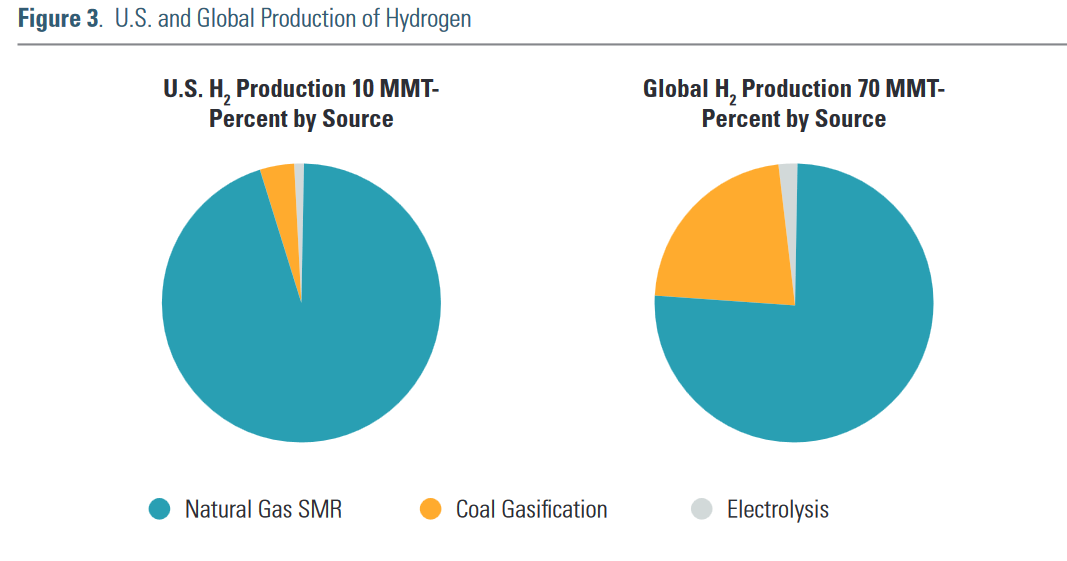

https://www.energy.gov/sites/prod/files/2020/07/f76/USDOE_FE_Hydrogen_Strategy_July2020.pdf
References:
-International Energy Agency (IEA). «The Future of Hydrogen.» 2019. Accessed online.
https://www.iea.org/reports/the-future-of-hydrogen
-Shaner, Matthew R.; Atwater, Harry A.; Lewis, Nathan S.; McFarland, Eric, W.
“A comparative technoeconomic analysis of renewable hydrogen production using solar energy.” 2016.
doi:10.1039/c5ee02573g. Accessed online.
https://www.osti.gov/servlets/purl/1436115.
-IEA. “Technology Roadmap: Hydrogen and Fuel Cells.” 2015. Accessed online.
Download full report
https://www.iea.org/reports/technology-roadmap-hydrogen-and-fuel-cells.
-Heid, B.; Linder, M.; Orthofer, A.; Wilthaner M.
«Hydrogen: The next wave for electric vehicles?» 2017. Accessed online.
-European Commission.
«A hydrogen strategy for a climate-neutral Europe.» 2020. Accessed online:
https://ec.europa.eu/energy/sites/ener/files/hydrogen_strategy.pdf
Production of hydrogen for steelmaking
-Integration of water electrolysis for fossil-free steel production
AndriesKrügera,JoakimAnderssonb,StefanGrönkvistb,AnnCornella
International Journal of Hydrogen Energy Volume 45, Issue 55, 6 November 2020, Pages 29966-29977.
https://www.sciencedirect.com/science/article/pii/S0360319920331207
—–
-Anion exchange membrane water electrolysis using AemionTM membranes and nickel electrodes.
Amirreza Khataee, Anuja Shirole, Patric Jannasch Ann Cornell
Journal of Materials Chemistry A 10(30) January 2020
DOI: 10.1039/D2TA03291
———————–
137.08 H2 green steel
H2 Green Steel was founded in 2020 with the ambition to accelerate the decarbonization of the steel industry, using green hydrogen. Steel production, which is one of the world’s largest carbon dioxide emitters, is the company’s first vertical business. The founder and largest shareholder of H2 Green Steel is Vargas, which is also co-founder and one of the larger shareholders in Swedish battery maker Northvolt. H2 Green Steel is headquartered in Stockholm, Sweden, with its first commercial green steel plant under development in Boden, northern Sweden.
Steel is the world’s most important engineering and construction material, used in every aspect of our lives – from the cars we drive and the buildings we work in, to the homes in which we live and the kitchen appliances we use every day.
Steel is the foundation to our modern society. Europe has a rich history of cooperation on steel with a common market that spurred economic growth and innovation, improving living standards as well as generating employment and tax revenue.
But steel is also one of the world’s dirtiest industries, responsible for more than 7 percent of global CO2 emissions. At H2 Green Steel, we are taking on decarbonization on an industrial scale, working with our customers and partners to show that change is possible.
Sustainable green steel production will unlock immense opportunities for people and the planet. And we’re not going to stop innovating, developing, and collaborating to find new and better ways to make steel that is not only kind to people, but also the environment.
https://www.h2greensteel.com/green-steel
Includes ( very complete ):
The basics of hydrogen – an introduction
The Colors of Hydrogen
Green hydrogen enables the decarbonization of steel production
The power of green hydrogen
https://www.h2greensteel.com/green-hydrogen
H2 Green Steel
H2 Green Steel
H2 Green Steel raises €1.5 billion in equity to build the world’s first green steel plant 7.09.2023
In the largest private placement in Europe this year, H2 Green Steel has raised about €1.5 billion in equity from an investor group led by Altor, GIC, Hy24 and Just Climate. The round will finance the world’s first large-scale green steel plant and Europe’s first giga-scale electrolyzer.
The proceeds will finance the construction and development of H2 Green Steel’s flagship large-scale green steel plant in Boden, Sweden. Groundworks have been ongoing on the site in Boden since summer 2022, and through this transaction H2 Green Steel takes another big leap towards start of operations end of 2025.
The plant will deliver steel with up to 95 percent less CO2 emissions compared to steel produced with traditional blast furnace technology. This is made possible by replacing coal in the production process with hydrogen, produced on-site with Europe’s largest electrolyzer, using electricity from renewable sources. Next-generation technology and digitalization, along with an unmatched approach to both circularity and recycling, will make the steel plant the first of its kind.
Download complete information ( pdf) from:
—-
H2 Green Steel
Contracts with Midrex and Paul Wurth for the world’s first commercial 100% hydrogen direct reduced iron plant, and Kobe Steel partners with H2 Green Steel for equity investment.
Kobe Steel, Ltd October 12, 2022
Midrex Technologies (Midrex), a wholly owned subsidiary of Kobe Steel, and its consortium partner Paul Wurth, an SMS group company, have signed a contract with Sweden-based H2 Green Steel to supply the innovative MIDREX H2™ technology for the world’s first commercial 100% hydrogen direct reduced iron (DRI) plant, which is expected to start operation in 2025 and have an annual capacity of 2.1 million tonnes of DRI/HBI .
In addition, Kobe Steel has decided an investment in H2 Green Steel and has begun discussions with H2 Green Steel for the possible purchase of green HBI in the future.
https://www.kobelco.co.jp/english/releases/1210747_15581.html
—-
H2 Green Steel
Mercedes-Benz and H2 Green Steel announce agreements in both Europe and North America 7.06.2023
Mercedes-Benz and H2 Green Steel have signed a binding agreement for the delivery of about 50.000 tonnes of green steel to the car maker’s European production annually. In a pioneer move Mercedes-Benz has also signed a memorandum of understanding with H2 Green Steel for the potential supply of green steel produced in North America.
Mercedes-Benz was an early investor in H2 Green Steel and was also early out in confirming customer demand for green steel through an offtake agreement. This agreement has now been further developed into a binding agreement covering volumes of about 50.000 tonnes per year, which will be produced in H2 Green Steel’s green hydrogen-powered iron and steel plant in Boden in northern Sweden. In using high-quality steel that is sustainably produced, Mercedes-Benz takes yet another step towards reducing the environmental impact from its car manufacturing.
—-
H2 Green Steel
H2 Green Steel collaborates with Volvo Group for supply of near zero emissions steel 14.09.2023
STOCKHOLM, Sept. 14, 2023 /PRNewswire/ — As commercial vehicles increasingly run on electrified solutions, reducing the emissions when the product is in use, the environmental footprint from the supply network and production becomes increasingly important. Since steel is one of the main input materials in the manufacturing of trucks, buses and construction machines, a shift towards green steel is a vital element for Volvo Group’s continued journey towards decarbonization.
The long-term supply agreement placed from Volvo Group is for green steel from H2 Green Steel’s new plant in Boden in Northern Sweden. Start of production is planned for end of 2025. Deliveries to Volvo Group will start mid-2026.
https://www.prnewswire.com/news-releases/h2-green-steel-collaborates-with-volvo-group-for-supply-of-near-zero-emissions-steel-301927382.html
https://www.prnewswire.com/news-releases/h2-green-steel-is-the-first-manufacturing-company-to-join-exponential-roadmap-initiative-as-climate-solutions-company-301931803.html
Complete information from :
H2 Green Steel collaborates with Volvo Group for supply of near zero emissions steel
https://mb.cision.com/Main/20623/3834924/2294234.pdf
——
Porsche, Volvo, IKEA, Rio Tinto etc….plans to use CO2-reduced steel from H2 Green Steel in sports cars from 2026 ( And much more ) 31.10.2023
https://www.h2greensteel.com/latestnews
and
https://news.cision.com/h2-green-steel/?q=H2%20green%20Steel&m=Press
—-
H2 Green Steel has signed a 7-year binding agreement with ZF, one of the biggest suppliers to the automotive industry globally. Deliveries of near zero emissions steel are set to begin in 2026.
https://www.h2greensteel.com/latestnews/h2-green-steel-in-15-billion-euro-agreement-with-zf
—————–
137.08.01 Salzgitter orders one of Europe’s largest green hydrogen plants from ANDRITZ 20.09.2023
Salzgitter AG has ordered a 100 MW green hydrogen plant for low-CO2 steel production from ANDRITZ GROUP.
Hydrogen will be used instead of coal on an industrial scale.
This contract completes the orders for all plants and systems for the first stage of Salzgitter’s SALCOS® sustainable transformation program.
ANDRITZ will build a 100 MW electrolysis plant at the Salzgitter Flachstahl GmbH site on an EPC basis, incorporating pressurized alkaline electrolyzer technology from HydrogenPro. Starting in 2026, The 100 MW plant will comprise 18 units of HydrogenPro’s 5.5MW cell stacks.
The plant will produce around 9,000 tons of green hydrogen per year, which will be used to produce green steel. This will mark the start of the industrial utilization of hydrogen under the SALCOS® program.
https://www.andritz.com/newsroom-en/metals/2023-09-20-salzgitter-group
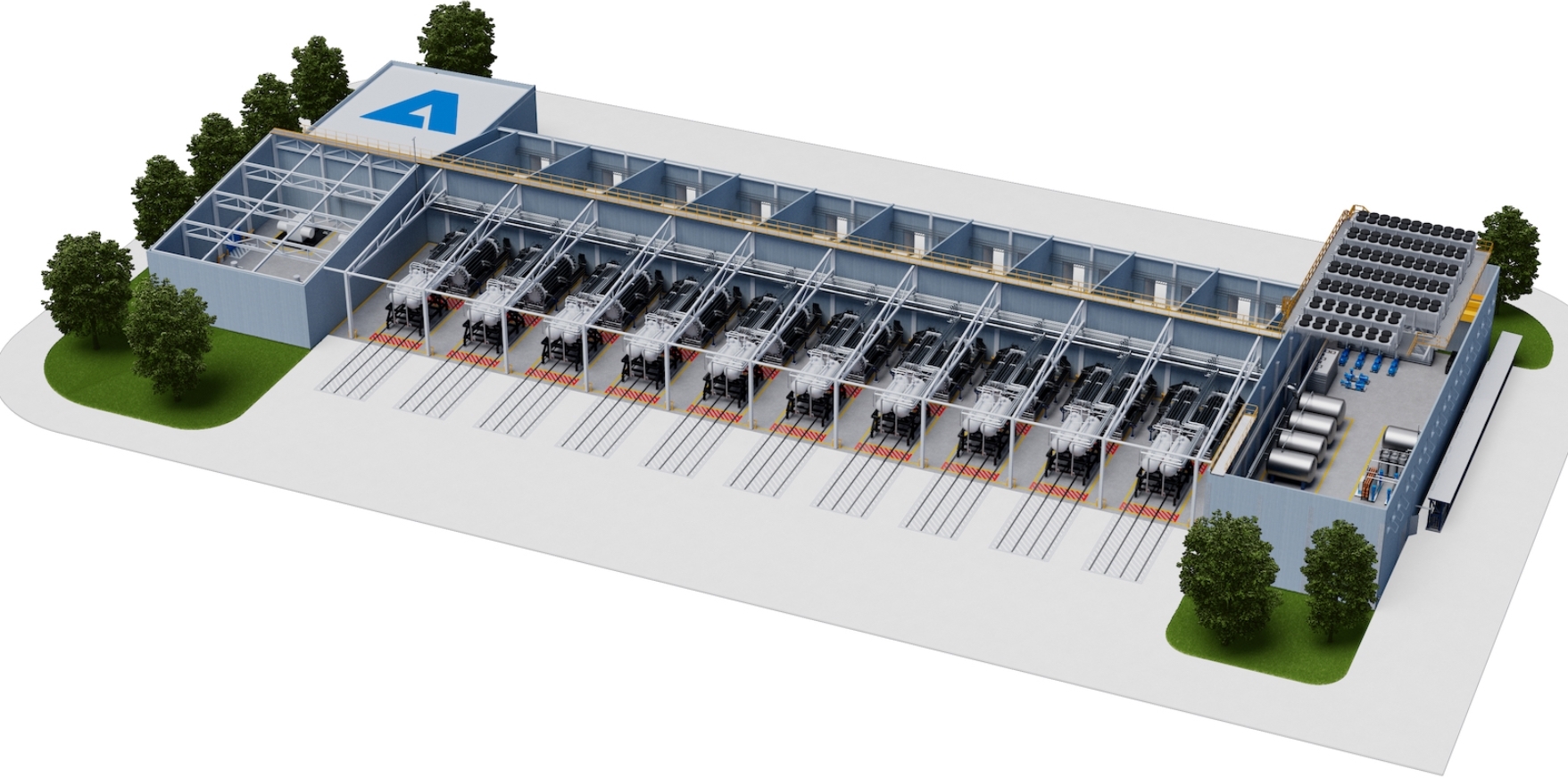
https://www.greencarcongress.com/2023/09/20230923-salcos.html
See: What happen during electrolysis:
——————–
137.08.02 ArcelorMittal and EDP to study the use of green hydrogen in steel production in Brazil.
Green car Congress 04.11.2023
ArcelorMittal Tubarão and EDP, a company that operates in all segments of the Brazilian electricity sector, signed a Memorandum of Understanding (MOU) to evaluate the technical and economic feasibility of a pilot plant for the production and use of green hydrogen in the steel manufacturing process.
The initiative is part of the efforts of ArcelorMittal Tubarão to boost the production of low-carbon steel and EDP to expand the production of green hydrogen using the expertise of the company, which pioneered the production of the first green hydrogen molecule in Latin America in December 2022.
According to Jorge Oliveira, CEO ArcelorMittal Aços Planos Latin America, this initiative is aligned with the Group’s global goal of becoming carbon neutral by 2050, participating in the transition process to a low-carbon economy.
https://www.greencarcongress.com/2023/11/20231104-arcelor.html
———————
137.08.03 Toward green steel: Modeling and environmental economic analysis of iron direct reduction with different reducing gases
Antonio Trinca, Daniele Patrizi, Nicola Verdone, Claudia Bassano, Giorgio Vilardi.
Journal of Cleaner Production VOL. 427 November 2023
https://doi.org/10.1016/j.jclepro.2023.139081
Download From
https://www.sciencedirect.com/science/article/pii/S0959652623032390
—————-
137.09 Hydrogen Production from Natural Gas Reforming
Office of Energy Efficiency & renewable Energy USA
Natural gas reforming is an advanced and mature production process that builds upon the existing natural gas pipeline delivery infrastructure. Today, 95% of the hydrogen produced in the United States is made by natural gas reforming in large central plants. This is an important technology pathway for near-term hydrogen production.
Natural gas contains methane (CH4) that can be used to produce hydrogen with thermal processes,
- Steam-methane reformation
CH4 + H2O (+ heat) → CO + 3H2
CO + H2O → CO2 + H2 (+ small amount of heat)
- Partial oxidation.
CH4 + ½O2 → CO + 2H2 (+ heat)
CO + H2O → CO2 + H2 (+ small amount of heat)
https://www.energy.gov/eere/fuelcells/hydrogen-production-natural-gas-reforming
———————
137.10 SMR Hydrogen Plant. (System Steam Methane Reforming).
Sichuan Techairs Co., Ltd China, Chengdu, Sichuan
Manufacturer of a wide range of products which include 35000Nm3/h Natural Gas SMR Hydrogen Plant Industrial Hydrogen Production,Automatic SMR Hydrogen Generation System Steam Methane Reforming Technology,1200Nm3/H High Purity SMR (System Steam Methane Reforming).
——————-
137.10.01 Utility Global partners with Stelco for the decarbonization of integrated steelmaking
H2TECH 24.03.2023
Utility Global and Stelco announced an agreement to test certain of Utility’s advanced decarbonization technologies at Stelco’s Lake Erie Works integrated steelmaking site located in Nanticoke, Ontario, Canada. Utility’s eXERO technology is uniquely suited to processing by-product gases from hard-to-decarbonize industries, particularly steelmaking, and converting these gases into high-value H2.
Following the successful completion of Utility’s pilot program in February 2023, Utility is installing a field demonstration facility at the Stelco site. This will demonstrate Utility’s technology and capability to produce reliable and cost-effective H2 under actual site conditions. Scheduled for operation in the second-half of 2023, it is the next key milestone in commercializing this disruptive by-product gas-to-value technology, and its unique ability to decarbonize hard-to-abate sectors.
———————
137.11 SALCOS (Salzgitter Low CO2 Steelmaking),
https://www.salzgitter-ag.com/en/index.html (see Figures)

SALCOS® (Salzgitter Low CO2 Steelmaking)
With SALCOS® (Salzgitter Low CO2 Steelmaking), we have joined forces with partners from industry and research to lay the foundations for virtually CO2-free steel production. Central elements of the concept are electricity from renewable sources and its use in the production of hydrogen by means of electrolysis. This green hydrogen will replace the coal we currently use in the conventional blast furnace process. This will be possible with the help of so-called direct reduction plants, in which iron ore is reduced to iron directly in the solid state by hydrogen. This technology emits water vapor instead of CO2.
How do we produce green hydrogen?
Hydrogen can be produced by means of electrolysis. In this chemical reaction, water is split into its components hydrogen and oxygen by means of electricity. It is beyond doubt for us that the electricity required for this must come from renewable energies such as wind power.
Project WindH2
For the production of green hydrogen, we erected seven wind turbines on our Group premises in Salzgitter under the project name «WindH2 – Wind Hydrogen Salzgitter«, together with Avacon Natur GmbH. The green electricity generated by these plants is used to produce green hydrogen by means of PEM (Polymer Electrolyte Membrane) electrolysis.
PEM https://en.wikipedia.org/wiki/Polymer_electrolyte_membrane_electrolysis
https://salcos.salzgitter-ag.com/en/windh2.html
—-
Project GrenHy2.0
Another electrolysis is being operated as part of the GrInHy2.0 project. The high-temperature electrolyzer is the largest of its kind in the world and operates highly efficiently. Unlike PEM electrolysis, the GrInHy2.0 electrolyzer uses steam from industrial waste heat from steel production. Both plants can cover today’s hydrogen demand for annealing processes and for steel refining, thus displacing gray hydrogen generated from natural gas from our production. However, the quantity required for this is only a fraction of the hydrogen needed for SALCOS® implementation.
https://salcos.salzgitter-ag.com/en/grinhy-20.html
—-
Project mDRAL Innovation Project ( experimental Project for micromills)
Our direct reduction ironmaking plant is the world’s first direct reduction plant (DRI plant) flexibly operated with hydrogen and natural gas in an integrated steel mill, μ here stands for the reduction scale of the plant. In this way, we demonstrate the process and gain the necessary knowledge to produce on a much larger scale on DRI plants in a few years.
Direct reduction enables us to avoid the generation of CO2 in steel production from the outset («carbon direct avoidance» strategy) and is therefore a significant sub-step of the SALCOS® project.
https://salcos.salzgitter-ag.com/en/mydral.html
—-
SALZGITTER DRI PRODUCTION USING UP TO 100% H2
Tenova received the order for a demonstration DRI plant using up to 100% hydrogen as reducing agent from Salzgitter Flachstahl GmbH.
Salzgitter Flachstahl GmbH, the largest steel subsidiary in the Salzgitter Group, has commissioned Tenova for the construction of µDRAL, a demonstration plant for the production of Direct Reduced Iron (DRI), using up to 100% hydrogen as reducing agent. The plant is based on the ENERGIRON® technology and will be installed on the premises of the Salzgitter steel mill at Salzgitter, Germany.
The µDRAL will have a nominal production capacity of 100 kg/h and will be operated with hydrogen and natural gas showing the flexibility of the technology in terms of fluctuating availabilities of reducing agents, including 100% hydrogen. The DRI produced by µDRAL will be both used in the blast furnace process to save injected coal and in the electric arc furnace of the Peine plant.
The ENERGIRON® process, jointly developed by Tenova and Danieli, represents the base for the plant design and is the most feasible high-intensity H2 DR system available, already designed for extremely low CO2 emissions while processing virgin metallic units. This enables Salzgitter to achieve the long-term CO2 reduction targets, defined with SALCOS® approach.
https://www.energiron.com/energiron-towards-a-green-future/
——
SALCOS® milestone reached – Salzgitter AG awards contract for direct reduction plant
Salzgitter AG 24.05.2023
——
TENOVA :
SALCOS®: The Hydrogen Revolution in Steelmaking
Green hydrogen can replace fossil fuels in Direct Reduction plants: The strategic cooperation between Tenova and Salzgitter AG aims to slash CO2 emissions up to 95%.
The steel business is one of the major industrial sources of climate pollution. It is responsible for 7% to 9% of all direct fossil fuel emissions. Reversing the emissions course is more urgent than ever. The viable pathway to reduce the emissions from making steel relies on hydrogen technologies. As the notion of replacing fossil fuels with green hydrogen in steelmaking has recently been gaining traction, Tenova and its partners have already taken some big and concrete steps.
The strategic cooperation signed with Salzgitter AG, originated in the pursuit of SALCOS®, a revolutionary concept for a significantly CO2-reduced steel production method that will potentially slash CO2 emissions up to 95%.
VIDEO (Interesting)
https://tenova.com/metals-insights/salcosr-hydrogen-revolution-steelmaking
—-
HBIS is producing DRI by using more than 60% of hydrogen
—-
ENERGIRON® technology has set a new milestone in Green Steel production 29.05.2023
Chinese HBZX High Tech, part of Hebei Iron & Steel Group – HBIS, is the first worldwide steelmaker producing DRI using more than 60% Hydrogen in the feed gas mix, on industrial basis. This happened at the HBZX plant, in Xuan Hua, Zhangjiakou, Hebei province, where a new, 600,000 tpy, Zero Reformer, ENERGIRON® direct reduction plant has been supplied and achieved continuous, stable, and safely production with outstanding quality.
This is an outstanding achievement, since the plant is the first hydrogen-enriched gas-powered DRI industrial production facility in the world and represents a significant accomplishment for the Chinese steel industry, being also the first green gas-based DRI plant in the country, paving the way to the transition from the carbon-based BF route to gas-based DRI technology and electric steelmaking.
The ENERGIRON® direct reduction technology, jointly developed by Tenova and Danieli, allows the highest targets in terms of energy efficiency, product quality and environmental compliance, thanks to use of hydrogen as reducing agent up to 100%. With a CO2 release as low as 250 kg/ton of DRI, the HBIS plant will be the greenest industrial DRI plant in the world. Furthermore, the carbon dioxide is selectively recovered by a CO2 removal unit included in the basic ENERGIRON® DR technology process scheme, and part of it will be reutilized in downstream processes (carbon capture and use or storage CCU/CCS).
This would lead to a final net emission of just about 125 kg of CO2 per ton of DRI.
https://tenova.com/newsroom/latest-tenova/hbis-producing-dri-using-more-60-hydrogen
https://tenova.com/technologies/energironr
SUSTAINABILITY REPORT 2022. pag 1 – 83
https://tenova.com/newsroom/latest-tenova/2022-sustainability-report-released
————————
137.12 COAL GASIFICATION
Coal Gasification Pilot Plant for Hydrogen Production. Part B: Syngas Conversion and Hydrogen Separation.
ResearchGate January 2005
Giovanni RAGGIO, Alberto PETTINAU *, Alessandro ORSINI, Marcella FADDASOTACARBO S.p.A.– Società Tecnologie Avanzate Carbone – c/o Centro Servizi C.N.I.S.I. 09010,Portoscuso (CA), ITALY
Daniele COCCO University of Cagliari – Department of Mechanical Engineering – piazza d’Armi, 09123 Cagliari, ITALY
Paolo DEIANAENEA – Centro Ricerche della Casaccia – via Anguillarese 301, 00060 S.Maria di Galeria (RM),ITALY.
Maria Luisa PELIZZA, Massimo MARENCOAnsaldo Ricerche – corso Perrone, 25 – 16152 Genova, ITALY
———————
137.13 Iberdrola and H2 Green Steel sign 2.3 billion euros green hydrogen deal. 12.2021
Iberdrola (Bilbao, Spain) and H2 Green Steel have signed an agreement to build a green hydrogen plant with an installed capacity of 1,000 MW and an estimated investment of €2.3 billion. The new plant will power with clean fuel a direct steel reduction furnace with a capacity to produce around 2 million tons per year of pure green steel, with a 95% reduction in CO2 emissions.
The site will be located on the Iberian Peninsula, where several possible locations are currently being considered, with the intention of production starting in 2025 or 2026. All locations that H2 Green Steel and Iberdrola are evaluating will have access to renewable energy, as well as all the infrastructure necessary to operate a successful hydrogen, green steel business.
https://www.iberdrola.com/press-room/news/detail/deal-green-hydrogen-iberdrola-h2-green-steel
————————–
137.14 Safety First : Production, Storage and Safe Handling of Hydrogen (video 24.06.2020)
AIST Association for Iron & Steel Technology https://www.aist.org/home/
Presenters:
Minish Shah, Corporate Fellow, H2 and Syngas R&D, Linde PLC
Alexander Schriefl, Lurgi Technologies Director, Air Liquide Global E&C Solutions
Stewart Stewart, Chief Commercial Officer, BayoTech Inc
Moderators: Chris Pistorius, Carnegie Mellon University and Zane Voss, CIX Inc
Hydrogen has been identified by some organizations as a key part in the decarbonization of ironmaking. It shows great potential in this role, but also presents substantial challenges. With this webinar, the DRITC hopes to educate members on the current state of hydrogen production.
https://www.youtube.com/watch?v=Kbwdj418Kxc&t=71s
———————-
137.15 Safety First : HYBRIT: A unique, underground, fossil-free hydrogen gas storage facility is being inaugurated in Luleå. 14.06.2022
SSAB, LKAB and Vattenfall are inaugurating HYBRIT’s pilot facility for fossil-free hydrogen gas storage at Svartöberget in Luleå, Sweden. The rock cavern storage facility is the first of its kind in the world. The inauguration ceremony marks the start of the two-year test period, which will run until 2024.
The HYBRIT initiative was launched in 2016 by the three owners; SSAB, LKAB and Vattenfall. The hydrogen storage facility will play a very important role in the overall value chain for fossil-free iron and steel production. Producing fossil-free hydrogen gas when there is a lot of electricity, for example when it is very windy, and using stored hydrogen gas when the electricity system is under strain, will ensure a steady production of sponge iron, the raw material behind fossil-free steel.
https://www.ssab.com/en/news/2022/09/hybrit-milestone-reached–pilot-facility-for-hydrogen-storage-up-and-running
———————-
Safety First : Hydrogen storage bibligraphic references
Efficiency of subset simulation in the design of lined rock caverns for storage of hydrogen gas
Davi R. Damasceno, Johan Spross, Fredrik Johansson & Jan Johansson.
May 26, 2019. Conference: 13th International Conference on Applications of Statistics and Probability in Civil Engineering At: Seoul, South Korea
—–
Large-scale storage of hydrogen
Joakim Andersson & Stefan Grönkvist. May 3, 2019. In:
International Journal of Hydrogen Energy Volume 44, Issue 23, Pages 11901-11919
https://www.researchgate.net/publication/332763250_Large-scale_storage_of_hydrogen
—–
Investigation of research needs regarding the storage of hydrogen gas in lined rock caverns
Fredrik Johansson, Johan Spross, Davi R. Damasceno & Jan Johansson. Report. June 20, 2018. Stockholm: KTH Royal Institute of Technology.
http://kth.diva-portal.org/smash/record.jsf?pid=diva2%3A1221714&dswid=-7605
—–
Reliability-based design methodology for lined rock cavern depth using the response surface method
Davi R. Damasceno, Johan Spross & Fredrik Johansson. March 2020. In: ISRM International Symposium – EUROCK 2020, International Society for Rock Mechanics.
http://kth.diva-portal.org/smash/record.jsf?pid=diva2%3A1539230&dswid=3894
———-
A comparison of two hydrogen storages in a fossil-free direct reduced iron process
Joakim Andersson & Stefan Grönkvist. August 2021. In: International Journal of Hydrogen Energy. Volume 46, Issue 56, Pages 28657-28674.
https://www.sciencedirect.com/science/article/pii/S0360319921022436?via%3Dihub
——-
Non –geological hydrogen storage for fossil – free steelmaking
Joakim Andersson. PhD thesis. April 2022. Stockholm: KTH Royal Institute of Technology.
http://kth.diva-portal.org/smash/record.jsf?pid=diva2%3A1643654&dswid=6984
https://kth.diva-portal.org/smash/get/diva2:1643654/FULLTEXT03.pdf
——–
Application of Liquid Hydrogen Carriers in Hydrogen Steelmaking
Joakim Andersson. March 2021. In: Energies, 14(5), 1392
https://www.mdpi.com/1996-1073/14/5/1392
——
————————
————————
6- GENERAL BIBLIOGRAPHY, CONGRESSES AND CONFERENCES.
137.15.01 Course Introduction – Hydrogen Energy: Production, Storage, Transportation and Safety
Prof. Pratibha Sharma
ITT BOMBAY July 2022,
See or Download from:
https://www.youtube.com/watch?v=anDF-nUHZW4&t=107s
Lecture 01: Properties of Hydrogen
https://www.youtube.com/watch?v=Et6bYcn_uQE&list=PLOzRYVm0a65dtZiqOUeyWCiCWL4vWaDwj&index=3
Lecture 02: Status of Hydrogen Supply and Demand
https://www.youtube.com/watch?v=BWk4ulwa7pY&list=PLOzRYVm0a65dtZiqOUeyWCiCWL4vWaDwj&index=4
Lecture 03: Methods of Hydrogen Production
https://www.youtube.com/watch?v=_w4XDfNPh68&list=PLOzRYVm0a65dtZiqOUeyWCiCWL4vWaDwj&index=5
Lecture 04: Steam Methane Reforming Part – 1 – YouTube
https://www.youtube.com/watch?v=_w4XDfNPh68&list=PLOzRYVm0a65dtZiqOUeyWCiCWL4vWaDwj&index=6
Lecture 05: Steam Methane Reforming Part-2 – YouTube
Lecture 06: Steam Reforming of Higher Hydrocarbons – YouTube
Lecture 07: Tutorial -1 – YouTube
Lecture 08: Advanced Methods of Steam Reforming – YouTube
Lecture 09: Partial Oxidation Method for Hydrogen Production – YouTube
Lecture 10: Autothermal Reforming – YouTube
Lecture 11: Combined, Dry, Bi and Tri Reforming – YouTube Lecture 12: Reforming using Alternate Energy Sources – YouTube
Lecture 12: Reforming using Alternate Energy Sources – YouTube
Lecture 13: Tutorial – 2 – YouTube
Lecture 14: Hydrogen Production by Methane Decomposition – YouTube
Lecture 16: Hydrogen Production from Biomass Part -2 – YouTube
Lecture 17: Hydrogen Production from Biomass Part -3 – YouTube
Lecture 18: Hydrogen Production from Coal – YouTube
Lecture 19: Tutorial -3 – YouTube
Lecture 20: Hydrogen Separation and Purification Part-1 – YouTube
Lecture 21: Hydrogen Separation and Purification Part-2 – YouTube
Lecture 22: Thermochemical Cycles for Hydrogen Production – YouTube
Lecture 23: Electrolysis of Water for Hydrogen Production – YouTube
Lecture 24: Fundamental of Electrolysis of Water – YouTube
Lecture 25: Electrolytic Cell Components and Electrolyzer stack – YouTube
Lecture 26: Different Types of ElectrolyzerTechnologies – YouTube
Lecture 27: Photoelectrochemical Hydrogen Production – YouTube
Lecture 28: Tutorial -4 – YouTube
Lecture 29: Technical Comparison of Various Hydrogen Production Routes – YouTube
Lecture 30: Economics and Status of Various Hydrogen Production Routes – YouTube
Lecture 31: Introduction to Hydrogen Storage – YouTube
Lecture 32: Underground Hydrogen Storage – YouTube
Lecture 33: Fundamentals of Hydrogen Compression and Expansion – YouTube
Lecture 34: Thermodynamics of Hydrogen Compression Part – 1 – YouTube
Lecture 35: Thermodynamics of Hydrogen Compression Part – 2 – YouTube
Lecture 36: Reciprocating and Diaphragm compressors for Hydrogen Compression – YouTube
Lecture 37: Linear and Liquid Hydrogen Compressors – YouTube
Lecture 38: Cryogenic and Metal Hydride based Hydrogen Compressors – YouTube
Lecture 39: Electrochemical and Adsorption based Compressors – YouTube
Lecture 40: Compressed Hydrogen Tanks – YouTube
Lecture 41: Tutorial – 5 – YouTube
Lecture 42: Hydrogen Liquefaction – YouTube
Lecture 43: Liquid State Hydrogen Storage – YouTube
Lecture 44: Fundamentals of Adsorption based Materials for Hydrogen Storage – YouTube
Lecture 45: Adsorption based Solid State Hydrogen Storage Materials – YouTube
Lecture 46: Metal Hydrides for Solid State Hydrogen Storage Part -1 – YouTube
Lecture 47: Fundamentals of Metal hydrides for Solid State Hydrogen Storage Part -1 – YouTube
Lecture 48: Fundamentals of Metal Hydrides for Solid State Hydrogen Storage Part -2 – YouTube
Lecture 49: Different Types of Hydrides for Hydrogen Storage – YouTube
Lecture 50: Tailoring Metal Hydrides for Practical Applications: Nanostructure Part 1 – YouTube
Lecture 51: Tailoring Metal Hydrides for Practical Applications: Nanostructure Part 2 – YouTube
Lecture 52: MH System Design and Experimental Facilities on SolidState Hydrogen Storage – YouTube
Lecture 53: Tutorial – 6 ( MH systems design) – YouTube
Lecture 54: Novel Materials and Overall Storage – YouTube
Lecture 55: Overview of Storage Methods and Economics – YouTube
Lecture 56: Hydrogen Transportation via H2 Pipelines – YouTube
Lecture 57: Other Options for Long Distance Hydrogen Transmission – YouTube
Lecture 58: Hydrogen Transport via Road – YouTube
Lecture 59: Hydrogen Refuelling Stations – YouTube
Lecture 60: Use of Hydrogen in Internal Combustion Engines Part -1 – YouTube
Lecture 61: Use of Hydrogen in Internal Combustion Engines Part -2 – YouTube
Lecture 62: Use of Hydrogen in Fuel Cells – YouTube
Lecture 63: Hydrogen Sensing Part-1 – YouTube
Lecture 64: Hydrogen Sensing Part -2 – YouTube
Lecture 65: Properties of Hydrogen Associated with Accidents – YouTube
Lecture 66: Classification of Hydrogen related Hazards – YouTube
Lecture 67: Compressed and Liquid Hydrogen Related Hazards – YouTube
Lecture 68: Regulations, Codes and Standards – YouTube
Lecture 69: Utilisation in Different Sectors, Global Status and Future Directions – YouTube
——————-
137.15.02 HYDROGEN TECH WORLD
News letters free Subscription
( Information ; news, articles conferences events ….)
https://hydrogentechworld.com/newsletter-subscription-thank-you
——————
137.15.03 Institute for Sustainable Process Technology
The Institute for Sustainable Process technology is a co-operation between industry, universities, and knowledge institutes, which aims at speeding up innovation processes and make them more efficient than they are at present.
-By 2050, we will have transitioned to a circular and carbon neutral process industry. Together!
-A circular and carbon-neutral process industry in 2050: how to get there?
https://ispt.eu/news/a-circular-and-carbon-neutral-process-industry-in-2050-how-to-get-there/
-Hydrogen
https://ispt.eu/themes/hydrogen/
-Deep-dive in a 1-GW scale green-hydrogen plant 17.03.2022
To develop a viable hydrogen economy, we must cooperate now to make innovations ready for the market. Recently we published the design and corresponding investment costs of a one-gigawatt green-hydrogen plant that can be operational in 2030. This design is an important step in the development of the hydrogen economy. Related to the publications of this report, we have received a lot of sharp questions and valuable remarks. Therefore on the 16th of March from 14:30–17:00 discussed these matters with you during a webinar on the 1-GW scale green hydrogen plant
https://www.youtube.com/watch?v=uLcfEOi-QUs
——————–
137.16 Experts Explore Decarbonization in the Steel Industry
Sachin Nimbalkar, Oak Ridge National Laboratory
“Meeting the carbon challenge will require continued energy efficiency and yield improvements, a shift to circular economy, and adoption of low emissions technologies.
Iron & Steel Technologies, AIST , August 2021 pp. 96-97
https://www.aist.org/AIST/aist/AIST/Publications/Monthly/096-097-August-2021.pdf (Copy and paste )
—————-
137.17 Why Both Hydrogen and Carbon Are Key for Net-Zero Steelmaking I. (Very Interesting )
Carl De Maré Expert Carbon-Neutral Industry
Sint-Niklaas, Belgium
Iron & Steel Technologies, AIST , Sept 2021 pp. 49-66
This article gave an overview of the challenges and opportunities to transform the steel sector to carbon neutrality. The main technological steps were described and the constraints for implementation in a 2050 carbon-neutral world were identified. Starting from the traditional and conflicting narratives for carbon neutral steelmaking, which are the CCS narrative and the hydrogen narrative, it was shown that steelmakers need to develop the new compelling the Smart Carbon based on a flexible combination of carbon and hydrogen inputs from
renewables and from waste resources at the entry and production of high valuable chemicals with CCU (carbon capture and use), CCE (carbon capture and export) and BECCS (bio-energy CCS). The Smart Carbon narrative will bring the steel sector at the center of the carbon-neutral ecosystem with a more “just transition” which creates jobs and prosperity for our society.
( See Figures )
https://www.aist.org/AIST/aist/AIST/Publications/Monthly/049-066_September-2021.pdf (Copy and paste )
—————
137.18 Why Both Hydrogen and Carbon Are Key for Net-Zero Steelmaking II. (Very Interesting )
Carl De Maré. Expert Carbon-Neutral Industry, Carl De Mare Consult
Key Note 2nd ESTEP Brokerage Event
November 17.2021
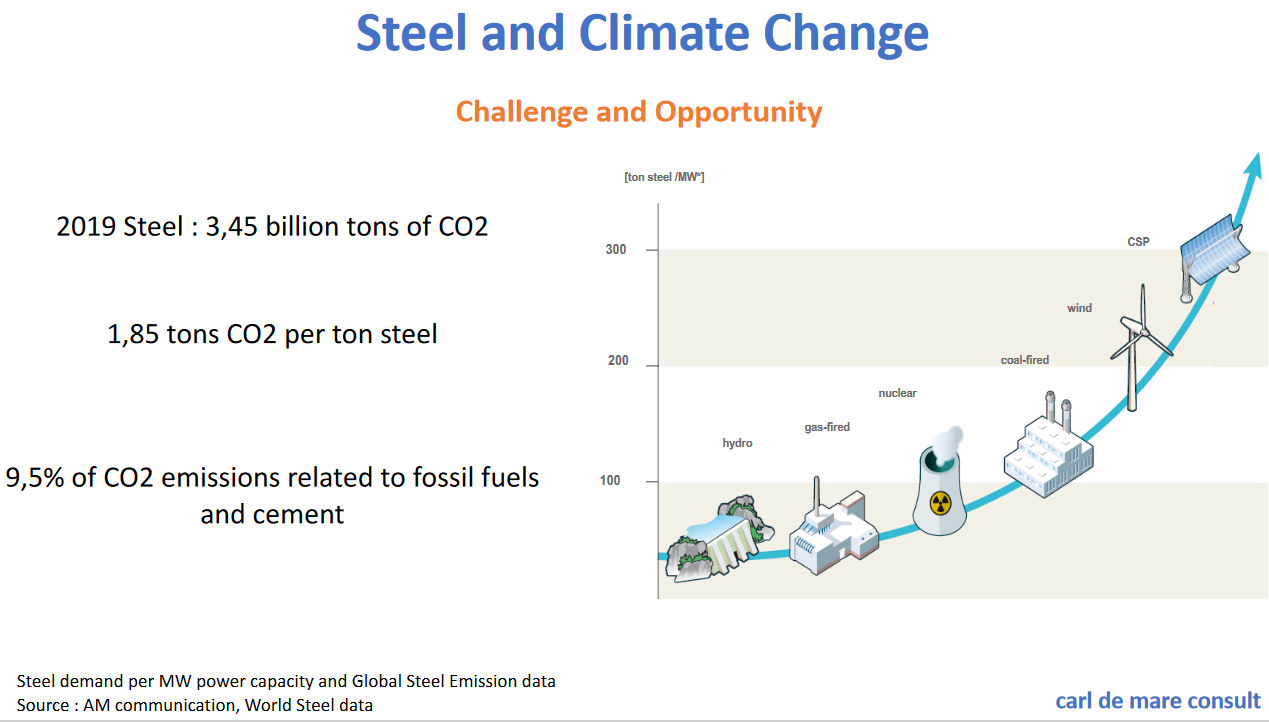
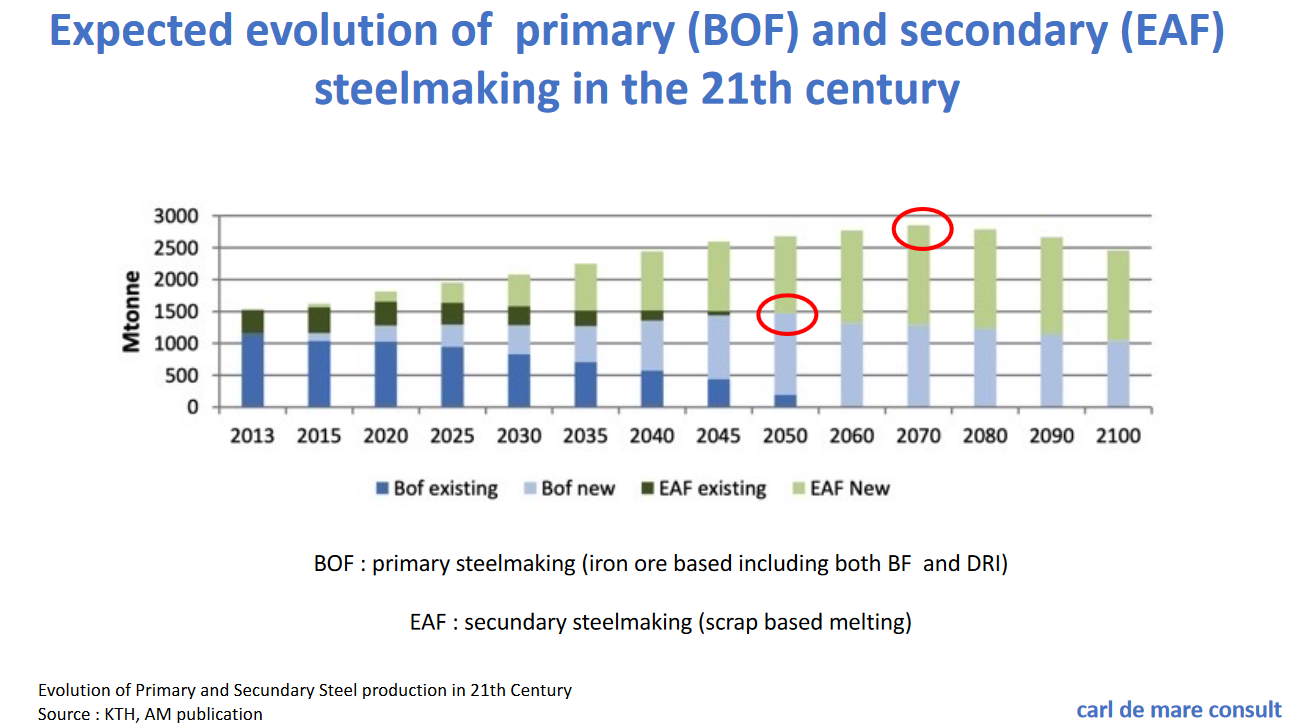
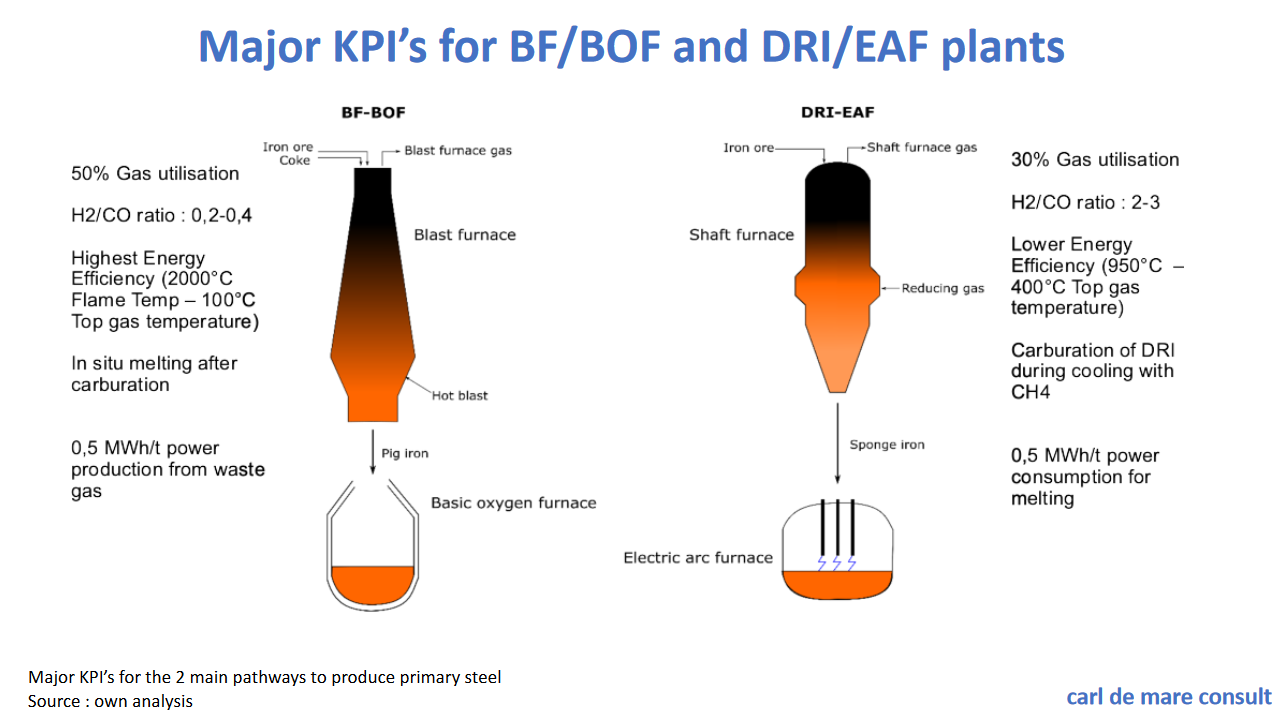
https://www.estep.eu/assets/Uploads/ESTEP-Brokerage-20211117-Key-Note-Carl-De-Mare-v2.pdf (Copy and paste )
—————
137.19 American Steel, the Environment and the Next Decade
Lourenco Goncalves, Chairman President and Chief Executive Officer, Cleveland –Cliffs Inc.
Iron & Steel Technologies, AIST , Sept 2021 pp. 70-82
https://www.aist.org/AIST/aist/AIST/Publications/Monthly/070-082_September-2021.pdf
—————————-
137.20 Hydrogen Ironmaking: How It Works (Very interesting )
Fabrice Patisson and Olivier Mirgaux
Institut Jean Lamour, CNRS, Université de Lorraine, Labex DAMAS, 54011 Nancy, France;
Metals 2020, 10(7), 922
Special Issue Challenges and Prospects of Steelmaking Towards the Year 2050.
Abstract: A new route for making steel from iron ore based on the use of hydrogen to reduce iron oxides is presented, detailed and analyzed. The main advantage of this steelmaking route is the dramatic reduction (90% off) in CO2 emissions compared to those of the current standard blast-furnace route.
The first process of the route is the production of hydrogen by water electrolysis using CO2-lean electricity. The challenge is to achieve massive production of H2 in acceptable economic conditions.
The second process is the direct reduction of iron ore in a shaft furnace operated with hydrogen only.
The third process is the melting of the carbon-free direct reduced iron in an electric arc furnace to produce steel.
From mathematical modeling of the direct reduction furnace, we show that complete metallization can be achieved in a reactor smaller than the current shaft furnaces that use syngas made from natural gas. The reduction processes at the scale of the ore pellets are described and modeled using a specific structural kinetic pellet model. Finally, the differences between the reduction by hydrogen and by carbon monoxide are discussed, from the grain scale to the reactor scale. Regarding the kinetics, reduction with hydrogen is definitely faster. Several research and development and innovation projects have very recently been launched that should confirm the viability and performance of this breakthrough and environmentally friendly ironmaking process.

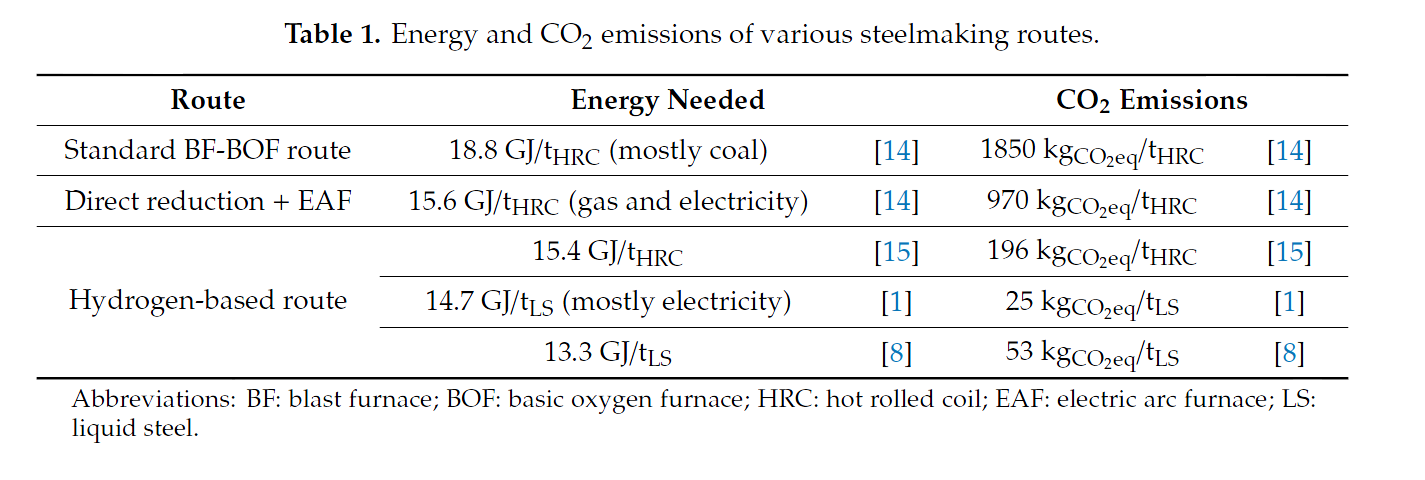
https://www.mdpi.com/2075-4701/10/7/922
——————
137.21 Recent Sustainability Developments in the Iron and Steel Industry
Alisha Giglio.
Process Engineer, Climate Change and Sustainability, Hatch Ltd., Mississauga, Ont., Canada alisha.giglio@hatch.com
Iron & Steel Technology March 2021 pp. 44-54. With 32 interesting references
An overview of some of the recent steel industry carbon emission reduction innovations will be provided, including: (1) Reduction in blast furnace production and the trend toward electric arc furnace steelmaking with scrap or direct reduced iron; (2) Hydrogen use in direct reduced iron processes with hydrogen created via green electricity; (3) Hydrometallurgical-based electrolysis of iron ore; (4) Molten oxide electrolysis (Boston Metals); (5) European developments under the Ultra-Low CO2 Steelmaking (ULCOS) program (blast furnace top gas recycling, HISarna); (6) Chemical production from waste gases; and (7) Slag use in the cement industry
———————–
138 Ironmaking and Steelmaking Processes: Greenhouse Emissions, Control, and Reduction
Pasquale Cavaliere Editor, Department of Innovation Engineering, University of Salento Lecce, Italy
Springer international Publishing Switzerland 2016.
ISBN 978-3-319-39527-2e-ISBN 978-3-319-39529-6
This book describes improvements in the iron and steel making process in the past few decades. It also presents new and improved solutions to producing high quality products with low greenhouse emissions. In addition, it examines legislative regulations regarding greenhouse emissions all around the world and how to control these dangerous emissions in iron and steel making plants.
https://www.springer.com/gp/book/9783319395272
Index
https://link.springer.com/book/10.1007%2F978-3-319-39529-6
——————
139 Handbook of Environmental Materials Management
Chaudhery Mustansar Hussain
Springer Nature Switzerland AG 2019
Online ISBN 978-3-319-73645-7
Print ISBN 978-3-319-73644-0
—————-
140 Handbook of Environmental Materials Management
Environmental Impact of Steel Industry
Andrea Di Schino, Dipartimento di Ingegneria Università di Perugia Perugia Italy
Springer Cham, 21 May 2019, Pages 2463-2483
Print ISBN 978-3-319-73644-0
Online ISBN 678-3-319-73645-0
The iron and steel industry is the world’s biggest energy consuming manufacturing industry with the largest share in the world’s economy. In the iron and steel production over world, China takes the first place, and Japan and USA follow it. Turkey, with a 34.7 million tons production, has a share of 2.1% of the total world production in 2016. In Europe there are declared targets of the European Community aimed to protect the environment and to improve its quality, to serve the protection of the human health, and to guarantee a cautious and efficient use of the natural resources. In this framework, steel companies are becoming increasingly aware about the sustainability challenges, in order to satisfy such requirements and to increase their competitiveness through an adequate management of resource and energy. Steel production is in fact characterized by an energy-intensive activity, since the largest part of the production process takes place at high temperatures. Besides, iron ore is converted into metallic iron by using carbon as reducing agent. As global warming due to CO2 emissions, steel production is considered one of today’s main environmental problem and environmental impact of steel production mainly focus on reduction of energy use. This reduction of energy use is mainly achieved by important process measures and the reduction of material losses in the different production steps (also by looking at the use of steel slag as an opportunity to save natural resources) as well as of good housekeeping practices. Next to CO2, large industrial steelworks also emit pollutants addressing the discussion to “how and where” treat them.
https://link.springer.com/referenceworkentry/10.1007%2F978-3-319-73645-7_101
——————–
141 Hydrogen gas and its use in Iron and Steel industry
I, Satyendra Kumar Sarna
January 14, 2019
Hydrogen gas and its use in Iron and Steel industry, Production of hydrogen, Hydrogen gas as reductant of iron ore, Hydrogen reduction processes :
Circored process, http://www.ispatguru.com/circored-and-circofer-processes-of-ironmaking/
Energiron process, http://www.ispatguru.com/energiron-direct-reduction-technology/
Midrex process, http://www.ispatguru.com/midrex-process-for-direct-reduction-of-iron-ore/
Flash ironmaking process, hydrogen, Hydrogen plasma
https://www.ispatguru.com/hydrogen-gas-and-its-use-in-iron-and-steel-industry/
https://www.ispatguru.com/about/
———————
142 Carbon Neutral Steelmaking
I, Satyendra Kumar Sarna
December 9, 2020
Allam cycle, Biomass, CCS, CCU, CO2 emissions, DRI, EAF, Electro winning, Electrolysis, GHG, HYBRIT process, Hydrogen based reduction, ULCOS
https://www.ispatguru.com/carbon-neutral-steelmaking/
———————-
143 Impacts of iron and steelmaking facilities on soil quality
Strezov V, Chaudhary C.
J. Environ Manage. 2017 Dec 1; 203 (Pt 3): 1158-1162
https://www.ncbi.nlm.nih.gov/pubmed/28237220
————————–
144 Updated atmospheric speciated mercury emissions from iron and steel production in China during 2000–2015.
QingruWu,Wei Gao, ShuxiaoWang, and Jiming Hao
Atmospheric Chemistry and physics, 17, 2017, 10423-10433
Download :
https://www.atmos-chem-phys.net/17/10423/2017/
——————–
145 Energy Efficiency Improvement and Cost Saving Opportunities for the U.S. Iron and Steel Industry.
An ENERGY STAR Guide for Energy and Plant Managers
Ernst Worrell, Paul Blinde, Maarten Neelis, Eliane Blomen, and Eric Masanet
Environmental Energy Technologies Division
Ernest Orlando Lawrence, Berkeley National Laboratory
University of California, Berkeley, CA 94720
Sponsored by the U.S. Environmental Protection Agency
October 2010 ( pages 160 ).
Energy is an important cost factor in the U.S iron and steel industry. Energy efficiency improvement is an important way to reduce these costs and to increase predictable earnings, especially in times of high energy price volatility. There are a variety of opportunities available at individual plants in the U.S. iron and steel industry to reduce energy consumption in a cost-effective manner. This Energy Guide discusses energy efficiency practices and energy-efficient technologies that can be implemented at the component, process, facility, and organizational levels. A discussion of the structure, production trends, energy consumption, and greenhouse gas emissions of the iron and steel industry is provided along with a description of the major process technologies used within the industry. Next, a wide variety of energy efficiency measures are described.
Download :
https://www.osti.gov/biblio/1026806
———————-
146 Energy Use in the U.S. Steel Industry: An Historical Perspective and Future Opportunities.
Dr. John Stubbles: Steel Industry Consultant, Mason, Ohio
For the U.S. Department of Energy Office of Industrial Technologies Washington, DC.
September 2000, pages 1-58
The U.S. steel industry has taken enormous strides over the past decades to reduce its energy consumption; since the end of World War II, the industry has reduced its energy intensity (energy use per shipped ton) by 60 percent. Between 1990 and 1998 alone, intensity has dropped from 20 to 18 million Btu (MBtu) per ton. This figure is projected to decrease to 15 MBtu/ton by 2010 with anasymptotic trend towards 14 MBtu/ton.
https://www.energy.gov › sites › prod › files › 2013/11
————————–
147 ENVIRONMENTAL ASPECTS OF IRON AND STEEL PRODUCTION
A Technical Review
UNITED NATIONS ENVIRONMENT PROGRAMME
First edition 1986 pages 1-166
ISBN 92 807 1079 6
POLLUTANT DISCHARGES IN THE STEEL INDUSTRY: Air Pollution, Water Pollution, Waste Pollution.
ENVIRONMENTAL EFFECTS: Principal Air Pollutants, Principal Water Pollutants.
AIR POLLUTION CONTROL: Fume Collection and Dust Cleaning Installations, Techniques for Eliminating Gaseous Pollutants, Equipment for Control of Gaseous Pollutants.
WATER POLLUTION CONTROL: Technigues of Wastewater Treatment, Recycle Systems Suspended Solids Removal, Oil Removal, Metals Removal, Organic Removal.
( See from internet )
https://www.unep.org/
https://wedocs.unep.org/handle/20.500.11822/28292
AND
UNITED NATIONS ENVIRONMENT PROGRAMME
Annual Report 2018 2019 2020
Download 2020 pdf pag 1- 25
https://www.unep.org/ietc/resources/report/annual-report-2020
———————————-
148 Global Technology Roadmap for CCS in Industry
Steel sectoral report
J.P.Birat
Contribution to the UNIDO roadmap on CCS – fifth draft ,24.09.2010 Pages 1- 66
United Nations Industrial Developmemt Organization – ArcelorMittal
(copy and paste)
—————————
149.Efficiency stagnation in global steel production urges joint supply- and demand – side mitigation efforts.
Peng Wang, Morten Ryberg , Yi Yang, Kuishuang Feng, Sami Kara, Michael Hauschild ,Wei-Qiang Chen.
Nature Communications, (2021)12:2066
Steel production is a difficult-to-mitigate sector that challenges climate mitigation commitments. Efforts for future decarbonization can benefit from understanding its progress to date.
Here we report on greenhouse gas emissions from global steel production over the past century (1900-2015) by combining material flow analysis and life cycle assessment. We find that ~45 Gt steel was produced in this period leading to emissions of ~147 Gt CO2-eq.
Significant improvement in process efficiency (~67%) was achieved, but was offset by a 44-fold increase in annual steel production, resulting in a 17-fold net increase in annual emissions. Despite some regional technical improvements, the industry’s decarbonization progress at the global scale has largel stagnated since 1995 mainly due to expanded production in emerging countries with high carbon intensity. Our analysis of future scenarios indicates that the expected demand expansion in these countries may jeopardize steel industry’s prospects for following 1.5 °C emission reduction pathways. To achieve the Paris climate goals, there is an urgent need for rapid implementation of joint supply- and demand-side mitigation measures around the world in consideration of regional conditions.
https://www.nature.com/articles/s41467-021-22245-6.pdf
—————————–
149.01 European Steel Forum 2021
https://www.aist.org/AIST/aist/AIST/Conferences_Exhibitions/European_Steel_Forum/21-esf-recap.pdf
———————————-
150 AIST Association for Iron & Steel Technology AISTech 2021
Development and Successful Evaluation of an Atmosphere-Controlled Furnace for Direct Reduction Feedstock Studies
Monday, 28 June 2021 • 10:30–11 a.m. • Virtual
Investigation of Carbon Deposition During Natural Gas and Oxygen Injection for the Direct Reduction Ironmaking Process
Tuesday, 29 June • 9:30–10 a.m. • Room 201 B
Reduced Fuel Gas Usage With Improved Reheat Furnace Pressure Control
Tuesday, 29 June • 2–2:30 p.m. • Room 209 C
How U.S. Steelmaking Became a Green Industry and What Lies Ahead
Tuesday, 29 June • 2–2:30 p.m. • Room 207 A
Ironmaking, Reinvented: Gas-Based Hot Metal Process for a Clean Steelmaking Era
Tuesday, 29 June • 3–3:30 p.m. • Room 207 A
Hydrogen-Based DRI EAF Steelmaking — Fact or Fiction?
Tuesday, 29 June • 3–3:30 p.m. • Room 201 B
Searching New Horizons: The Hydrogen Revolution in Steelmaking
Tuesday, 29 June • 4–4:30 p.m. • Room 201 B
Effects of Reduction and Carburization on Strength of Direct Reduced Iron
Wednesday, 30 June • 10:30–11 a.m. • Room 201 B
High-Carbon DRI for the Production of High-Purity Pig Iron
Wednesday, 30 June • 11:30–noon • Room 201 B
Investigation of High-Rate and Pre-Heated Natural Gas Injection in the Blast Furnace
Thursday, 1 July • 8–8:30 a.m. • Room 201 A
Ask for : https://www.aist.org/home.aspx
————————-
151 AISTech 2020
Hydrogen and Low-Co2.
Iron- and Steelmaking Webinar Series. 19 June 2020.
Ironmaking With Alternative Reductants
Ask for : https://www.aist.org/home.aspx
https://www.youtube.com/watch?v=ALapmVXoHgM
Production, Storage and Safe Handling of hydrogen 23.June 20202
https://www.youtube.com/watch?v=Kbwdj418Kxc&t=19s
——————-
151.01 AISTech 2023
8-11 May 2023 Detroit ,Mich USA.
Decarb Sessions
The future of steelmaking requires change in order to achieve significant reduction of greenhouse gas emissions.
Find out the advancements and investments the steel producers are making in order to take the next step toward net zero and what the industry suppliers and research partners are doing to help us all get there.
-DRI and Green Steel — Unaccounted-for Cost of Inputs
-Biomass Pyrolysis for Coke and Ironmaking: An Alternative for Decarbonization
-Decarbonization Perspectives: Assessment of Different Scenarios in the Iron- and Steelmaking Industry
-Brazilian Breakthrough Technology for a Low-Carbon Metallurgy Industry
-A Model-Driven Framework to Enable Decarbonization in the Iron and Steel Industry
-Applications of Carbon Sources for Green Steel Using Power Carbon
-Use of Green Pig Iron in the Electric Arc Furnace
-The Decarbonization of Reheating Furnaces: A Stepwise Approach
———————–
152 ESF 2023 European Steel Forum
17–19 October 2023 • University of Leoben • Leoben, Austria
https://www.aist.org/conference-expositions/european-steel-forum/program
——————–
153 ATA Insights
Decarbonization opportunities through Green Hydrogen: Mining, Steel and Transport. Sept 2020
https://www.youtube.com/watch?v=T1Z4c43v7DE
———————————
154 MITei (energy center)
The role of hydrogen in future low-carbon energy systems ( MIT Low-carbon Energy Center ) 28 July 2020.
https://www.youtube.com/watch?v=l-0YcIOnrs8
—————————————————————–
—————————————————————–