Haz clic en el botón para descargar | Download Here
1.-GENERAL BIBLIOGRAPHY (ENGLISH)
- H. Bechtold, G.W. Wiener. «The History of Soft Magnetic Materials». The Sorby Centennial Symposium on the History of Metallurgy. Ch. 32, 1963, C.S. Smith Ed. New York, Gordon and Breach
- L. Walter. «History of Silicon-lron». The Sorby Centennial Symposium on the History of Metallurgy. Ch. 32, 1963, C.S. Smith Ed., Gordon and Breach, New-York, U.S.A.
- Néel. «Bases d’une Nouvelle Théorie Générale du Champ Coercitif». Annales Univ. Grenoble, 22, 1946, 299-343.
- M. Bozorth. «Ferromagnetism». Chap. 1, 10, 1 1, 12, 13, 6th Edition, 1951, D. Van Nostrand Company. lnc. Princenton, New Jersey.
- Chikazumi. «Physics of Magnetism». Parts 2, 3, 1978, R.E. Krieger Pub. Comp., Malabar Florida, U.S.A.
- Herpin. «Theorie du Magnetisme». Chap. 11, VIII, IX, X, XXII, 1968, Press Universitaires du France, París.
- D. Cullity. C.D. Graham . «lntroduction to Magnetic Materials». Chap. 1 – 10. Ed. Wiley-Blackwell (an imprint of John Wiley & Sons Ltd); Edición: 2ª. 26 .06.2007 . ISBN-13 : 978-0471477419, pp.562.
- Robert O´Handley. ´ Modern Magnetic Materials Principles and Applications ¨. Ed. John Wiley & Sons, Inc. , 1999, ISBN 0-471-15566-7, pp 768.
- Chih- Wen Ch «Magnetism and Metallurgy of Soft Magnetic Materials». Chap. 2, 3, 1986, ISBN 0-486-64997-0. Dover Pub. lnc., New York.
- Brissonneau ¨ Magnétisme et Matériaux Magnétiques pour l´electrotechniqhe ¨ . Ed. Hermes Science Publications 1997. ISBN-13: 978-2866015794. pp. 318.
- H. Stewart. «Ferromagnetic Domains». Chap. 1-V, Cambridge Monographs on Physics, 1954, Cambridge University Press.
- Trueba. «Dinámica de la pared de Bloch en Whiskers de Hierro». Tesis Doctoral, Enero 1970. Fac. Ciencias Físicas, Univ. Complutense, Madrid.
- S. Girón. «Materiales Magnéticos». Cap. I y II, 1965 Dep. Legal M. 11.346-1965, Ed. Montecorvo, Madrid.
- S. Steel. «The Making Shaping and Treating of Steel». Chap. 45,
Ed. Harold E. Mc Gannon, 9th Edition, Pittsburgh, Pa,1970, 1157-1162.
- Energy Efficient Electrical Steels, A.R. Marder and E.T. Stephenson. Pub The Metall. Soc. of. A.l.M.E. ISBN 0-89520-374-x, 1981
2.- PHYSICAL – CHEMICAL, METALURGICAL BACKGROUND. INDUSTRIAL PROCESSES AND QUALITIES OBTAINED.
2.1- General Information of the Iron and Steel Processes for the Manufacture of Non-Oriented Magnetic Sheet:
A.Coombs. «A Review of Electrical Steels». Steel Times May.1970, 311 – 321.
H.Shimanaka et al. «Recent Development of Non-Oriented Electrical Steel Sheets». J. Magn. Magn. Mater., 26, ( 1-3), Mar. 1982, 57-64
I.Ibarrondo. “Estudio de los Modernos Procesos Empleados en la Fabricación de Chapa Magnética de Grano No-Orientado. Nuevas Calidades Obtenidas”. Rev. Metal. CENIM, 21, (6) Nov.-Dic. 1985, 366-376. (VER/SEE EN PUBLICATIONS).
Oda Yoshihiko, Okubo Tomoyuki, Takata Masaaki, Recent Development of Non-Oriented Electrical Steel in JFe Steel. JFe technical report No. 21, Mar. 2016, pp. 7-13.
http://esales.baosteel.com/baosteel_products/eleSteel/en/products/products_02.jsp
2.2- Electrical sheet of mild carbon steel and decarburized. Small and Fractional Motors.
In the information provided, in both, the general and specific information on this quality, the general steel manufacturing process is described in detail, as well as:
– The physics – chemical, metallurgical and thermodynamic aspects.
– Magnetic and mechanical characteristics
for this type of decarburized mild carbon steel sheet.
The last heat treatment supplied to the material is particularly noteworthy, which consists of a solid phase decarburizing process using the expanded coil procedure or separate turns using the Open Coil system. Through this procedure it is possible to lower the carbon content to contents of three to five thousands.
It should be noted that this procedure cannot currently compete in productivity with modern continuous heat treatment furnaces, therefore it must be considered as a process without great future viability.
Ibarrondo. “Contribuciones a la Optimización del Procedimiento Open-Coil”. Tesis Doctoral, E.T.S. Ing. Ind. Bilbao (Univ. País Vasco), Mayo 1981.
Ibarrondo. “Contribuciones a la Optimización del Procedimiento Open-Coil”. [Comunicación Oral]. Proc. V Asamblea General del Centro Nacional de Investigaciones Metalúrgicas (C.E.N.I.M.), Tomo II (T-34), Madrid 6-9 Oct. 1981. (VER/SEE EN PUBLICATIONS). .
I.Ibarrondo. “Estudio de la Descarburación en Chapa de Calidad Comercial Laminada en Frío para la Obtención de Nuevas Calidades de Chapa Magnética”. Rev. Metal. CENIM, 19, (6), Nov-Dic. 1983, 343-348. (VER/SEE EN PUBLICATIONS). .
I. Ibarrondo.”Aspectos Físico-Metalúrgicos del Proceso de Denitruración y su Aplicación a la Obtención de Acero Efervescente no Envejecible”. [Comunicación Oral]. Proc. VI Asamblea General del Centro Nacional de Investigaciones Metalúrgicas (C.E.N.I.M.), Sesión 10, Madrid 8-11 Oct. 1985. (VER/SEE EN PUBLICATIONS)..
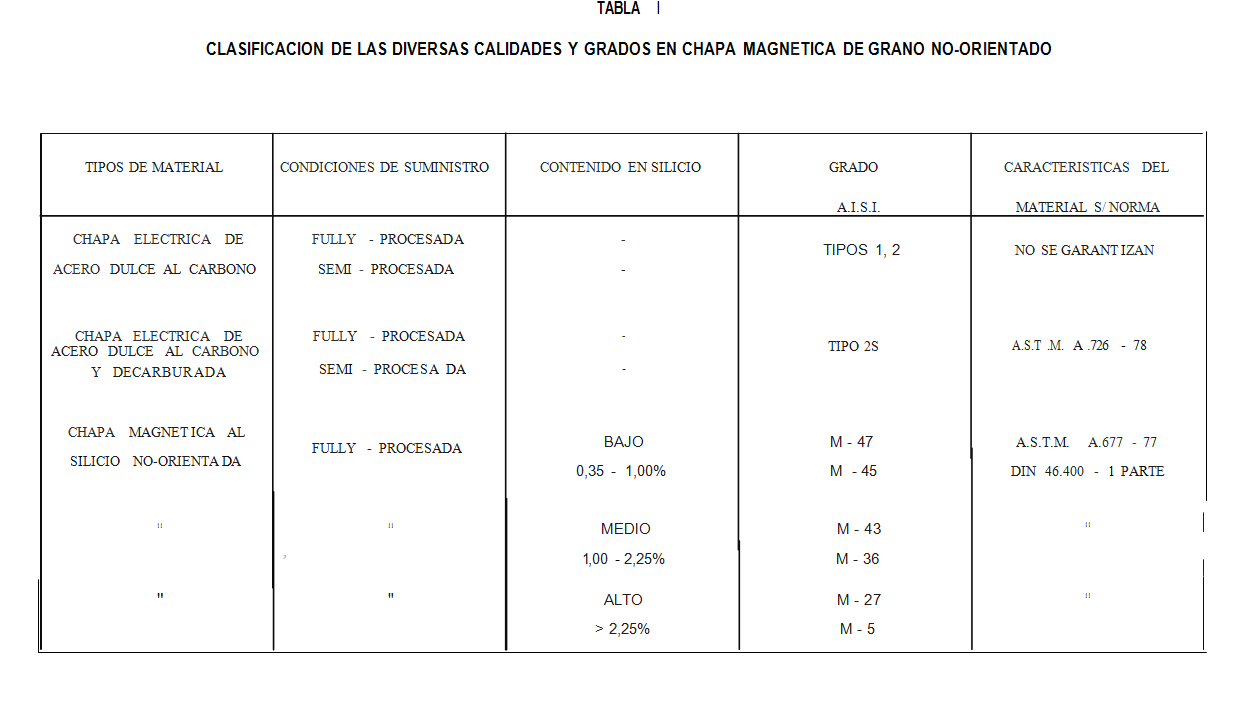
2.3 – Non-grain oriented magnetic sheet with low (0.35-1%), medium (1.0-2.50%) and high (2.5-3.0%) silicon content.
It is impossible to describe here the great complexity involved in the manufacturing process of non-oriented grain Magnetic Sheet in its various qualities and grades, as well as the amounts of silicon that each one of them has incorporated. For this reason, I will refer to the bibliography cited below, as well as to the various types of furnaces that constitute the final phase of the process and which is one of the most important within the entire steelmaking process, especially with regard to the next section in which we will consider the isotropic but textured non-oriented grain magnetic sheet.
Likewise, for a better understanding of the steel process as a whole, the section in which I refer to the main industrial companies and the catalog of their products must also be taken into consideration, where the process we are considering is exposed in a general way.
I.Ibarrondo. “Estudio de los Modernos Procesos Empleados en la Fabricación de Chapa Magnética de Grano No-Orientado. Nuevas Calidades Obtenidas”. Rev. Metal. CENIM, 21, (6) Nov.-Dic. 1985, 366-376. (VER/SEE EN PUBLICATIONS). .
I.Ibarrondo. “Study on Process for Obtaining low Grades of Non Oriented Silicon Steel Sheets and their Applications in Small and Medium Motors”. [Comunicación Oral]. Proc. of 27th Mechanical Working and Stell Processing Conference of American Institute of Mining, Metallurgical, and Petroleum Engineers(A.I.M.E.), Sesion I, 27-29 Oct. 1985, Cleveland, Ohio (U.S.A.). (VER/S EN PUBLICATIONS)..
I.Ibarrondo. “Empleo de la Técnica de Desgasificación al Vacío para la Obtención de Nuevas Calidades en Chapa Magnética No-Orientada”. [Comunicación Oral]. Proc. VI Reunión Española del Vacío y sus Aplicaciones. Instituto de Física de Materiales, CM-CTV 4, Madrid 3-5, Dic. 1985. (VER EN PUBLICATIONS)..
A. Moses, K. Jenkins, P. Anderson, H. Stanbury. Electrical Steels: Production, characterisation and applications. Energy Engineering. Ed. Institution of Engineering and Technology, 26.04.2019. ISBN-13: 978-1785612763. pp.375.
A.Moses, K. Jenkins, P. Anderson, H. Stanbury. Electrical Steels: Volume 1: Fundamental and basic concepts . Energy Engineering. Ed. Institution of Engineering and Technology, 26.06.2019. ISBN-13: 978-1785619700. pp.404.
A.Moses, K. Jenkins, P. Anderson, H. Stanbury. Electrical Steels: Volume 2 : Performance and applications. Energy Engineering. Ed. Institution of Engineering and Technology, 26.06.2019. ISBN-13: 978-1785619724. pp.463.
PRODUCTION LINES AND INDUSTRIAL FURNACES
https://www.ebner.cc/en/steel/electrical-strip/ngo-continuous-annealing-lines/
https://www.ebner.cc/en/steel/electrical-strip/bell-annealers/
https://www.sms-group.com/plants/all-plants/silicon-steel-lines/
https://www.tenova.com/products-technologies/metals/processing/processing-lines-for-strip/
https://www.tenova.com/product/annealing-and-pickling-line-%28apl%29-for-silicon-steel-strip/
https://www.tenova.com/product/annealing-and-coating-line-%28acl%29-for-silicon-steel-strip/
https://www.tenova.com/product/decarburizing-and-coating-line-%28dcl%29-for-silicon-steel-strip/
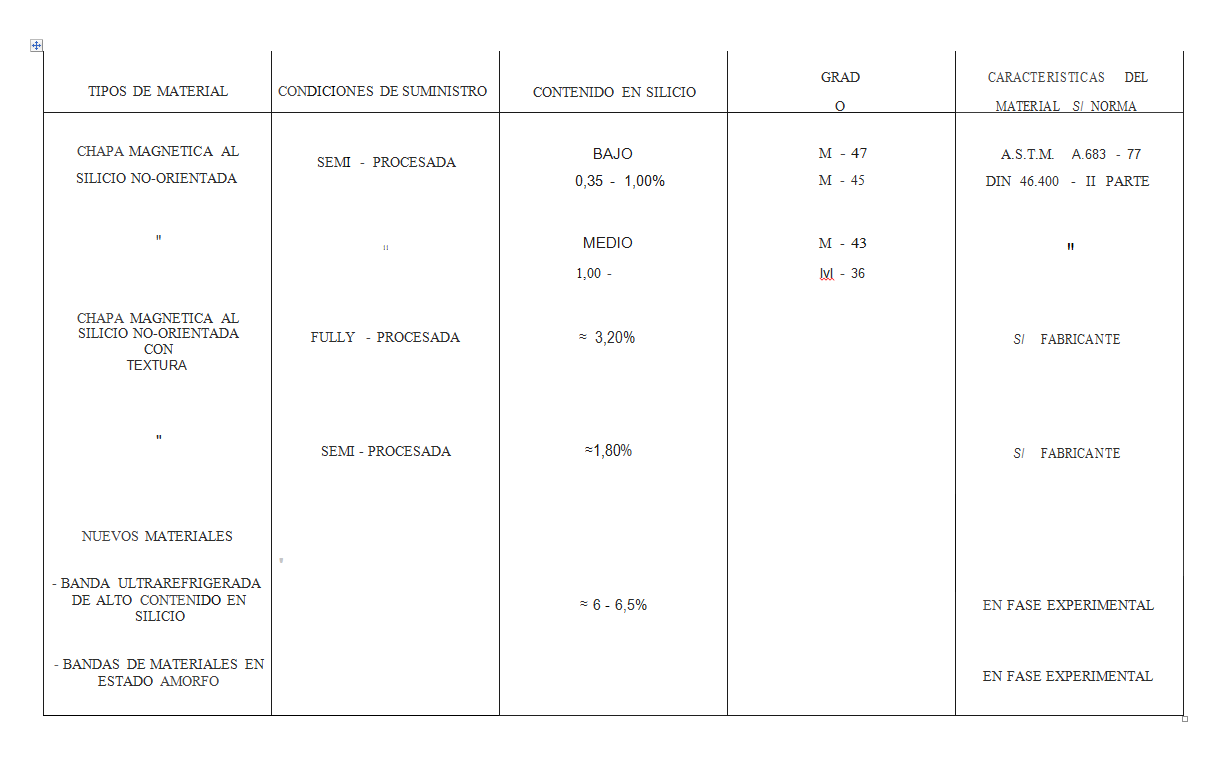
2.4 – Non-oriented grain magnetic sheet (1.80 – 3.20% Si) with texture.
As early as the mid-1970s, the possibility of inducing a certain texture in non-oriented grain magnetic sheet, while maintaining its isotropy, began to be studied.
Its development is closely related to the work carried out prior to 1970 leading to obtaining double-oriented magnetic sheet, cube texture 100[001], whose manufacturing process was not developed, at an industrial level, due to its high economic cost. However, by means of a non-oriented variant of this texture called ¨Random Cube Texture 100 <uvw> ¨, lower loss figures and permeability values higher than the best grade of the non-oriented grain magnetic sheet were obtained, which it is due to the elimination of the difficult magnetization directions <111> from the plane of the sheet, which makes this material ideal for its application in rotating machines.
In the author’s opinion, there are two main processes for the induction of texture in these materials:
-Texture induction in mild carbon steel sheets through the use of g®a transformation.
-Texture induction in non-oriented grain magnetic sheets with high silicon content, fully processed quality and medium semi-processed quality silicon content.
In both cases, it is evident that the final texture developed and, therefore, the final magnetic characteristics are a function of the parameters of the steel manufacturing process, among which the following are preferably mentioned:
-The chemical composition of the raw material:
Levels of impurity present in the material, for which it would be desirable, and depending on the qualities essential, a vacuum degassing process in a steel mill.
Levels in silicon, aluminum and sulfur.
-Temperature, texture and grain size developed in the intermediate annealing.
-Ratio of cold reduction prior to the recrystallization process.
-Variables of the final recrystallization process, including heating and cooling ratios, temperature and soaking time, as well as and very especially the type of atmosphere used, that has to play a decisive role in the recrystallization process and consequently in the development of the final texture, all of which makes this process as a whole present an extraordinary complexity from the physical-chemical, thermodynamic and thermotechnical point of view.
A more detailed exposition of what is exposed here can be seen in the previous work of the author:
I.Ibarrondo. “Estudio de los Modernos Procesos Empleados en la Fabricación de Chapa Magnética de Grano No-Orientado. Nuevas Calidades Obtenidas”. Rev. Metal. CENIM, 21, (6) Nov.-Dic. 1985, 371-373. (VER/SEE EN PUBLICATIONS).
A series of articles are detailed below, indicating the latest advances in this field.
Marcos F. de CAMPOS, Fernando J. G. LANDGRAF, Ivan G. S. FALLEIROS, Gabriela C. FRONZAGLIA and Henrique KAHN. Texture Evolution during Processing of Electrical Steels with 0.5% Si and 1.25% Si. ISIJ International, Vol. 44 (2004), No. 10, pp. 1733–1737
Jong –Tae PARK and Jerzy A.SZPUNAR. Texture Development during Grain Growth in Non Oriented Electrical Steels. ISIJ International, Vol 45, (2005), No 5, pp. 743-749
J.T. Park, J. K. Kim, J. A. Szpunar, «Recrystallisation, Grain Growth and Texture Evolution in Nonoriented Electrical Steels». Materials Science Forum, Vols. 558-559, 2007, pp. 657-664.
Na Li, Liang Ma, Li Xiang, Shengtao Qiu and Pei Zhao. Evolution of Texture in a 2.8%Si Non-Oriented Electrical Steel Annealed at 1100°C. Materials Transactions, Vol. 55, No. 2 (2014) pp. 387 – 390.
Mehdi Sanjari, Youliang He, Erik Hilinski, Steve Yue, Leo Kestens. Texture evolution during skew cold rolling and annealing of a non-oriented electrical steel containing 0.9 wt% silicon. J. Mater Sci., Mar 2017, 52, 6, 3281 – 3300.
Kim Verbeken1, Edgar Gomes1, Jürgen Schneider1 and Yvan Houbaert .Correlation between the magnetic properties and the crystallographic texture during the processing of non oriented electrical steel. Solid State Phenom, (Volume 160),2010, 189-194.
N. Zhang, P. Yang and W. M. Mao. Improving magnetic properties by optimization of textures in non-oriented electrical steel with initial columnar grains. 17th International Conference on Textures of Materials (ICOTOM 17). IOP Conf. Series: Materials Science and Engineering 82, (2015), 012041.
Jong-Tae Park, Jerzy A. Szpunar. Effect of initial grain size on texture evolution and magnetic properties in nonoriented electrical steels. J. Magn. Magn. Mater. Volume 321,13,2009, 1928 – 1932.
A. Sonboli, M. R. Toroghinejad, H. Edris and J. A. Szpunar. The Effect of Cold Rolling Process on the Microstructure and Texture Evolution in a 1 wt% Si Non-oriented Electrical Steel. International Journal of ISSI, Vol. 12 (2015), No. 2, pp. 1-6
Shu-Yu WU, Chun-Hung LIN, Wei-Chih HSU, Liuwen CHANG, Pei-Ling SUN and Po-We KAO. Effect of Heating Rate on the Development of Annealing Texture in a 1.09 wt% Si Non-oriented Electrical Steel .ISIJ International, Vol. 56, (2016), No. 2, pp. 326–334.
2.5 – Non-oriented magnetic sheet with high silicon content (6.0 – 6.5%).
It is known that Fe-Si alloys with a high silicon content (6.5% Si) present high brittleness, being therefore difficult to process by conventional iron and steel processes.
This material, properly processed, presents characteristics superior to the best grade of non-oriented magnetic sheet, and even loss figures lower than the oriented quality (3% Si), and in some cases even to amorphous materials or those obtained by powder metallurgy.
Specifically, this material, with this silicon composition, has high permeability, high resistivity, low losses due to hysteresis at high frequency, and magnetostriction close to zero.
Then I will expose the three main procedures for obtaining this type of materials.
2.5.1 – Obtained directly from the molten state by rapid quenching.
The procedure similar to that used to obtain amorphous materials consists of projecting the molten metal directly onto a cylinder that rotates at high revolutions, producing a cooling in this case of one or two orders of magnitude lower than that of amorphous materials.
Although the author has spent a lot of time studying these materials, and contrary to what is stated in some recent publications, these materials present a problem of brittleness at the edges and a lack of homogeneity in the thickness of the band, being also feasible to manufacture in small widths and not from 600 mm for its application in machines and electric motors. Its use being restricted to the core of small transformers and very small motors.
I. Ibarrondo, J. González. “Estudio de las Características Magnéticas de Cintas Cristalinas Fe-Si con Alto Contenido de Silicio ( » 6,5%), Obtenidas por Temple Ultrarrápido y Sometidas a Recocido por Corriente Eléctrica”. Rev. Metal. CEMIN, 23, (5), Sept.-Oct. 1987, 329-332. (VER/SEE EN PUBLICATIONS). .
I. Ibarrondo, A.A. Rodríguez, J. González. “Estudio de las Características Magnéticas de Bandas Cristalinas de Alto Contenido en Silicio (6,5%) sometidas a Current Annealing”, [Comunicación Oral]. Proc. XXI Reunión Bienal de la Real Sociedad Española de Química, Sección 15, 22-26 Septiembre 1986, Santiago de Compostela. (VER/SEE EN PUBLICATIONS)..
I.Ibarrondo, J.M. San Juan, J. González. “Estudio de las Características Magnéticas en Cintas Cristalinas de Alto Contenido en Silicio (6,0-6,5%) Obtenidas por Enfriamiento Ultrarrápido”. [Comunicación Oral]. Proc. 7º Congreso Nacional de Ciencia y Tecnología Metalúrgicas (C.E.N.I.M.), Madrid, 3-5 Oct. 1990, Vol III, 163-172(VER/SEE EN PUBLICATIONS).
IIbarrondo, J.M. San Juan, J. González. “Study of the incidence of the Last Annealing on the Magnetic Characteristics of High Silicon ( 6,0-6,5% ) Crystalline Ribbons Directly Obtained from the Melted State By Rapid Quenching”. European Magnetic Materials and Applications Conference (E.M.M.A.´91), Dresden 16-19 April 1991. J. Magn. Magn. Mater., 101, 1991, 83-85. (VER/SEE EN PUBLICATIONS). .
I.Ibarrondo, S. Suriñach, J. González. “Influence of Manufacturing Process Parameters on Magnetic Characteristics of High-FeSi Crystalline Rapidly Quenched Ribbons”. Soft Mgnetic Materials Conference (S.M.M.10), Dresden 11-13 Sept. 1991. J. Magn. Magn. Mater., 112, 1991, 232-234. (VER/SEE EN PUBLICATIONS)..
I. Ibarrondo, J. Degauque.,“Incidencia de la Temperatura de Recocido en la Cifra de Pérdidas y Textura en Cintas Microcristalinas Fe – Si 6,4% Obtenidas Mediante Enfriamiento Ultrarrápido”. [Comunicación Oral]. Proc. XXV Reunión Bienal de la Real Sociedad Española de Física, Santiago de Compostela, 18-23 Septiembre 1995. (VER/SEE EN PUBLICATIONS)..
I.Ibarrondo, J. Degauque, V. Recarte, J. San Juán “Incidencia del Recorrido bajo Atmósfera de Nitrógeno en el Tamaño de Grano, Textura y Pérdidas en el Núcleo (10 – 1000 Hz), en Cintas Microcristalinas Fe – 6.4% Si Obtenidas por Solidificación Rápida”. 8º Congreso Nacional de Ciencia y Tecnología Metalúrgicas, CENIM, Madrid, 27 -29 Mayo 1998. Rev. Metal. CENIM, 34, Mayo, 1998, 286-290. (VER/SEE EN PUBLICATIONS).
I.Ibarrondo, J. Degauque. “ Metallurgical Processing of High Silicon (6,4%) Non-Oriented Magnetic Steel Sheets Directly from the Melted State by rapid Quenching “. [Comunicación Oral]. Proc. of 40th Mechanical Working and Steel Processing Conference of Iron and Steel Society (I.S.S.) of American Institute of Mining, Metallurgical, and Petroleum Engineers (A.I.M.E.), 25-28 Oct. 1998, Pittsburgh, Pennsylvania (U.S.A.),pp 499- 504. (VER/SEE EN PUBLICATIONS).
I.Ibarrondo, J. Degauque. “ Study of Vacuum Levels in the Annealing of High Silicon ( 6.4 wt% ) Non- Oriented Magnetic Steel Sheets Obtained by Rapid Quenching and its Incidence on Grain Size, Texture and Core Losses. “ 14th International Vacuum Congress ( I.V.C. – 14 ), 10 th International Conference on Solid Surfaces (I.C.S.S. – 10), 5th International Conference on Nanometer-scale Science and Technology ( N.A.N.O.– 5 ), 10th International Conference on Quantitative Surface Analysis ( Q.S.A. – 10 ). Birmingham 31/08 – 04/09, 1998. Vacuum 53, 1999, 75 – 78.
I. Ibarrondo, J.M. San Juan. “Incidence of the annealing parameters on core losses in high silicon (6.4%) – iron electrical steels obtained as much by rapid quenching as by enrichment in silicon by means of C.V.D. techniques.” Proc. of European Congress on Advanced Materials and Processes (Euromat 99),Munich Alemania), 27 – 30 Septiembre 1999. Vol. 7, PP.182-1Advanced Engineering Materials, 2, 8, 2000, pp.518 – 521. (VER/SEE EN PUBLICATIONS)..
I. Ibarrondo, J. Degauque. “Metallurgical processing of high silicon (6.4% wt) non-oriented magnetic steel sheets directly from the melted state by rapad quenching. A stydy of the continuous annealing step and its incidence on texture, grain size and core losses.” Proc. of Thermomechanical Processing of Steels Conference, Institute of Materials, London (U.K.), 24-26 May 2000., Vol 2,pp.557-562. (VER/SEE EN PUBLICATIONS)..
D.Bouchara, ¨ Elaboration, microestructure et propriétés magnétiques des alliages Fe-6.5Si élaborés par solidification rapide ¨. Thése Doctorat I.N.S.A. Toulouse. Spécialité Physique des Solides, Nº d´ordre 122, 6 Mars 1990, pp. 188.
Y. Gannac, ¨Alliages Fe-6.5Si élaborés par solidification rapide sous atmosphere controlee: Microstructure, proprietes magnetiques et comparaison avec des alliages Fe–Si industriels ¨. Thése Doctorat I.N.S.A. Toulouse. Spécialité Physique des Solides, Nº d´ordre 198, 26 Juin 1992, pp. 223.
Gaoyuan Ouyanga, Xi Chen, Yongfeng Liang, Chad Macziewski, Jun Cui. Review of Fe-6.5 wt%Si high silicon steel—A promising soft magnetic material for sub-kHz application. J. Magn. Magn. Mater.,481, 2019, 234-250.
Process with greater possibilities for the future within this line.
In the author’s opinion, the best existing possibility for obtaining this material by a process similar to the one described above consists in the use of the continuous casting technique by means of rapid solidification Strip Casting Technology, although the company CASTRIP (NUCOR) does not consider it, for now, as a viable option.
A monography on this procedure can be seen below, as well as two laboratory-level tests to obtain this high-silicon material directly from the molten state.
I.Ibarrondo. » Revisión del proceso siderúrgico de colada continua mediante solidificación rápida. Sistema de dos cilindros de colada conformación». ISBN 978-84-612-9489-3, Octubre 2008, pp. 1-355. ( VER/SEE en Strip Casting Technology)
Li, H., Liu, H., Liu, Z., et al., Characterization of microstructure, texture and magnetic properties in twin-roll casting high silicon non-oriented electrical steel. Materials Characterization, 88, 2014, 1-6.
Yunbo Xu , Haitao Jiao, ID , Wenzheng Qiu , Raja Devesh Kumar Misra and Jianping Li. Effect of Cold Rolling Process on Microstructure,Texture and Properties of Strip Cast Fe-2.6%Si Steel. Materials 2018, 11, 1161. 1-12.
Alternative process on a laboratory scale (Academic).
K.Verbeken, I. Infante-Danzo, J. Barros-Lorenzo, J. Schneider and Y. Houbaert. Innovative processing for improved electrical steel properties. REV. METAL. MADRID, 46 (5), SEPTIEMBRE-OCTUBRE, 2010 pp. 458-468, ISSN: 0034-8570.
2.5.2 – Obtained by conventional process at 3% in Si and subsequent enrichment by C.V.D up to 6.5% Si. (Super E-Core): Fundamentals, Features and Applications.
This process is currently the only one that can produce non-silicon-oriented magnetic sheet with contents up to 6.5% Si at an industrial level and in broadband, having started its production more than 15 years ago.
The procedure consists of manufacturing non-oriented grain magnetic sheet, as I have indicated in section 2.3, up to a content of 3% in silicon, and later, by means of a chemical vapor deposition process, Chemical Vapor Deposition CVD, deposit the silicon on the surface of the metal and subsequent diffusion of it towards the interior in accordance with Fick’s law.
The process is of enormous interest both from an academic and an industrial point of view. If I refer to the first of them, the process as a whole is of extraordinary complexity since it is necessary to place the silicon within the vapor phase, subsequent transfer of it through the boundary layer and its adsorption on the metal surface, to later diffuse into the interior, the leading potential being the concentration gradient in silicon from the periphery to the interior. Having achieved in this way various grades of material that include controlled diffusion up to a certain thickness since it is the surface of the material where the highest number of losses occur.
For all this, as can be seen, the process is enormously complex and requires a total mastery of the physical-chemistry and thermodynamic of the process as well as the processes of heat and mass transfer. All of which is of enormous academic interest.
Regarding the second aspect, what is its industrial importance, it is evident since it is currently the only procedure for obtaining high-silicon content 6.5% Si broadband magnetic sheet.
Manufacturing process and properties:
Kazuhisa Okada, Tsunehiro Yamaji, Katsushi Kasai. Basic Investigation of CVD Method for Manufacturing 6.5% Si Steel Sheet. ISIJ International,Vol.36,(1996),Nº6,pp.706-71
Yamaji, T., Abe, M., Takada, Y., et al., 1994. Magnetic properties and workability of 6.5% silicon steel sheet manufactured in continuous CVD siliconizing line. Journal of Magnetism and Magnetic Materials, 133, 1994, 187-189.
Kasai shoji, Namikawa misao, Hiratani tatsuhiko. Recent Progress of High Silicon Electrical Steel in JFE Steel. JFE TECHNICAL REPORT No. 21 (Mar. 2016), 14 – 19
http://www.jfe-steel.co.jp/en/products/electrical/product/supercore/detail.php
Magnetic Characteristics:
S.Crottier-Combe, S. Audisio, J. Degauque, C. Beraud, F. Fiorillo, M. Baricco and J.L. Porteseil. Evolution of Magnetomechanical and Magnetic Properties of Siliconized Iron-Silicon Alloys by CVD Process Using SiCl4 Journal de Physique IV, Colloque C5, Supplément au Journal de Physique II, Volume 5, Juin 1995, pp. C5-1045 – C5-1052.
H.Haiji, K.Okada, T.Hiratani , M.Abe, M.Ninomiya. Magnetic properties and workability of 6.5% Si steel sheet. J. Magn. Magn. Mater., 160, 1 July 1996, 109-114.
Namikawa Misao, Ninomiya Hironori, Yamaji Tsunehiro,. High Silicon Steel Sheets Realizing Excellent High Frequency Reactor Performance. JFe Technical Report, No. 6, Oct. 2005, pp. 12-17.
http://www.jfe-steel.co.jp/en/products/electrical/product/supercore/index.php
Applications
http://www.jfe-steel.co.jp/en/products/electrical/product/supercore/use.php
2.5.3 – Obtained directly at 6.5% Si by rolling and intermediate heat treatments; warm – cold rolling technology
The development of more powerful rolling mills, as well as a much more elaborate thermomechanical hot rolling process and the possibility of introducing some intermediate thermal treatment, has meant that lately efforts have been made in order to directly obtain materials with a high silicon content. 6.5% Si directly by modifying the steelmaking process.
J.Barros, P. R. Calvillo, T. Ros – Yañes, R Colás and Y. Houbaert. Advances in the workability of high silicon electrical steel. Proceedings of the 16th Soft Magnetic Materials Conference., (2004). p.100-105.
T.Ros-Yañez, Y. Houbaert, O. Fischer, J. Schneider. Production of high silicon steel for electrical applications by thermomechanical processing. Journal of Materials Processing Technology 143–144 (2003) 916–921
Jianxin Xie, Hongjiang Pan, Huadong Fu, Zhihao Zhang. High efficiency warm-cold rolling technology of Fe-6.5wt%Si alloy sheets. 11th International Conference on Technology of Plasticity, ICTP 2014, 19-24 October 2014, Nagoya Congress Center, Nagoya, Japan. Procedia Engineering 81, (2014), 149 – 154.
Hua-dong Fu1, Zhi-hao Zhang, Hong-jiang Pan, Yuan-ke Mo1 and Jian-xin Xie. Warm/cold rolling processes for producing Fe-6.5wt% Si electrical steel with columnar grains International Journal of Minerals, Metallurgy and Materials Volume 20, Number 6, June 2013, Page 535.
Zhaoyang Cheng, Jing Liu, Jiachen Zhu, Zhidong Xiang, Juan Jia and Yunjie Bi. Microstructure, Texture Evolution and Magnetic Properties of Fe-6.5 wt.% Si and Fe-6.5 wt.% Si-0.5 wt.%Cu Alloys during Rolling and Annealing Treatment. Metals 2018, 8(2), 144.
J. L. Liu, Y. H. Sha , F. Zhang, H. P. Yang and L. Zuo. Development of strong {001}〈210〉 texture and magnetic properties in Fe–6.5wt.%Si thin sheet produced by rolling method. J. of Appl. Phys., 109, 7, April 2011.
Yong Feng Liang, F.Ye, J.P.Lin, Y.L.Wang, G.L.Chen. Effect of annealing temperature on magnetic properties of cold rolled high silicon steel thin sheet. Journal of Alloys and Compounds Volume 491, Issues 1–2, 18 February 2010, Pages 268-270.
Feng Ye, Y.F. Liang, Y.L. Wang, Jun Pin Lin, G.L. Chen. «Fe-6.5wt.%Si High Silicon Steel Sheets Produced by Cold Rolling «. Materials Science Forum, Vols. 638-642, 2010, pp. 1428-1433.
Tie Ye1, Zhiwen Lu1, and Chunhua Ma1. Research of Rolling Process with Warm for Cold-Rolled Non-Oriented Electrical Steel. 2nd International Symposium on Resource Exploration and Environmental Science. IOP Conf. Series: Earth and Environmental Science, 170, (2018), 042085.
3.-APPLICATION AND FUTURE PERSPECTIVES.
Darja Steiner Petrovié. Non-oriented electrical steel sheets. Materials and technology 44 (2010) 6, 317–325
Oda Yoshihiko, Okubo Tomoyuki, Takata Masaaki, Recent Development of Non-Oriented Electrical Steel in JFe Steel. JFe technical report No. 21, Mar. 2016, pp. 7-13.
Icon group International. The World Market for Silicon-electrical Steel Flat-rolled Products: A 2018 Global Trade Perspective. Ed. Icon group International, 17.02.2017, ASIN : B06XKRBL74, pp. 148.
VER/SEE SECCION 2.1
http://www.jfe-steel.co.jp/en/products/electrical/catalog/f1e-001.pdf
http://esales.baosteel.com/baosteel_online/en/product/dgg_2.jsp
4.- INDUSTRIAL COMPANIES CATALOGS AND PROPERTIES OF THE PRODUCTS
ArcelorMittal
https://industry.arcelormittal.com/catalogue/D20/EN
Tata Steel
https://cogent-power.com/products/non-oriented-electrical-steel
AK Steel
https://www.aksteel.com/our-products/electrical-steel/non-oriented-electrical-steels
JFe
http://www.jfe-steel.co.jp/en/products/electrical/product/n_core.php
http://www.jfe-steel.co.jp/en/products/electrical/catalog/f1e-001.pdf
POSCO
http://www.posco.com/homepage/docs/eng6/jsp/product/s91p1000110l.jsp?seq=29
Thyssenkrupp
Aperam
Baosteel
http://esales.baosteel.com/baosteel_products/eleSteel/en/products/products_04.jsp
Voestalpine
https://www.voestalpine.com/stahl/en/Products/Steel-strips/Electrical-steel
U S Steel Corporation
https://www.ussteel.com/products-solutions/products/cold-rolled-motor-lamination-sheet
————————————–
————————————–
1.-BIBLIOGRAFIA GENERAL (Spanish)
- – J.H. Bechtold, G.W. Wiener. «The History of Soft Magnetic Materials». The Sorby Centennial Symposium on the History of Metallurgy. Ch. 32, 1963, C.S. Smith Ed. New York, Gordon and Breach
- – J.L. Walter. «History of Silicon-lron». The Sorby Centennial Symposium on the History of Metallurgy. Ch. 32, 1963, C.S. Smith Ed., Gordon and Breach, New-York, U.S.A.
- – L. Néel. «Bases d’une Nouvelle Théorie Générale du Champ Coercitif». Annales Univ. Grenoble, 22, 1946, 299-343.
- – R.M. Bozorth. «Ferromagnetism». Chap. 1, 10, 1 1, 12, 13, 6th Edition, 1951, D. Van Nostrand Company. lnc. Princenton, New Jersey.
- – S. Chikazumi. «Physics of Magnetism». Parts 2, 3, 1978, R.E. Krieger Pub. Comp., Malabar Florida, U.S.A.
- A. Herpin. «Theorie du Magnetisme». Chap. 11, VIII, IX, X, XXII, 1968, Press Universitaires du France, París.
- – BD. Cullity. C.D. Graham . «lntroduction to Magnetic Materials». Chap. 1 – 10. Ed. Wiley-Blackwell (an imprint of John Wiley & Sons Ltd); Edición: 2ª. 26 .06.2007 . ISBN-13 : 978-0471477419, pp.562.
- – Robert C. O´Handley. ´ Modern Magnetic Materials Principles and Applications ¨. Ed. John Wiley & Sons, Inc. , 1999, ISBN 0-471-15566-7, pp 768.
- – Chih- Wen Ch «Magnetism and Metallurgy of Soft Magnetic Materials». Chap. 2, 3, 1986, ISBN 0-486-64997-0. Dover Pub. lnc., New York.
- – P. Brissonneau ¨ Magnétisme et Matériaux Magnétiques pour l´electrotechniqhe ¨ . Ed. Hermes Science Publications 1997. ISBN-13: 978-2866015794. pp. 318.
- – K.H. Stewart. «Ferromagnetic Domains». Chap. 1-V, Cambridge Monographs on Physics, 1954, Cambridge University Press.
- – A. Trueba. «Dinámica de la pared de Bloch en Whiskers de Hierro». Tesis Doctoral, Enero 1970. Fac. Ciencias Físicas, Univ. Complutense, Madrid.
- – V.S. Girón. «Materiales Magnéticos». Cap. I y II, 1965 Dep. Legal M. 11.346-1965, Ed. Montecorvo, Madrid.
- – U.S. Steel. «The Making Shaping and Treating of Steel». Chap. 45,
Ed. Harold E. Mc Gannon, 9th Edition, Pittsburgh, Pa,1970, 1157-1162.
- – Energy Efficient Electrical Steels, A.R. Marder and E.T. Stephenson. Pub The Metall. Soc. of. A.l.M.E. ISBN 0-89520-374-x, 1981.
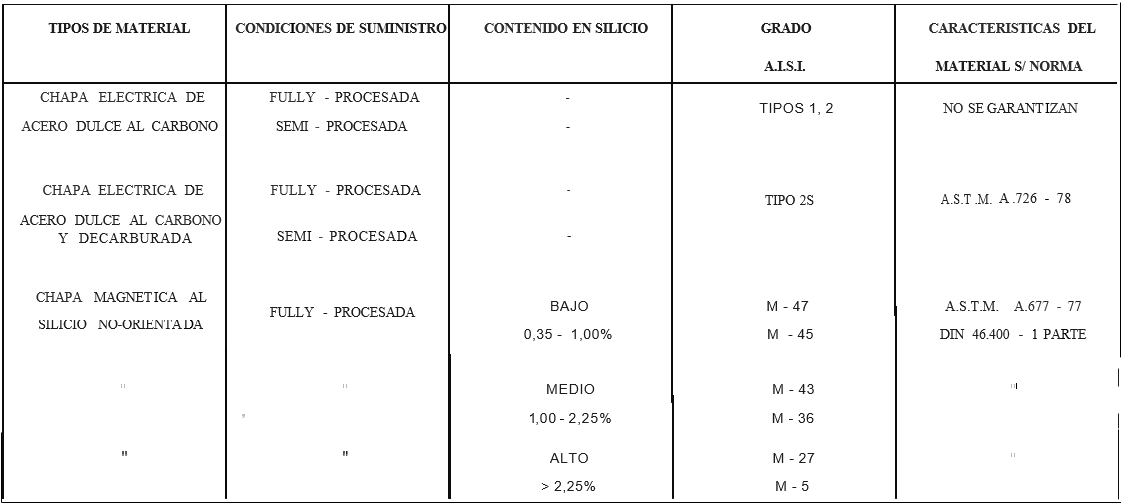
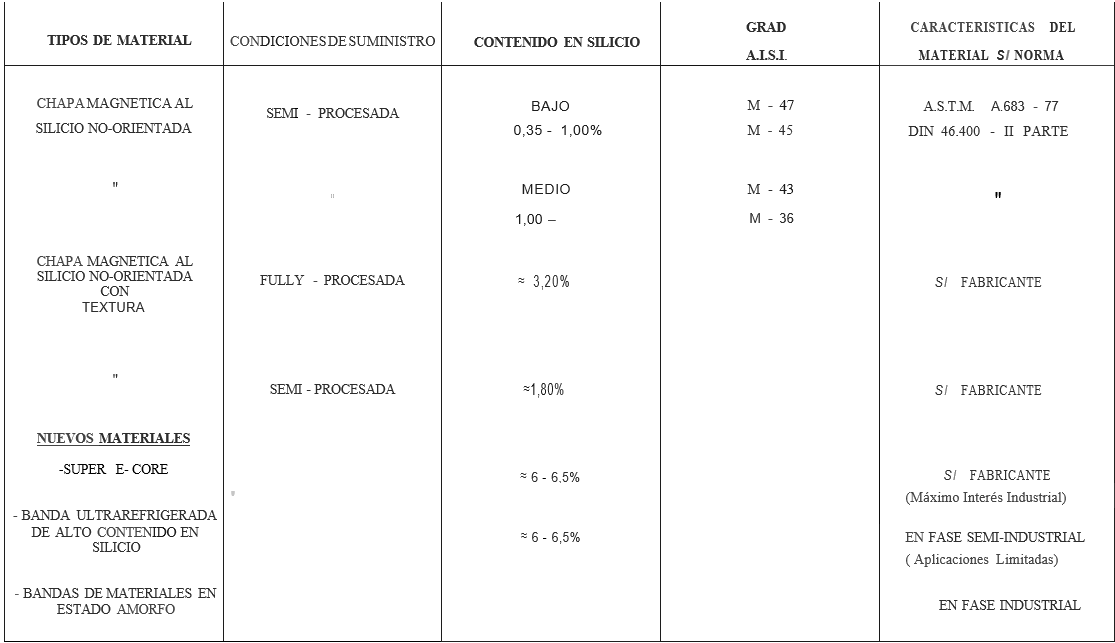
CLASIFICACION DE LAS DIVERSAS CALIDADES Y GRADOS EN CHAPA MAGNETICA DE GRANO NO-ORIENTADO
2.- FUNDAMENTOS FISICO – QUIMICOS, METALÚRGICOS. PROCESOS INDUSTRIALES Y CALIDADES OBTENIDAS.
2.1- Información General de los Procesos Siderúrgicos para la Fabricación de Chapa Magnética No – Orientada:
A. Coombs. «A Review of Electrical Steels». Steel Times May.1970, 311 – 321.
H. Shimanaka et al. «Recent Development of Non-Oriented Electrical Steel Sheets». J. Magn. Magn. Mater., 26, ( 1-3), Mar. 1982, 57-64
I. Ibarrondo. “Estudio de los Modernos Procesos Empleados en la Fabricación de Chapa Magnética de Grano No-Orientado. Nuevas Calidades Obtenidas”. Rev. Metal. CENIM, 21, (6) Nov.-Dic. 1985, 366-376. ( VER EN PUBLICATIONS ).
Oda Yoshihiko, Okubo Tomoyuki, Takata Masaaki, Recent Development of Non-Oriented Electrical Steel in JFe Steel. JFe technical report No. 21, Mar. 2016, pp. 7-13.
http://esales.baosteel.com/baosteel_products/eleSteel/en/products/products_02.jsp
2.2- Chapa eléctrica de acero dulce al carbono y descarburada. Motores pequeños y fraccionarios.
En la información suministrada tanto en el apartado de información general, como en la específica de esta calidad, se describe con detalle el proceso siderúrgico general de fabricación, así como:
- – Los aspectos físico-químicos, metalúrgicos y termodinámicos.
- – Las características magnéticas y mecánicas.
para este tipo de chapa de acero dulce al carbono descarburada.
Es de señalar de forma especial el último tratamiento térmico suministrado al material, que consiste en un proceso descarburante en fase sólida mediante el procedimiento de bobina expandida o de espiras separadas mediante el procedimiento Open Coil. Mediante este procedimiento se consigue rebajar el contenido de carbono hasta contenidos de tres a cinco milésimas.
Es de señalar, que este procedimiento no puede competir actualmente en productividad con los modernos hornos de tratamiento térmico en continuo, por ello debe considerarse como un proceso sin gran viabilidad del futuro.
I. Ibarrondo. “Contribuciones a la Optimización del Procedimiento Open-Coil”. Tesis Doctoral, E.T.S. Ing. Ind. Bilbao (Univ. País Vasco), Mayo 1981.
Ibarrondo. “Contribuciones a la Optimización del Procedimiento Open-Coil”. [Comunicación Oral]. Proc. V Asamblea General del Centro Nacional de Investigaciones Metalúrgicas (C.E.N.I.M.), Tomo II (T-34), Madrid 6-9 Oct. 1981. ( VER EN PUBLICATIONS ).
I.Ibarrondo. “Estudio de la Descarburación en Chapa de Calidad Comercial Laminada en Frío para la Obtención de Nuevas Calidades de Chapa Magnética”. Rev. Metal. CENIM, 19, (6), Nov-Dic. 1983, 343-348. ( VER EN PUBLICATIONS ).
I. Ibarrondo.”Aspectos Físico-Metalúrgicos del Proceso de Denitruración y su Aplicación a la Obtención de Acero Efervescente no Envejecible”. [Comunicación Oral]. Proc. VI Asamblea General del Centro Nacional de Investigaciones Metalúrgicas (C.E.N.I.M.), Sesión 10, Madrid 8-11 Oct. 1985. ( VER EN PUBLICATIONS ).
2.3 – Chapa magnética grano no – orientado de bajo (0.35-1%), medio (1.0-2.50%) y alto (2.5-3.0%) contenido en silicio.
Se hace imposible describir aquí la gran complejidad que comporta el proceso de fabricación de Chapa Magnética de grano no orientado en sus diversas calidades y grados, así como a las cantidades de silicio que cada una de ellas lleva incorporada. Por ello me referiré a la bibliografía que se cita a continuación, así como a los diversos tipos de hornos que constituyen la fase final del proceso y que es una de las más importantes dentro del conjunto del proceso siderúrgico, especialmente en lo que se refiere al siguiente apartado en el cual consideraremos la chapa magnética de grano no orientado isótropa pero con textura.
Asimismo para un mejor entendimiento del conjunto del proceso siderúrgico ha de tenerse también en consideración el apartado en el cual hago referencia a las principales empresas industriales y al catálogo de sus productos, donde se expone de forma general el proceso que estamos considerando.
I. Ibarrondo. “Estudio de los Modernos Procesos Empleados en la Fabricación de Chapa Magnética de Grano No-Orientado. Nuevas Calidades Obtenidas”. Rev. Metal. CENIM, 21, (6) Nov.-Dic. 1985, 366-376. ( VER EN PUBLICATIONS ).
I. Ibarrondo. “Study on Process for Obtaining low Grades of Non Oriented Silicon Steel Sheets and their Applications in Small and Medium Motors”. [Comunicación Oral]. Proc. of 27th Mechanical Working and Stell Processing Conference of American Institute of Mining, Metallurgical, and Petroleum Engineers(A.I.M.E.), Sesion I, 27-29 Oct. 1985, Cleveland, Ohio (U.S.A.). ( VER EN PUBLICATIONS ).
I. Ibarrondo. “Empleo de la Técnica de Desgasificación al Vacío para la Obtención de Nuevas Calidades en Chapa Magnética No-Orientada”. [Comunicación Oral]. Proc. VI Reunión Española del Vacío y sus Aplicaciones. Instituto de Física de Materiales, CM-CTV 4, Madrid 3-5, Dic. 1985. ( VER EN PUBLICATIONS ).
A. Moses, K. Jenkins, P. Anderson, H. Stanbury. Electrical Steels: Production, characterisation and applications. Energy Engineering. Ed. Institution of Engineering and Technology, 26.04.2019. ISBN-13: 978-1785612763. pp.375.
A. Moses, K. Jenkins, P. Anderson, H. Stanbury. Electrical Steels: Volume 1: Fundamental and basic concepts . Energy Engineering. Ed. Institution of Engineering and Technology, 26.06.2019. ISBN-13: 978-1785619700. pp.404.
A. Moses, K. Jenkins, P. Anderson, H. Stanbury. Electrical Steels: Volume 2 : Performance and applications. Energy Engineering. Ed. Institution of Engineering and Technology, 26.06.2019. ISBN-13: 978-1785619724. pp.463.
LINEAS DE PRODUCCION Y HORNOS INDUSTRIALES
https://www.ebner.cc/en/steel/electrical-strip/ngo-continuous-annealing-lines/
https://www.ebner.cc/en/steel/electrical-strip/bell-annealers/
https://www.sms-group.com/plants/all-plants/silicon-steel-lines/
https://www.tenova.com/products-technologies/metals/processing/processing-lines-for-strip/
https://www.tenova.com/product/annealing-and-pickling-line-%28apl%29-for-silicon-steel-strip/
https://www.tenova.com/product/annealing-and-coating-line-%28acl%29-for-silicon-steel-strip/
https://www.tenova.com/product/decarburizing-and-coating-line-%28dcl%29-for-silicon-steel-strip/
2.4 – Chapa magnética grano no-orientado (1.80 – 3.20 % Si) con textura.
Ya desde mediados de los años 70 se comenzó a estudiar la posibilidad de la inducción de una determinada textura en la chapa magnética de grano no orientado, pero manteniendo al mismo tiempo la isotropía de la misma.
El desarrollo de la misma está estrechamente relacionado con los trabajos realizados con anterioridad a 1970 conducentes a la obtención de chapa magnética doblemente orientada textura cubo {100}[001], cuyo proceso de fabricación no llegó a desarrollarse, a nivel industrial, debido a su alto coste económico. Sin embargo, mediante una variante no orientada de dicha textura denominada «Random Cube Texture {100}», se obtuvieron cifras de pérdidas inferiores y valores de la permeabilidad superiores al mejor grado de la chapa magnética de grano no orientado, lo que se debe a la eliminación de las direcciones de difícil imanación <111> del plano de la chapa, lo cual hace que este material sea idóneo para su aplicación en máquinas rotativas.
En opinión del autor, dos son los principales procesos para la inducción de textura en estos materiales:
- – Inducción de textura en chapas de acero dulce al carbono mediante el empleo de la transformación y➝a.
- – Inducción de textura en chapas magnéticas de grano no orientado y contenidos altos en silicio, calidad totalmente tratada (fully processed) y contenidos medios de silicio calidad semitratada (semi processed).
En ambos casos se hace evidente que la textura final desarrollada y, por ende, las características magnéticas finales son función de los parámetros del proceso siderúrgico de fabricación entre los que cabe citar de manera preferente:
- – La composición química de la materia prima:
Niveles de impureza presentes en el material, para los cuales sería deseable, y dependiendo de las calidades imprescindible, un proceso de desgasificación en vacío en acería.
Contenidos en silicio aluminio y azufre.
- – Temperatura textura y tamaño de grano desarrolladas en el recocido intermedio.
- – Grado de reducción en frío previo al proceso de re cristalización.
- – Variables del proceso de recristalización final, entre las que se incluyen ratios de calentamiento y enfriamiento, temperatura y tiempo de mantenimiento, así como y muy especialmente el tipo de atmósfera empleada que ha de jugar un papel decisivo en el proceso de recristalización y por consiguiente en el desarrollo de la textura final, todo lo cual hace que este proceso en su conjunto presente una extraordinaria complejidad desde el punto de vista físico-químico termodinámico y termotécnico.
Una exposición más detallada de lo aquí expuesto puede verse en el trabajo previo del autor:
I.Ibarrondo. “Estudio de los Modernos Procesos Empleados en la Fabricación de Chapa Magnética de Grano No-Orientado. Nuevas Calidades Obtenidas”. Rev. Metal. CENIM, 21, (6) Nov.-Dic. 1985, 371-373. ( VER EN PUBLICATIONS ).
Marcos F. de CAMPOS, Fernando J. G. LANDGRAF, Ivan G. S. FALLEIROS, Gabriela C. FRONZAGLIA and Henrique KAHN. Texture Evolution during Processing of Electrical Steels with 0.5% Si and 1.25% Si. ISIJ International, Vol. 44 (2004), No. 10, pp. 1733–1737
Jong –Tae PARK and Jerzy A.SZPUNAR. Texture Development during Grain Growth in Non Oriented Electrical Steels. ISIJ International, Vol 45, (2005), No 5, pp. 743-749
J. T. Park, J. K. Kim, J. A. Szpunar, «Recrystallisation, Grain Growth and Texture Evolution in Nonoriented Electrical Steels». Materials Science Forum, Vols. 558-559, 2007, pp. 657-664.
Na Li, Liang Ma, Li Xiang, Shengtao Qiu and Pei Zhao. Evolution of Texture in a 2.8%Si Non-Oriented Electrical Steel Annealed at 1100°C. Materials Transactions, Vol. 55, No. 2 (2014) pp. 387 – 390.
Mehdi Sanjari, Youliang He, Erik Hilinski, Steve Yue, Leo Kestens. Texture evolution during skew cold rolling and annealing of a non-oriented electrical steel containing 0.9 wt% silicon. J. Mater Sci., Mar 2017, 52, 6, 3281 – 3300.
Kim Verbeken1, Edgar Gomes1, Jürgen Schneider1 and Yvan Houbaert. Correlation between the magnetic properties and the crystallographic texture during the processing of non oriented electrical steel. Solid State Phenom, (Volume 160),2010, 189-194.
N. Zhang, P. Yang and W. M. Mao. Improving magnetic properties by optimization of textures in non-oriented electrical steel with initial columnar grains. 17th International Conference on Textures of Materials (ICOTOM 17). IOP Conf. Series: Materials Science and Engineering 82, (2015), 012041.
Jong-Tae Park, Jerzy A. Szpunar. Effect of initial grain size on texture evolution and magnetic properties in nonoriented electrical steels. J. Magn. Magn. Mater. Volume 321,13,2009, 1928 – 1932.
A. Sonboli, M. R. Toroghinejad, H. Edris and J. A. Szpunar. The Effect of Cold Rolling Process on the Microstructure and Texture Evolution in a 1 wt% Si Non-oriented Electrical Steel. International Journal of ISSI, Vol. 12 (2015), No. 2, pp. 1-6
Shu-Yu WU, Chun-Hung LIN, Wei-Chih HSU, Liuwen CHANG, Pei-Ling SUN and Po-We KAO. Effect of Heating Rate on the Development of Annealing Texture in a 1.09 wt% Si Non-oriented Electrical Steel. ISIJ International, Vol. 56, (2016), No. 2, pp. 326–334.
2.5 – Chapa magnética no – orientada de alto contenido en silicio ( 6.0 – 6.5% ).
Es conocido el hecho de que las aleaciones Fe-Si con alto contenido en silicio (6.5% Si) presentan una alta fragilidad, siendo por ello difíciles de procesar por los procesos siderúrgicos convencionales.
Este material, debidamente procesado presenta unas características superiores al mejor grado de la chapa magnética no orientada, e incluso cifras de pérdidas inferiores a la calidad orientada (3% Si), y en algunos casos incluso a los materiales amorfos o aquellos obtenidos por pulvimetalurgia.
Concretamente este material, con esta composición en silicio, presenta una alta permeabilidad, alta resistividad, bajas pérdidas por histéresis a alta frecuencia, y una magnetoestricción próxima a cero.
Seguidamente expondré los tres principales procedimientos para la obtención de este tipo de materiales.
2.5.1 – Obtenida directamente desde el estado fundido mediante solidificación rápida.
El procedimiento similar al empleado para la obtención de materiales amorfos, consiste en la proyección del metal fundido directamente sobre un cilindro que gira a altas revoluciones produciéndose un enfriamiento en este caso de uno o dos órdenes de magnitud inferior al de los materiales amorfos.
Aunque el autor ha empleado bastante tiempo en el estudio de estos materiales, y contrariamente a lo que se afirma en algunas publicaciones recientes, estos materiales presentan un problema de fragilidad en bordes y una falta de homogeneidad en el espesor de la banda, siendo además factibles de fabricar en anchos pequeños y no a partir de 600 mm para su aplicación en máquinas y motores eléctricos.
Estando su uso restringido al núcleo de pequeños transformadores y motores muy pequeños.
I. Ibarrondo, J. González. “Estudio de las Características Magnéticas de Cintas Cristalinas Fe-Si con Alto Contenido de Silicio ( 6,5%), Obtenidas por Temple Ultrarrápido y Sometidas a Recocido por Corriente Eléctrica”. Rev. Metal. CEMIN, 23, (5), Sept.-Oct. 1987, 329-332. ( VER EN PUBLICATIONS ).
I. Ibarrondo, A.A. Rodríguez, J. González. “Estudio de las Características Magnéticas de Bandas Cristalinas de Alto Contenido en Silicio (6,5%) sometidas a Current Annealing”, [Comunicación Oral]. Proc. XXI Reunión Bienal de la Real Sociedad Española de Química, Sección 15, 22-26 Septiembre 1986, Santiago de Compostela. ( VER EN PUBLICATIONS ).
I. Ibarrondo, J.M. San Juan, J. González. “Estudio de las Características Magnéticas en Cintas Cristalinas de Alto Contenido en Silicio (6,0-6,5%) Obtenidas por Enfriamiento Ultrarrápido”. [Comunicación Oral]. Proc. 7º Congreso Nacional de Ciencia y Tecnología Metalúrgicas (C.E.N.I.M.), Madrid, 3-5 Oct. 1990, Vol III, 163-172. ( VER EN PUBLICATIONS ).
I. Ibarrondo, J.M. San Juan, J. González. “Study of the incidence of the Last Annealing on the Magnetic Characteristics of High Silicon ( 6,0-6,5% ) Crystalline Ribbons Directly Obtained from the Melted State By Rapid Quenching”. European Magnetic Materials and Applications Conference (E.M.M.A.´91), Dresden 16-19 April 1991. J. Magn. Magn. Mater., 101, 1991, 83-85. ( VER EN PUBLICATIONS ).
I.Ibarrondo, S. Suriñach, J. González. “Influence of Manufacturing Process Parameters on Magnetic Characteristics of High-FeSi Crystalline Rapidly Quenched Ribbons”. Soft Mgnetic Materials Conference (S.M.M.10), Dresden 11-13 Sept. 1991. J. Magn. Magn. Mater., 112, 1991, 232-234. ( VER EN PUBLICATIONS ).
I. Ibarrondo, J. Degauque.,“Incidencia de la Temperatura de Recocido en la Cifra de Pérdidas y Textura en Cintas Microcristalinas Fe – Si 6,4% Obtenidas Mediante Enfriamiento Ultrarrápido”. [Comunicación Oral]. Proc. XXV Reunión Bienal de la Real Sociedad Española de Física, Santiago de Compostela, 18-23 Septiembre 1995. ( VER EN PUBLICATIONS ).
I.Ibarrondo, J. Degauque, V. Recarte, J. San Juán “Incidencia del Recorrido bajo Atmósfera de Nitrógeno en el Tamaño de Grano, Textura y Pérdidas en el Núcleo (10 – 1000 Hz), en Cintas Microcristalinas Fe – 6.4% Si Obtenidas por Solidificación Rápida”. 8º Congreso Nacional de Ciencia y Tecnología Metalúrgicas, CENIM, Madrid, 27 -29 Mayo 1998. Rev. Metal. CENIM, 34, Mayo, 1998, 286-290. (VER EN PUBLICATIONS ).
I. Ibarrondo, J. Degauque. “ Metallurgical Processing of High Silicon (6,4%) Non-Oriented Magnetic Steel Sheets Directly from the Melted State by rapid Quenching “. [Comunicación Oral]. Proc. of 40th Mechanical Working and Steel Processing Conference of Iron and Steel Society (I.S.S.) of American Institute of Mining, Metallurgical, and Petroleum Engineers (A.I.M.E.), 25-28 Oct. 1998, Pittsburgh, Pennsylvania (U.S.A.),pp 499- 504. ( VER EN PUBLICATIONS ).
I. Ibarrondo, J. Degauque. “ Study of Vacuum Levels in the Annealing of High Silicon ( 6.4 wt% ) Non- Oriented Magnetic Steel Sheets Obtained by Rapid Quenching and its Incidence on Grain Size, Texture and Core Losses. “ 14th International Vacuum Congress ( I.V.C. – 14 ), 10 th International Conference on Solid Surfaces (I.C.S.S. – 10), 5th International Conference on Nanometer-scale Science and Technology ( N.A.N.O.– 5 ), 10th International Conference on Quantitative Surface Analysis ( Q.S.A. – 10 ). Birmingham 31/08 – 04/09, 1998. Vacuum 53, 1999, 75 – 78.
I. Ibarrondo, J.M. San Juan. “Incidence of the annealing parameters on core losses in high silicon (6.4%) – iron electrical steels obtained as much by rapid quenching as by enrichment in silicon by means of C.V.D. techniques.” Proc. of European Congress on Advanced Materials and Processes (Euromat 99),Munich Alemania), 27 – 30 Septiembre 1999. Vol. 7, PP.182-186.
Advanced Engineering Materials, 2, 8, 2000, pp.518 – 521. ( VER EN PUBLICATIONS ).
I. Ibarrondo, J. Degauque. “Metallurgical processing of high silicon (6.4% wt) non-oriented magnetic steel sheets directly from the melted state by rapad quenching. A stydy of the continuous annealing step and its incidence on texture, grain size and core losses.” Proc. of Thermomechanical Processing of Steels Conference, Institute of Materials, London (U.K.), 24-26 May 2000., Vol 2,pp.557-562. ( VER EN PUBLICATIONS ).
D. Bouchara, ¨ Elaboration, microestructure et propriétés magnétiques des alliages Fe-6.5Si élaborés par solidification rapide ¨. Thése Doctorat I.N.S.A. Toulouse. Spécialité Physique des Solides, Nº d´ordre 122, 6 Mars 1990, pp. 188.
Y. Gannac, ¨Alliages Fe-6.5Si élaborés par solidification rapide sous atmosphere controlee: Microstructure, proprietes magnetiques et comparaison avec des alliages Fe–Si industriels ¨. Thése Doctorat I.N.S.A. Toulouse. Spécialité Physique des Solides, Nº d´ordre 198, 26 Juin 1992, pp. 223.
Gaoyuan Ouyanga, Xi Chen, Yongfeng Liang, Chad Macziewski, Jun Cui. Review of Fe-6.5 wt%Si high silicon steel—A promising soft magnetic material for sub-kHz application. J. Magn. Magn. Mater.,481, 2019, 234-250.
Proceso con mayores posibilidades de futuro dentro de esta línea.
En opinión del autor, la mayor posibilidad existente para la obtención de este material por un proceso similar al descrito precedentemente consiste en el empleo de la técnica de colada continua mediante solidificación rápida Strip Casting Technology, aunque la empresa CASTRIP (NUCOR) no lo considera , de momento, como una opción viable.
Una monografía sobre dicho procedimiento puede verse a continuación, así como dos ensayos a nivel de laboratorio para la obtención de este material alto el silicio directamente desde el estado fundido.
I. Ibarrondo. » Revisión del proceso siderúrgico de colada continua mediante solidificación rápida. Sistema de dos cilindros de colada conformación». ISBN 978-84-612-9489-3, Octubre 2008, pp. 1-355. ( VER EN STRIP CASTING TECHNOLOGY )
Li, H., Liu, H., Liu, Z., et al., Characterization of microstructure, texture and magnetic properties in twin-roll casting high silicon non-oriented electrical steel. Materials Characterization, 88, 2014, 1-6.
Yunbo Xu , Haitao Jiao, ID , Wenzheng Qiu , Raja Devesh Kumar Misra and Jianping Li. Effect of Cold Rolling Process on Microstructure,Texture and Properties of Strip Cast Fe-2.6%Si Steel. Materials 2018, 11, 1161. 1-12.
Proceso alternativo a escala laboratorio (Académico).
K. Verbeken, I. Infante-Danzo, J. Barros-Lorenzo, J. Schneider and Y. Houbaert. Innovative processing for improved electrical steel properties. REV. METAL. MADRID, 46 (5), SEPTIEMBRE-OCTUBRE, 2010 pp. 458-468, ISSN: 0034-8570.
2.5.2 – Obtenida mediante proceso convencional al 3% en Si y posterior enriquecimiento mediante C.V.D hasta 6.5% Si. (Super E-Core) : Fundamentos, Características y Aplicaciones.
Este procedimiento es el único en la actualidad que puede producir chapa magnética no orientada al silicio con contenidos hasta 6,5%Si a nivel industrial y en banda ancha, habiéndose iniciado su producción hacen más de 15 años.
El procedimiento consiste en fabricar chapa magnética de grano no orientado, tal y como he indicado en el apartado 2.3 hasta un contenido del 3% en silicio, para posteriormente, mediante un proceso de deposición química en fase vapor, Chemical Vapour Deposition C.V.D., depositar el silicio sobre la superficie del metal y posterior difusión del mismo hacia el interior de conformidad a la ley de Fick.
El proceso reviste un enorme interés tanto desde el punto de vista académico como industrial. Si me refiero al primero de ellos el proceso en su conjunto es de una extraordinaria complejidad ya que hay que colocar el silicio dentro de la fase vapor, posterior transferencia del mismo a través de la capa límite y adsorción del mismo sobre la superficie del metal, para posteriormente difundir hacia el interior, siendo el potencial dirigente el gradiente de concentración en silicio desde la periferia hasta el interior. Habiéndose conseguido de esta manera diversos grados de material que incluyen la difusión controlada hasta determinado espesor ya que se la superficie del material donde se producen la mayor cifra de pérdidas.
Por todo ello como se puede ver el proceso es enormemente complejo y requiere un dominio total de la fisíco – química y termodinámica del proceso así como de los procesos de transmisión de calor y transporte de materia. Todo lo cual es de un enorme interés académico.
En lo referente al segundo aspecto, cuál es su importancia industrial, es evidente la misma dado que en la actualidad es el único procedimiento para la obtención de chapa magnética en banda ancha de alto contenido en silicio 6.5% Si.
Proceso de fabricación y propiedades:
Kazuhisa Okada, Tsunehiro Yamaji, Katsushi Kasai. Basic Investigation of CVD Method for Manufacturing 6.5% Si Steel Sheet. ISIJ International,Vol.36,(1996),Nº6,pp.706-71
Yamaji, T., Abe, M., Takada, Y., et al., 1994. Magnetic properties and workability of 6.5% silicon steel sheet manufactured in continuous CVD siliconizing line. Journal of Magnetism and Magnetic Materials, 133, 1994, 187-189.
Kasai shoji, Namikawa misao, Hiratani tatsuhiko. Recent Progress of High Silicon Electrical Steel in JFE Steel. JFE TECHNICAL REPORT No. 21 (Mar. 2016), 14 – 19
http://www.jfe-steel.co.jp/en/products/electrical/product/supercore/detail.php
Características Magnéticas:
S. Crottier-Combe, S. Audisio, J. Degauque, C. Beraud, F. Fiorillo, M. Baricco and J.L. Porteseil. Evolution of Magnetomechanical and Magnetic Properties of Siliconized Iron-Silicon Alloys by CVD Process Using SiCl4 Journal de Physique IV, Colloque C5, Supplément au Journal de Physique II, Volume 5, Juin 1995, pp. C5-1045 – C5-1052.
H.Haiji, K.Okada, T.Hiratani , M.Abe, M.Ninomiya. Magnetic properties and workability of 6.5% Si steel sheet. J. Magn. Magn. Mater., 160, 1 July 1996, 109-114.
Namikawa Misao, Ninomiya Hironori, Yamaji Tsunehiro. High Silicon Steel Sheets Realizing Excellent High Frequency Reactor Performance. JFe Technical Report, No. 6, Oct. 2005, pp. 12-17.
http://www.jfe-steel.co.jp/en/products/electrical/product/supercore/index.php
Aplicaciones:
http://www.jfe-steel.co.jp/en/products/electrical/product/supercore/use.php
2.5.3 – Obtenida directamente al 6.5% Si mediante laminación y tratamientos térmicos intermedios; warm – cold rolling technology.
El desarrollo de laminadores más potentes, así como un proceso termomecánico de laminación en caliente mucho más celaborado y la posibilidad de introducir algún tratamiento térmico intermedio, ha hecho que últimamente se estén realizando esfuerzos en orden a la obtención directa de materiales de alto contenido en silicio 6,5%Si directamente mediante la modificación del proceso siderúrgico.
J. Barros, P. R. Calvillo, T. Ros – Yañes, R Colás and Y. Houbaert. Advances in the workability of high silicon electrical steel. Proceedings of the 16th Soft Magnetic Materials Conference., (2004). p.100-105.
T. Ros-Yañez, Y. Houbaert, O. Fischer, J. Schneider. Production of high silicon steel for electrical applications by thermomechanical processing. Journal of Materials Processing Technology 143–144 (2003) 916–921
Jianxin Xie, Hongjiang Pan, Huadong Fu, Zhihao Zhang. High efficiency warm-cold rolling technology of Fe-6.5wt%Si alloy sheets 11th International Conference on Technology of Plasticity, ICTP 2014, 19-24 October 2014, Nagoya Congress Center, Nagoya, Japan. Procedia Engineering 81, (2014), 149 – 154.
Hua-dong Fu1, Zhi-hao Zhang, Hong-jiang Pan, Yuan-ke Mo1 and Jian-xin Xie. Warm/cold rolling processes for producing Fe-6.5wt% Si electrical steel with columnar grains International Journal of Minerals, Metallurgy and Materials Volume 20, Number 6, June 2013, Page 535.
Zhaoyang Cheng, Jing Liu, Jiachen Zhu, Zhidong Xiang, Juan Jia and Yunjie Bi. Microstructure, Texture Evolution and Magnetic Properties of Fe-6.5 wt.% Si and Fe-6.5 wt.% Si-0.5 wt.%Cu Alloys during Rolling and Annealing Treatment. Metals 2018, 8(2), 144.
J. L. Liu, Y. H. Sha , F. Zhang, H. P. Yang and L. Zuo. Development of strong {001}〈210〉 texture and magnetic properties in Fe–6.5wt.%Si thin sheet produced by rolling method. J. of Appl. Phys., 109, 7, April 2011.
Yong Feng Liang, F.Ye, J.P.Lin, Y.L.Wang, G.L.Chen. Effect of annealing temperature on magnetic properties of cold rolled high silicon steel thin sheet. Journal of Alloys and Compounds Volume 491, Issues 1–2, 18 February 2010, Pages 268-270.
Feng Ye, Y.F. Liang, Y.L. Wang, Jun Pin Lin, G.L. Chen. «Fe-6.5wt.%Si High Silicon Steel Sheets Produced by Cold Rolling «. Materials Science Forum, Vols. 638-642, 2010, pp. 1428-1433.
Tie Ye1, Zhiwen Lu1, and Chunhua Ma1. Research of Rolling Process with Warm for Cold-Rolled Non-Oriented Electrical Steel. 2nd International Symposium on Resource Exploration and Environmental Science. IOP Conf. Series: Earth and Environmental Science, 170, (2018), 042085.
3.- CAMPO DE APLICACIÓN Y PERSPECTIVAS FUTURAS.
Darja Steiner Petrovié. Non-oriented electrical steel sheets. Materials and technology 44 (2010) 6, 317–325.
Oda Yoshihiko, Okubo Tomoyuki, Takata Masaaki, Recent Development of Non-Oriented Electrical Steel in JFe Steel. JFe technical report No. 21, Mar. 2016, pp. 7-13.
Icon group International. The World Market for Silicon-electrical Steel Flat-rolled Products: A 2018 Global Trade Perspective. Ed. Icon group International, 17.02.2017, ASIN : B06XKRBL74, pp. 148.
Ver sección 2.1
http://www.jfe-steel.co.jp/en/products/electrical/catalog/f1e-001.pdf
http://esales.baosteel.com/baosteel_online/en/product/dgg_2.jsp
4.- EMPRESAS INDUSTRIALES CATALOGO Y PROPIEDADES DE LOS PRODUCTOS
ArcelorMittal
https://industry.arcelormittal.com/catalogue/D20/EN
Tata Steel
https://cogent-power.com/products/non-oriented-electrical-steel
AK Steel
https://www.aksteel.com/our-products/electrical-steel/non-oriented-electrical-steels
JFe
http://www.jfe-steel.co.jp/en/products/electrical/product/n_core.php
http://www.jfe-steel.co.jp/en/products/electrical/catalog/f1e-001.pdf
POSCO
http://www.posco.com/homepage/docs/eng6/jsp/product/s91p1000110l.jsp?seq=29
Thyssenkrupp
Aperam
Baosteel
http://esales.baosteel.com/baosteel_products/eleSteel/en/products/products_04.jsp
Voestalpine
https://www.voestalpine.com/stahl/en/Products/Steel-strips/Electrical-steel
U S Steel Corporation
https://www.ussteel.com/products-solutions/products/cold-rolled-motor-lamination-sheet